Gleipnir
a review by planetJane
a review by planetJane

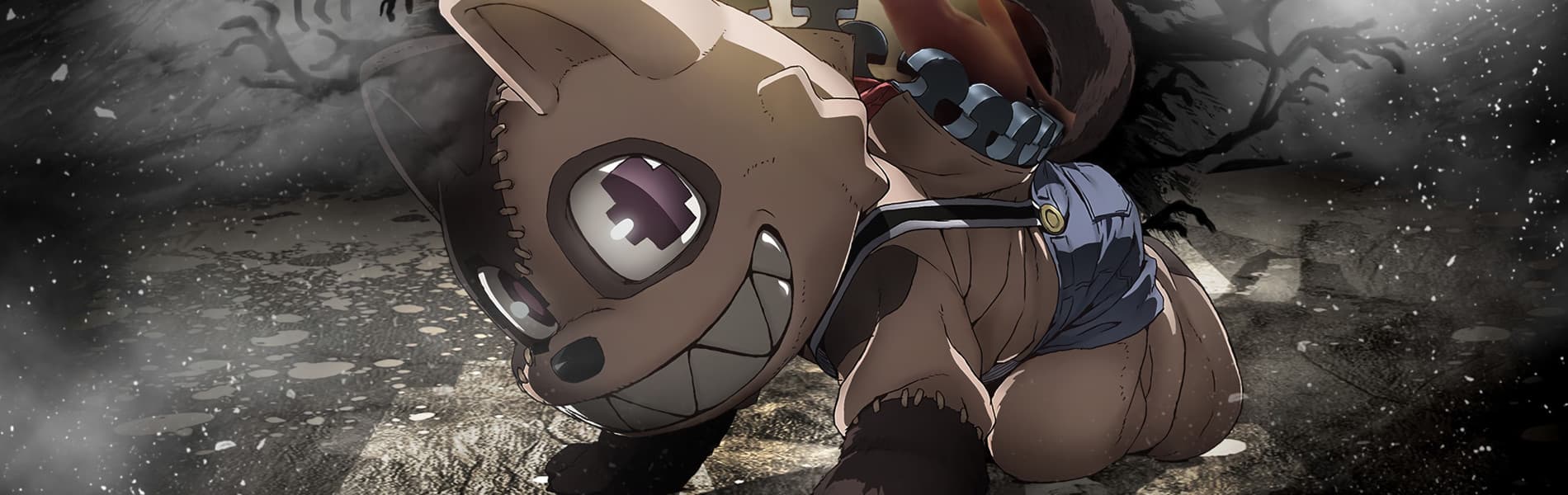
The messiest watch of the Spring 2020 season, (although only just) Gleipnir sounds promising on paper. He’s a disaffected loner who’s given a magic coin by an alien that grants him the superpower of turning into a fursuit with Hulk strength. She’s a wily femme fatale with a mind like a steel trap trying to find her sister--also her parents’ killer--and who has the guts to do what he doesn’t. Those coins are Gleipnir’s central plot tokens, as what people do with the powers the coins grant is the driving impetus behind the whole series, and behind Shuichi (He) and Claire (Her)’s quest to find the latter’s sister.
Gleipnir’s problem, for a good chunk of its run, is that it struggles to feel particularly meaningful. It has its setting, and it has its themes: what it means to connect with other people, how normal people become killers, bygone innocence, depression. Things many entries in this genre deal with. Knitting them together is a more uneven proposition. There are places where it manages to do this, and places where it really does not. Much of the anime’s first few arcs are firmly in the second category. And the one that takes up the show’s middle third--about a bizarre stereotypical ‘evil homeless person’ named Madoka (no relation) and his gang of thugs is probably the series’ low point. In other areas, such as Shuichi and Claire’s relationship, the show performs much better. It really is rather up and down throughout. (Until the end, we’ll get to that.)
Let it be known though, that the anime goes to great lengths to try to rescue its own source material. The series’ main strength is that by simple virtue of being an adaptation, it makes Gleipnir feel a good deal less like a piece of media for no one but its author. A problem the original manga, or at least the portion that the show’s first two arcs are adapted from, struggled with to a degree rare even for action seinen (and mind you, this is a genre that also includes Murcielago).
Production-wise, the visuals vary in quality but are often quite good. The series is consistently well-drawn when it matters and the animation ranges from competent to surprisingly good. It also has a real knack for striking visuals. Even the worst episodes generally have one or two shots that are exceptionally cool if nothing else.

The soundtrack, also, is among the best parts of the whole thing, with a wide variety of stirring mood pieces and interesting riffs, later taking on a dark electronic character toward the series’ end. Granted, they’re sometimes deployed at the absolute weirdest of times (take a peek at the bizarre krautrock shakedown that plays during what’s presumably supposed to be a fanservice scene in the first episode for an example), but good music is good music.
Speaking of; the show frequently indulges in noxiously sleazy sequences. Only intermittently does Gleipnir deliver what one might traditionally consider “fanservice”, instead, it chooses to coat shots of its mostly-nude female lead and the like in a thick layer of visual grease, covering her in whatever fluid sloshes around inside Shuichi’s fursuit form. Apparently under the belief that rendering this kind of thing viscerally unappealing by making it gross in the stepped-on-a-bug sense somehow absolves it of still very much putting a 15-year-old in fetish wear on screen. Which, even if you’re unfazed by any moral implications, is just kinda tactless. (Tellingly, in the show’s final fight, she’s fully clothed. Which feels like a tacit acknowledgement that this brushes up against the show’s more serious story in a jarring way.)
Claire being in her skivvies (or later, a swimsuit) while inside Shuichi’s weird flesh-fursuit is not just a recurring visual, but an actual core part of their dynamic, and the anime cranks the already-gross depiction in the manga up to eleven, complete with gross squishing sounds whenever Claire gets into Shuichi. Honestly, the show’s bizarre fondness for grody visual metaphors is almost admirable in how strongly it sticks to its guns despite what I must imagine is the full knowledge that no one really wants to see this, and that it doesn’t add anything to the show’s already-dicey storytelling.

Here’s the problem though with writing Gleipnir off wholesale, as tempting as that may be, on the surface, to do. At various points, the thematic underpinning it strives for and the strong parts of its aesthetic actually manage to interlock long enough for the show to do something insanely cool that also, crucially, actually feels like it matters. Shuichi and his new friend Chihiro being messily crushed into a paste in episode 7 is gratuitous, even silly. The two merging in a kind of grotesque fusion dance to form a monstrous “catgirl” is a relatively rare instance of the show’s “Shuichi needs someone else to complete him. Literally.” theme actually connecting the way it intends to, making it a highlight.


Later, in the tenth episode, an otherwise bum plotline is wrapped up in spectacular fashion by having Clair hatch the plan of setting a grove of poisonous flowers on fire. The strategy is unorthodox, the visuals striking, the narrative and thematic elements, actually welded together the way they’re meant to. This actually kicks off something of a trend, as the show’s latter half is stronger by an order of magnitude. The last two episodes in particular lean in to a more overt horror sensibility, and it will be about here that skeptics (including myself) might start to reevaluate Gleipnir on the whole. Here, Gleipnir seems to learn that it can’t have its cake and eat it too, and accordingly, its more obnoxious elements are greatly scaled back. The story is given room to breathe, and suddenly it’s like watching an entirely different show altogether. The finale contains what might be the most singularly inventive fight scene I’ve seen in an anime so far this year.

Thus, the basic “well, is it good or not?” question is going to come down to how forgiving you are of the show’s flaws. At its outset, and coming off of having read a chunk of the manga that only covers about the first half of the anime back when it was new, I was not inclined to give it the benefit of a doubt. At season’s end, I’m forced to admit that the series is much stronger than I gave it credit for. That does not, by any means, excuse some of its more serious issues, but it goes a long way toward making Gleipnir feel less like a bad anime with bright spots and more like a good anime that simply has some very real, but fixable, problems.
I didn’t imagine, starting this season, that I’d think much of Gleipnir, much less be genuinely hoping for a second season. That I am here now, admittedly somewhat reluctantly, praising it is a testament to the leaps and bounds it improves by. Admittedly, that’s not a reason to watch in of itself, but if you like this sort of thing, you could do a lot worse.
Two, nearly three years ago, I said in the review blurb for my (brief, amateurish) overview of the ongoing Gleipnir manga that it could do better. As strange as it may sound, I am happy to report that it very much has.

And if you liked this review, why not check out some of my others here on Anilist?
70 out of 74 users liked this review
