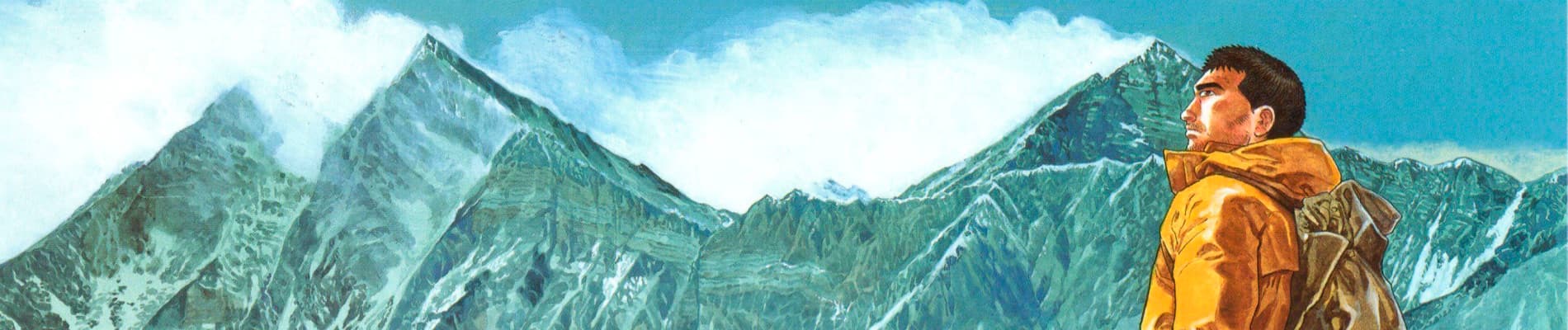
NOTE: This review was originally written and published by me on MAL on the 11th of February 2017, the day the great Mangaka Taniguchi Jiro died.
“The sky sinks steadily beneath the foot of the mountain, until the first snowflakes begin to fall. The traces of the chamois are fading. I am happy, that I am still alive and gaze at my shivering hands. Then I’ll open my fist...” – Jiro Taniguchi.
Today, the 11th of February in the year 2017, is a very sad day indeed. One of the most influential, ingenious writers of mature stories of all time, Jiro Taniguchi, did see the end of the day. And as for today, I can’t help but feel a little bit saddened because his demise leaves a big void in both the Manga industry and quality story-telling overall. It led to me skimming through the final volume of KnI in stasis once again, encountering the aforementioned statement in the epilogue, after the actual ending of the Manga. Suddenly, I physically felt being lifted out of the sadness I've fallen into by hearing the words of his death, the same feelings I felt during my initial read. It's still fascinating to me how such simple words can do that to the reader and the person behind it.
This actually shows one of the biggest strengths of Taniguchi once again, a juggler of words who can create subtle poetry through all of his Manga, by a simple and ingenious combination of artwork and powerful dialogues/monologues. And ironically, these words do not only make up a fine closure for each character’s wishes and desires in the mountains, but it also adds a sense of closure to Taniguchi’s life, finally reaching the roof of the world and go even further beyond.
Starting to read Taniguchi’s masterpiece after reading a lot of Manga which is aimed at young adults and older teens is like experiencing a fresh breeze coming straight out of the Manga’s spine, captivating you with a sophisticated and mature story from start to finish. A lot of its quality shows from the subtle, as the conflicting ideals and interactions the characters face during the story are explored continuously. The amazing combination of text, its masterful detail-oriented artwork, and Taniguchi's exact understanding of human traits do the magic. Additionally, seemingly straight-forward and overused methods of elaborating and explaining character motives like a four-chapter long flashback into their pasts are easily forgiven by just how genuine and consonant they are with the main story, never feeling out of place or even a little too long.
As the main subject of the story is alpinism, a lot of readers may be a little deterred by it, since a lot of details and insights of this form of sport aren’t spread widely through society. But as the Manga can expand widely on different topics of alpinism and the procedures during the actual act, it manages to explain every single needed detail to the reader and actually awakened some kind of enthusiasm in me for the sport and what kind of determination it does involve. A huge credit for it has to go to Yumemakura Baku, the original creator of the Japanese novel on which this Manga is based on, and its' incredible attention to detail.
Taniguchi is an absolute master when it comes to how to detect the perfect mixture of narration, dialogues, monologues, and artwork. Since there is a lot of text and information to be covered from the original novel, this Manga needs a perfect composition of both text-based and visual storytelling, the huge majority of Mangaka would most probably fail to adapt the original novel's essence by either emphasizing one of the aspects too much. However, finding the correct balance between visuals and the written text was apparently no big challenge for Taniguchi, as the text never distracts from actual happenings from the story, when the artwork tells an even bigger picture than the text does. Crowded places in Japan, the narrow alleys in Kathmandu, and the howling wind on top of the mountain managed to get me as intrigued into its story as this Manga surely did. On the other hand, when Taniguchi decides to drop in more information, for example through the means of an actual narrator or goes for expanding dialogues, I’ve not even once encountered a chapter where the Art did distract from the written information which gets delivered. The ascents of icy cliffs in winter, as well as the long marches towards the summit, get depicted through a variety of different angles and larger-scale perspectives, while being accompanied by the narrator, describing the thoughts and feelings of the ones ascending in a constant state of flux.
A common problem a lot of stories have with a set-up being as good as KnI’s is, that those actually don’t manage to exploit its great foundation and end up being perceived as underwhelming in our memories because of that. However, similar problems will surely not occur during your read-through Taniguchi Magnum Opus, making it pretty apparent that he has perfected the usage of a steadily increasing arc of suspense in his works and makes use of the perfect 'by the book' timing to lead his story to the grande finale. The manga does feel like a tale of rivalry and ambition written in a very worthwhile piece of literature and follows the 'tried and tested' rules for creating an absorbing and thrilling story step by step, absolutely mastering what it’s trying to achieve with its narrative. The deliberate incorporation of the narrative framework in the beginning, very similar to the ones in Novellas, gets utilized to the fullest during the final pages, creating one of the most cathartic endings I’ve ever experienced so far.
Inner conflicts, pressure and intriguing thought processes the main characters go through the story are unique qualities I've already talked about, but I have yet to touch on the main characters themselves. Fukamachi, our protagonist, is an avid sports photographer, working for an alpine magazine. He finds himself troubled and torn between different goals and relationships to keep up with and a seemingly impossible riddle to solve, haunting both, his consciousness and sub-consciousness for wherever he goes. Over the course of the story, this Manga manages to beautifully show how we not only see Fukamachi being confronted with new acquaintances and challenges over the course of his journey to solve and his discovery of why he exactly values solving this riddle so highly over so many other things in his life, but the author allows us to see and understand the inner-conflicts and questions being raised by Fukamachi himself, developing him throughout in a convenient, relatable and deliberate manner.
Habu Jouji, the second main character and undoubtedly the best one in the whole story, is the highlight of KnI character-wise. His journey to constantly top his opponents, lack of determination to anything else but alpinism and incredible backstory help us to see Habu not only as a character in fiction but to stand right beside us while we’re reading like some kind of guidance. The approach Taniguchi took to illustrate his way of thinking, behavior, desensitization, and inability to grasp the feelings of his acquaintances during his climb of life is remarkable in its own right, painting a perfect picture of Habu through the words of his acquaintances. His characterization is honestly one of the best ones I’ve ever seen in any kind of medium.
Conclusion:
As you’ve already seen in everything I've written up prior to the conclusion, my appraisal of KnI almost knows no ends, but it still just barely didn't get the adjective "flawless" by me, even though it came very, very close. Volume 3 did drop in quality a little bit, especially compared to the following two volumes to come, as it essentially just worked as a setup for what's to come and did get entangled a little bit too much with a subplot halfway through. Habu and Fukamachi, their interactions and mutual influence, are the prominent focus of KnI and provide an introspection almost unrivaled by its complexity and ingenuity.
These minor flaws I found while reading through Kamigami no Itadaki are completely negligible by the sheer amount of greatness this Manga offers in every category. If you’re looking for a mature, poetic and incredibly enclosed story with themes of escapism, self-inflicted pressure, ambition, and self-discovery, KnI might be the raw gem you’ve been looking for in all of your life, as it raises its greatness above the clouds and maybe even further beyond.
I sincerely hope that this review got at least one person to read this wonderful piece of art on this sad day, when one of the greatest storytellers did decease from our world and hopefully this Manga will finally climb as high in the popularity ranks as it truly deserves.
Rest In Peace Taniguchi Jiro.
-------------------------------------
Story (09/10)
Art (10/10)
Characters (10/10)
Enjoyment (10/10)
Overall (10/10)
48 out of 48 users liked this review