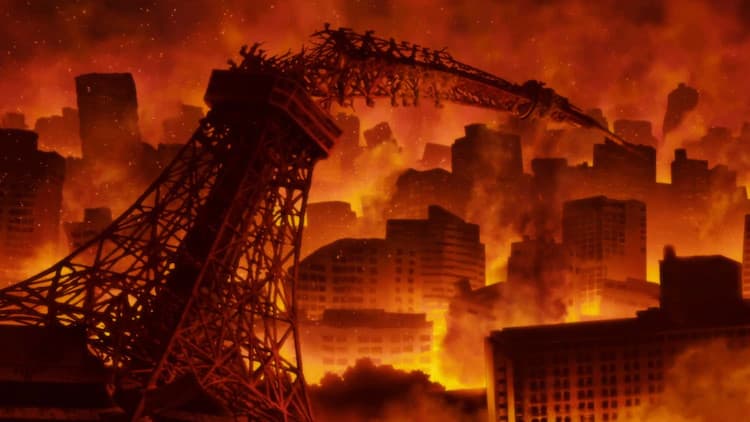


Tragedy hits hard.
I'm not going to pretend that I've had my fair share of any. People have been through far worse than I could ever comprehend. Yet, I get by. I know it's an arrogant thing to say, but it's the truth. Everyday I ignore all the bad things that happen in the greater world. Wars, poverty, depravity and death. I compartmentalize, I tell myself that the bad things aren't happening to me. These things exist, and there will be people to overcome those adversities when they inevitably knock on their doors. But what happens when you can't run away? What happens when it's time to face the music? What happens when those doors come crashing down, and your whole life along with it?
I just binged Japan Sinks: 2020 (JS), here are my thoughts. This review will be mostly spoiler-free, but feel free to check out my Tl;Dr if you wish to go in blind. Also, I'll be referencing Devilman Crybaby quite a bit, as I feel that both stories showing up in director Masaaki Yuasa's filmography and their thematic parallels are too important to ignore in this review.

8 minutes. That's all the reprieve you get.
During this time we meet the Mutou family, the characters whom we'll be experiencing this journey with. Ayumu, the family's 14 year old daughter, is a track-and-field athlete and the anchor for an upcoming meet. Her mother Mari is on a plane about to land at Haneda Airport. Kouchiro is the breadwinner, working his day job in construction. The son, Go, is an epic gamer with his bright eyes set on the future. Set in present-day Japan, life goes on the way you'd expect: the unremarkable hubbub of daily life ensues. Even when the first earthquake hits, most of the populace remain undeterred. People pull out their smartphones and break into excited discussion, as if some mere celebrity scandal got Trending on Twitter. In a place where earthquakes and other natural disasters are almost commonplace, life goes on as usual.
Here's the thing about earthquakes: the first wave isn't the most dangerous part. It's the aftershocks that hit the hardest. After 8 minutes, all hell breaks loose throughout Japan.
If it hasn't been made apparent by this point, JS is not a show for the faint of heart.
The island country is rumored to sink underwater from tumultuous seismic activity, and the scale of this threat looms large in every episode. The elements are a ticking time bomb for Ayumu and her family, as they race to find an escape from the chaos. The Mutou's race against time is powerful and devastating; the tension had me tugging at my hair on multiple occasions. Science SARU's latest outing looks surprisingly grounded (this isn't a pun I SWEAR), and this change from Yuasa's signature art style is fitting for what the show is going for. JS looks detailed and immaculate, with painstakingly well-crafted imagery of the ravaged cities and countryside. But occasionally his idiosyncratic free-flowing animation and pronounced facial expressions find their way into the show, wringing every bit of emotion from several big scenes. Former Yuasa collaborator Kensuke Ushio scores the show and complements those moments with both tense and soft pieces. These elements form a medley in service of hitting me with some of the most devastating moments I have ever experienced in my time with anime. I won't go as far as to say the show is pure nightmare fuel, my momma didn't raise a wuss. However, what I watched felt uncompromising and honest in its depiction. It's not just gratuitous torture porn for four hours, but rather a fully immersive experience which pulls me under the weight of such a disaster.

Audio flashbacks are played at several points in the show. Wildly at odds with the havoc taking place, these monologues serve to demonstrate where the show's real focus lies.
JS, while dark, is a tale about human nature.
The show unflinchingly puts humanity front-and-center. Conflict in JS can easily go from the external to more inward. It captures people with a variety of ideologies and goes to lengths to show several ways people respond to the world shattering around them. Much like Devilman Crybaby, JS isn't afraid to show the depraved places people can go to under adverse situations. But while Devilman's take on these ideas were nihilistic, JS acknowledges this capacity for immorality and responds with hope. Even amidst despair, we are given glimpses of this hope. The capacity for kindness, perseverance and love. Tears and loss make their way into many key moments, but they allow for each small victory that follows to mean so much more. Tragedy hits hard, yet it's often punctuated by brilliant showcases of resilience. JS pulls at your heart and fills it up again. It was a tiring experience binging this, but also one made worth it by that hope.

JS is not short of pitfalls,
and those faults (I really need to stop with the puns) do make this amazing work a tad harder to sit through. The first big issue that would affect your watch is, as I said before, the disturbing imagery and content. While purposeful, it can be really hard to stomach at times, especially during the few instances the show goes unnecessarily overboard. This ties into my next qualm, which is that of doing things for shock value. Some scenes feel like jump-scares and leave far weaker an impression than so many of the carefully built-up climaxes. JS can also be pretty frustrating with its cliffhangers, and there's one or two I found particularly infuriating. Not just 'cause they were cliffhangers, but because the story could have functioned perfectly fine without them. I also find that certain elements regarding the sorrow in the show could have been portrayed better. For starters, I know the score is superb, but maybe don't blast hype Devilman Crybaby music over characters dying? Also, how characters react to some of these deaths feel somewhat disjointed. We don't get a whole lot of grieving in between these moments, which then come across like mere plot points that need to be checked. Saving the worst for last, probably the biggest complaint I could lodge against the show would be its middle stretch of episodes. Our main characters don't have much to do in that arc, and it felt like a footnote happening behind the scenes instead of incidents I deeply cared about.

Tl;Dr:
Japan Sinks: 2020 is not easy to watch. Suffering and loss, amplified with strong visuals and sound design, permeate the show throughout the journey. JS holds no punches demonstrating the massive scale of such a disaster. But when I watched the show end I wasn't thinking about the earthquake. I was thinking of what we do when the bad things happen. And what we humans do is carry on. There are still things to learn, people to love, futures to strive towards. The human spirit has gotten us through troubles time and time again. There's no stopping what we can achieve, not even if you take the ground away from our feet. 6/10~
STRAY RAMBLINGS (SPOILERS):
- A small disclaimer: I'm not all clear on exactly how much of the show as a whole I can attribute to Yuasa. He's a co-director in the project and I'm not clear on how much creative influence he had. But the parallels between JS and Devilman Crybaby seem pretty clear in my eyes, which is why I felt it was right to make those comparisons.
- Yuasa's adaptation in Devilman Crybaby added the running motif to the original story. Seems like he's a big fan of track, 'cause he brought it back here.

- In Ep 2 the date shows 18 Sep 2020 on the KITE's Youtube video where Okinawa sinks. Fingers crossed that this year doesn't get any worse :s

- Why do they keep making Go speak English every now and then? I kinda see the point, but speaking basic English doesn't make you more of an epic gamer or anything.
- As detailed as the backgrounds and art are, the characters don't look dirty enough in most scenes. I know I sound like a nitpicking prick but it kinda takes me out of it when a disaster of such scale is occurring and their clothes look like they're fresh out of the dryer.
- Smoking in a gas station is straight-up dumb, no two ways about it.
- Ayumu needed to get her leg checked out like, 30 mins into the show.
- I was super scared for some weird shit to go down when I saw dance lights in Ep 5. We all know what happened the last time Yuasa did a scene in that setting…
Spoiler, click to viewclick to hide
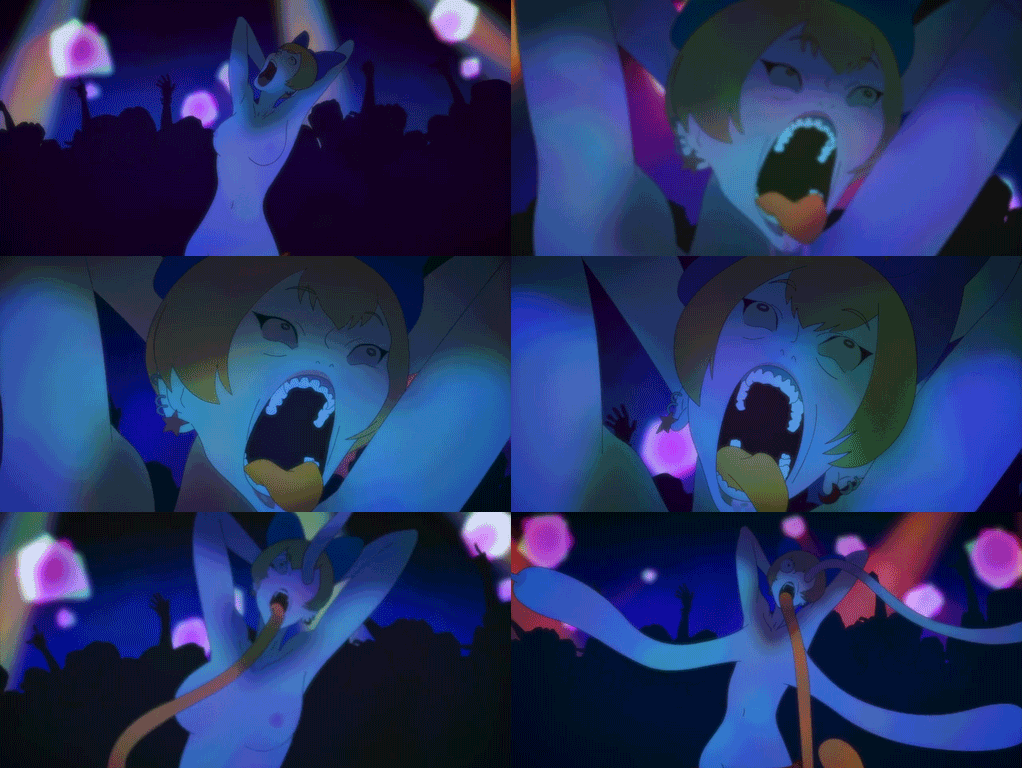
Spoiler, click to viewclick to hide
Credit where credit is due, the Shan City subplot is interesting on paper. Ultimately pointless however, Ep 6 is so far removed from the rest of the show. The stuff that went down felt really pointless, I didn't care that much for it.Spoiler, click to viewclick to hide
That photo motif breaks my heart. Almost every time a pic is taken, it spells death for a character. Breaking out that Polaroid only got more painful the further we got into the show.Spoiler, click to viewclick to hide
KITE became a V-Tuber. Absolute legend.- The first episode is probably my favorite. It told the entire story of the show in 20 minutes. The setup before the incident was expertly done, I got chills down my spine.
Spoiler, click to viewclick to hide
with the most impactful detail being that of Ayumu's track partner making an unfulfilled promise to our anchor runner. - BEST GIRL: I don't wanna, not for this show :'(
- Thanks so much for making it this far! I apologize if the review isn't completely up to stuff, I usually take more time to prepare. Penning this review was an enriching experience, and I look forward to doing more in future. Peace~
- "Though the sun may set, it will always rise again."