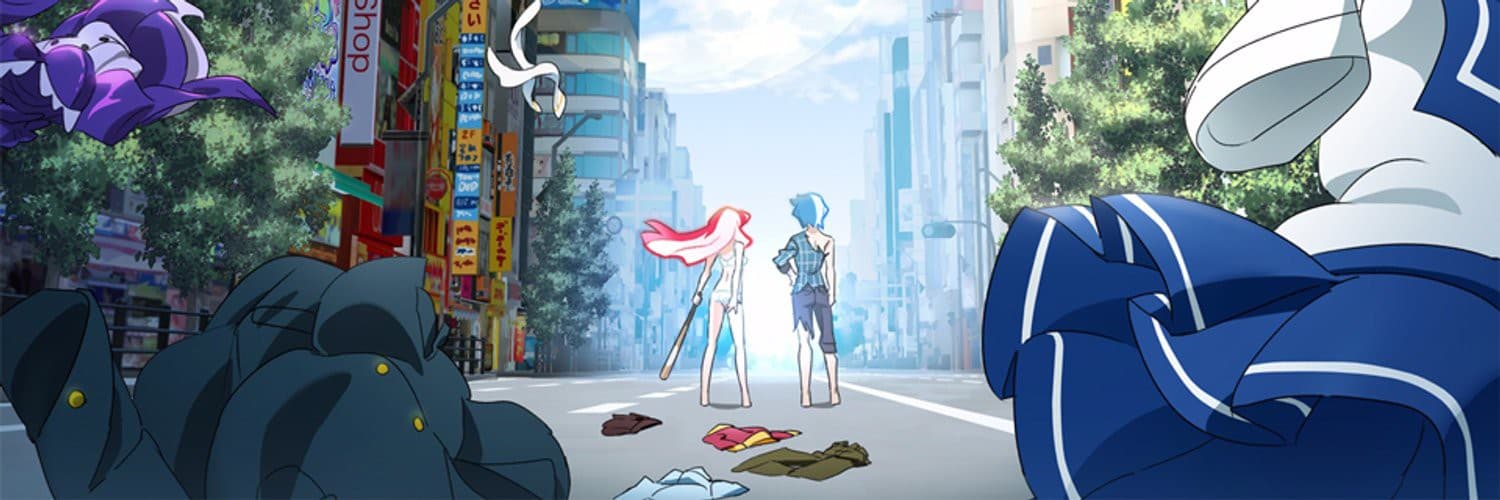

Colorful character designs, a commitment to truly nerdy comedy, a doofy premise, enough product placement to set Karl Marx a-spinning in his grave, more than a few small dashes of the old otaku persecution complex, and more open-hearted sincerity than you might expect. Mix them all together, and you have Akiba’s Trip, a 2017 series nominally based on a game of the same name from the we-animate-anything folks at Studio GONZO.

Akiba’s Trip, fundamentally, is a love letter to the city of Akihabara and to otaku culture itself. The bad news is that it has quite a few glaring flaws and how you feel about it is going to heavily involve your tolerance for nerds patting themselves on the back for liking really cool and/or dorky shit. The good news is that Akiba’s Trip itself, while certainly not up to the level of some other anime in this category, is a pretty cool and/or dorky thing. Its finale in particular is far stronger than what might be expected given the series’ mixed reputation.
The series’ plot ostensibly revolves around the comically-named trio Electric Mayonnaise, who defend Akihabara from infected superhumans called “Bagurimono” or “Bugged Outs” depending on whose subs you’re watching. However, for most of its runtime Akiba’s Trip leans heavily on the ‘comedy’ half of the term ‘action-comedy anime’. Most of the series is highly episodic, with each episode featuring our protagonist Tamotsu diving into some esoteric hobby or another, only for it to inevitably lead to conflict with a Bugged Out which he, along with co-stars Matome Mayonaka and Arisa Ahokainen, must defeat.

The content and quality of these episodes varies pretty wildly. Some are quite good: one involves Tamotsu getting caught up in the workaholic subculture of a butler cafe` in a surprisingly sharp piece of commentary. Another involves ham radio and, like many of the best of these episodes, coasts on the simple joy of watching other people geek out about a cool thing they like. That it ends with a tussle with a radio-obsessed Bugged Out who wants to black out the entirety of Akiba almost feels incidental.

Other episodes are, to put it mildly, less great, with an early episode that cracks a lot of downright gross jokes about the female half of our cast being nearly duped into doing porn being by far the worst of the lot.

We also must bring up the show’s near constant shower of fanservice, which is the sort of thing, as with say Senran Kagura, that one must take or leave. If you’re bothered by it, you’re not going to like this series, full stop. It doesn’t help that the series’ particular mechanism for doing this--shred a Bugged Out’s clothes and they either revert to normal humans or disappear in a puff of smoke--may remind viewers of the infinitely better Kill la Kill, which is a comparison the series should be striving to avoid at all costs.
The production values are also quite inconsistent, and the show is somewhat infamous for having both quite good and hilariously bad animation at different points--occasionally within the same episode. Some of the aforementioned fanservice parade, in fact, is rendered more laughable than whatever your default opinion may be by the intermittent low drawing quality.
Another aspect that must be touched on is the absurd amount of product placement in the series. There is a lot of it, and not always for what one might expect. A maid cafe`? That’s about on-brand for a show about the Jerusalem of otakudom. That Carl’s Jr. shows up, more than once, as a place where Matome drowns her sorrows in hamburgers, is such a crass display of selling out that it loops back around into comedic gold. (Is Akihabara known for having a really good Carl’s Jr.? I frankly don’t know, though I kind of doubt it.)
But all of this is fairly incidental compared to the show’s real strength, which is, believe it or not, its central narrative. Even the best of the more comedic episodes pale in comparison to those where Akiba’s Trip decides to get, well, not serious exactly, but to remember that it is also an action anime, at the very least. Fukame Mayonaka (Matome’s grandmother) and the organization of Metrotica that she controls are the show’s central antagonists, and if I can levy one major complaint against Akiba’s Trip’s pacing, it’s that Fukame gets nowhere near enough screen time. What we do see of her is fascinating, and in the final few episodes her plot to eradicate Akihabara and the humans who live there makes her by far the show’s most interesting villain.

But, well, this has its issues too. That old otaku persecution complex rears its ugly head here in a few ways both overt and subtle. The point of Fukame’s character is evidently that she is intended as a metaphor for those who abhor anything they consider abnormal or deviant and who will do anything to get rid of it. Over here in America, we had people who tried to get Doom banned. In Japan, they have prefectural governors who claim anime inspires people to be murderers. The stages are different, the effect much the same. The impulse to be defensive is understandable.
However, when writing a character who operates like this, it’s important to do so with a lot of care, as it’s easy to overshoot and just turn them into a caricature. Fukame herself does not fall here fortunately, but one of her assistants, a greedy ranting government minister who passes a law to ban Akiba itself? Yeah, it’s a little much.


More than a little much is the show’s clumsy co-opting of Nazi imagery to portray Metrotica’s agents who burn doujins and the like in the show’s closing arc. It is true that the actual Nazis did, in fact, prohibit what they considered to be “degenerate art”, but their true crimes were those of horrific genocide, as were those of Imperial Japan, and to conflate that with this seems somewhere between clueless and downright harmful. The show neglects to explore any deeper connections between these ideologies and what that might say about Japan’s own past. It’s probably far too much to expect something as goofy as Akiba’s Trip to have any genuine insight into how disdain of “the other” can abet and inflame fascism, but it’s not too much to expect the show not to go there if it can’t walk the walk. It strikes more as ill-considered than deliberately inflammatory, but it’s still not really excusable.
The show’s actual finale, then, being as good as it is, is something of a minor miracle.

To simply recap it would be to miss the point, but when a series ends on a gorgeously-animated fight between two massive pink energy constructs while an idol song that jacks the melody to freakin’ ”Ode To Joy” pumps along in the background, none of these criticisms suddenly seem like they matter all that much. Obviously, this will vary from person to person, but it is much easier to take Akiba’s Trip on good faith when it ends as well as it does, and the series’ final few moments seem wide-eyedly optimistic in a peculiar, meta way.
The show’s final sequence sees Arisa, as well as Tamotsu’s younger sister, abruptly emerge from a UFO. Frantically, they explain that they come from 100 years in the future, from the Akiba Empire, and they need Tamotsu and Mayonaka’s help.
The show may not be the all-encompassing, open-hearted call for nerd acceptance it entirely wants to be, but however unintentionally, the finale seems to suggest that maybe someday the world will be peaceful enough that we can entertain such ideas. It’s an oddly pure, almost cute, notion for the series to end on, but for all of its flaws, Akiba’s Trip very clearly believes in the promise of Akihabara as a place where everyone is accepted. It is, in this way, a fitting end.
To, then, a future where we may all share our passions in harmony. Somewhere in the city of dreams, they’ll be waiting.
