

One of my favorite videos found online is precisely one about disaster prevention in Japan. I found it when reading about the Tokai earthquakes, which blew my mind when I first heard about them, because I couldn’t stop wondering: how can an entire nation be so high-functioning when they are in such a fragile position with sure disaster looming over their heads every day? How do you not live in perpetual fear under this kind of circumstances? How can you live a very normal life dealing with very abnormal conditions (at least for someone like me, who has never dealt with any kind of natural catastrophe bigger than a cyclone)? This upbeat video seemed to have the answer for me: if disaster is unavoidable, and in Japan it is, the attitudes that really matter are being prepared, working collectively and making the most out of everyday life. It is almost mandatory that you do live a normal life exactly because the circumstances are dire. One day, this whole thing you call a life may just disappear!
Why am I mentioning this video, you ask? Well, because watching this decade-old 11-minute video on earthquake prevention gave me a lot more depth on the subject and got me thinking a lot more about human nature and resilience than the seemingly never-ending 10 episodes of the latest piece of crap with a Netflix logo launched into the animesphere, Japan Sinks.

Ok, I don’t want to be mean. But in all absolute seriousness, it is scary how not good it is. It has so much going for it, this show, especially if you consider the main thing that got many to even want to watch it, which is Masaaki’s name before it. But I will not go on and on about him and how Japan Sinks almost looks like something that could involve him but ultimately lacks any of his trademark creativity, because I’ve read way too many reviews that focus on that. I’ll skip him. He’s great, his visuals are great, yadda-yadda, this work he’s in is shit, the Shinkai Syndrome. That’s pretty much all I’m gonna say regarding Masaaki’s role in this mess. Now…
Spoiler alert, of course.
The opening sequence is soft, kind, ethereal, comforting, watercolor style, and it shows us a variety of calm, little everyday moments carried by a smooth piano and a song that sings on calm, little everyday moments. It is very transparent on its intent to create a soothing “aura” obviously contrasting with the theme of the show, and I think that this kind of play on dichotomy can only work reactively in a viewer if they go in and start out knowing absolutely nothing of the show, which I think means… no one? It’s almost impossible to go blank into a Netflix show, or any show whatsoever, these days, and this one in particular is called “Japan Sinks”, so you can probably guess it won’t be a heartwarming slice of life about the triviality of daily family life. And as the series progresses and the story gets more and more grim and deadly, this opening sequence wears off even more. So, cute, but ineffective.
And Japan is indeed sinking, one huge earthquake and volcanic eruption after another, as we follow along the path of survival of the Mutoh family, consisting of Athlete Daughter, Gamer Son, Dumb Dad and Annoying Mom. I am of course joking, these aren’t their names, but I could only really make out their real names around episode 5, so I had to nickname them. Humanizing them by remembering their names won’t really matter though, as you'll understand later.
They are supposed to be a plural, multicultural family, according to some creators of the show, to represent a different, more current, much more diverse Japan from the one that is generally portrayed in media. The way they accomplish that is by making the mother be from the Philippines while the dad is Japanese, and throwing around a lot of broken, disconnected sprinkles of English dialogue. It is not enough to carry the weight of all the narrative aspects that surround a multicultural family, and it ends up becoming a stereotype on its own. There are few moments on the show where their double-ethnicity and diversity come into play, and these are usually associated with displays of racial bias and extreme nationalism coming from other characters. This is also a very common trope, one that can only tell stories of foreign bodies through the lenses of the “native” eye. That has been done to exhaustion in non-Japanese media about Japanese people, and it is certainly not the worst thing Japan Sinks has to offer, but it does limit the possibilities of how to explore this sensible family characteristic.

It starts off awkward, but promising. We are right away presented with a major earthquake and we watch how it impacts the family members, who are each in a separate location, so we get to see the destruction and panic that follows from different perspectives: a school, a construction site, an airplane, their own home. This however should also be our first moment of connection to the Mutoh family, since they are the ones who are going to guide us through this tragedy, but that is overwhelmed by the disaster itself, and I believe what was intended to be a subtle or more reactive presentation of the family gets lost under the wreckage. That seemed like a blunder at first, because this is something so common to so many series (failing to captivate us on the first episodes due to being too busy laying out the plot) so I expected the story to catch up with its protagonists down the line; but one episode after another made it clear that it was no blunder, but an actual disregard for its main characters in an almost insensitive way.
The main way the creators chose to get us more into the psyche and history of these people are little snippets of voice-over dialogue from past times that are plastered in moments of tension, usually when a character is in peril or about to die. However, these are so poorly made and placed that not only they are not even close to enough to really make us feel any relation to these characters, but they are often dysfunctional, hard to separate from the current scene, sometimes even being difficult to make out as voice-over rather than actual ongoing dialogue. In film school, we often avoided voicing-over because it is like a minefield: too many things can go wrong with it, it is easy to over-use it and it is always an anti-immersive instrument. In Japan Sinks, the mines definitely blew up. I read many reviews in which people said they could not care less about the main characters of this show, and I will join them. This family has as much personality and depth as a ham sandwich, which means it has some and I can eat it, but damn, do I wish there was some fucking seasoning in this. And not only does that lack of complexity grow annoying as the show progresses, but it can even make the viewer feel insensitive for not being emotionally involved with bodies that are going through such a horrible struggle.
This bad feeling is, however, dimmed by the fact that not even the main characters seem to give much of a crap what happens to them. Take Athlete Daughter, for instance, who cuts her leg immediately during the first wave of earthquakes and provides us with the best example of how Japan Sinks doesn’t give a fuck about this family. She’s a track and field athlete, so she is injured, of course, on her leg, and that cut doesn’t seem to be a problem at any moment… apart from when her athleticism is needed. Then she’s in pain and can’t run! Apart from that, you barely even remember she is hurt, as none of the characters talk about it in worry, and Athlete Daughter herself never discusses it as a serious injury. It is literally a crippling plot device, and I am not here for it. And if it was just a crippling plot device made to keep her from solving issues that could be solved by her being athletic… fine. It would be annoying, but it would be a mere detail that would probably also get lost under the wreckage. But y’all, that cut leads to an amputation at the end. She has to have that leg cut off otherwise she’ll straight up die. She cuts her leg in episode one, no one cares, she goes around with that cut on her leg for days, no one cares, she gets to WORK at an alternative community’s HOSPITAL midway through the show, NO ONE CARES, and then suddenly that cut is the most serious thing going on with her. It makes no narrative sense, it makes no realistic sense, it is just an instrument designed to stop the flow of the narrative and make you feel vewy sowwy for her in the end. Personally, to me, it made me want to tear her other leg off and beat her stupid ass with it. How are you going around with a torn leg and you won’t even ask for some Merthiolate! A Band-aid! Something! Girl, Charlie cut his head in the island and Sayid fixed that shit right up with gun powder and a match. And you are a track-and-field ace who could barely gauze an open wound? I am so angry.

And then there’s the dad. My God, top tier for dumbest anime death ever. Dad dies in episode two, immediately before the credits (so after the episode is through and you have already realized the awkwardness of episode one was just the show being horrible), blown up by an underground mine that he dug up after ignoring multiple, MULTIPLE danger, do-not-enter, do-not-dig-shit-up warnings.
By the way, does anyone even know where he got that shovel? I keep trying to remember and I just can’t. He didn’t have a shovel before, right, since they were walking and carrying everything on their backs? And why would there be a shovel laying around at an I-JUST-TOLD-YOU-NOT-TO-FUCKING-DIG-OUT-SHIT-HERE-BITCH site? But I digress. That matters little compared to the other plot absurdities. Fact is: this story is supposed to be about a family, about how a family sticks together through thick and thin, we are supposed to be carried by their emotions and thoughts, and still they killed off Stupid Dad in a remarkable, historical, epically dumb way solely for shock value, for us to care, to feel something, anything. Please, dear viewer, sorrow away for this human being that was just blown to pieces in front of his whole family. His torn hand bearing his wedding ring got thrown right at the feet of his wife! Aren’t you sad, viewer? Aren’t you just so shocked that sad thing happened, even though there were as many flags predicting his death as there were do-not-dig warnings? Isn’t it just a tragedy that such an accident would happen when there’s already such a catastrophe in place? Not really, because it was not an accident, it was pure negligence, and it makes no sense that they would be so negligent and carefree when there’s already such a catastrophe in place.
But at least, I thought as I did not clutch to my pearls as the credits rolled, now we’ll start to feel something. Now we’ll see what this family is made of. They seem to be brushing off the disaster surrounding them, as if it was just another everyday earthquaky thing, but an internal crisis like this will shake them up, correct? Wrong as fuck, dummy! Next episode starts off and they’re already moving on, and apart from a very childish fight between Athlete Daughter and Annoying Mom, there is little to no reckoning concerning the traumatic and absolutely avoidable death of Stupid Dad. They barely cry. And contrary to what one optimistic viewer would maybe hope, this is not a one time thing that happened due to the extraordinary circumstances, or the insurmountable pain and trauma that would eventually be dealt with in a better light, no; as the show goes on and more people die around and in the Mutoh family, you realize that there will be no moment of grief and sorrow to address all these horrible incidents. In fact, the creators chose to mark every death with a quick apathetic recovery from the remaining living, an upbeat futuristic soundtrack that strums in whenever there is tension, and an overall sense of nihilism, of oh-well-ness to the whole concept of people dropping like flies during this catastrophic event, even if most deaths are avoidable and/or sacrificial, and not a direct consequence of Japan sinking. And when the characters are so adamantly against caring for what happens to one another, and when characters’ deaths are so dry, meaningless, cut-to-credits kinds of deaths, even the most sensible of viewers (and I consider myself to be one of these, since I am the stereotypical cries-watching-butter-ads-on-TV type of viewer) will feel at least discouraged to care as well. Why should I be bawling my eyes out for Stupid Dad if not even his family is willing to shed a tear for him? I’ll save mine for when I’m watching the next episode of Fruits Basket, thank you.

However cold the deaths in this show are, most of them are particularly shocking if you analyze them on their own: a man being blown to pieces at close range; a child being hit in the head with a massive piece of debris; a wounded old man who may or may not have been eaten alive by seabirds. These are all moments when the animation and art of the show could really popped, since death, as well as the scenery, could be considered a character, and a main one at that; however, most of the horror depicted in Japan Sinks has more of a classic uncanny valley approach to it rather than the grotesque and bizarre possibilities that animation makes available. The only death scene that really made a statement as far as I can remember was when the child I mentioned dies and we are uncomfortably forced to watch his mother’s reaction to it, as her face literally grows in horror in a way that no live-action acting could achieve. I missed more moments like this one: this show could’ve been much greater if there were more of these “only in animation” scenes, ways to represent a catastrophe that would stem away from realistic commonplace depictions and dive into straight-up imagination.
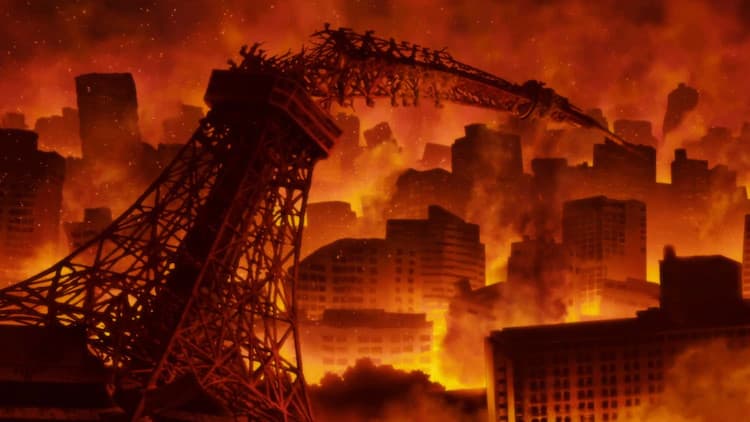
Since I mentioned these visuals, the background art representing the disaster is at first fine, but it is so stiff and one-dimensional that it really does become a background feature, rather than what I expect from a landscape that should be, as I said earlier, a protagonist character. But Japan Sinks is obsessed with being a realistic anime, which means basically every single portray of catastrophe in this show is something you probably have seen before, if you ever watched another disaster movie or series. And this lackluster representation goes all the way to the end, when Japan is rebuilt after it does sink, and the scenery is absolutely something any anime fan has seen before, many, many times. There is little to no input of real creativity, imagination, no daring attempt to bring something new to the story. It’s just another island with a bunch of skyscrapers and some beehive holographics. You add that to the brown-and-grey color palette and the… let’s call it “minimalistic” character design, since I don’t want to be mean here, and what you get is boring, generic art that should be at least provocative.

I said the visuals are boring, but let me take a moment to give credit where credit is due, and that means I have to stand in awe over how bad the sound is in this show. Not just the soundtrack, which is, as I mentioned, upbeat futuristic trying-too-hard music that gets jammed into moments of tension, such as deaths or rape attempts - yes, because a whole country sinking into the ocean is not horrific or edgy enough, you know you gotta add not one but TWO scenes of sexual assault, so people remember the real catastrophe are men – that feel as inappropriate and misplaced as sexting at your grandmother’s funeral. But it’s not just the soundtrack that is awful, the sound in general is despicable. My sound engineering professor used to say that when a work of art has good sound, you will probably not notice it, but when the sound is bad, you won’t be able to take your attention off of it. To me, that happened heavily while watching Japan Sinks, where people’s steps sound like shots fired and even a slight touch of a hand on someone shoulder has a cracking noise, while the best they could do to immerse us in the catastrophe scenes are the usual boom.mp3 you hear in every other anime. I often stared at my cats while watching this show because I honestly thought they were the ones making some of these weird noises.
I could go on into more detail about the other absurdities and obscenities of this show, like the insanity of putting a 14 year-old girl as some sort of villain; the deranged old man who attempts to murder a kid in one scene and is immediately pardoned in the next; the fact that the only emotional scene where Mom and Daughter seem to feel bad about Dad’s death is cut by an out of nowhere sex scene between characters that could not be less relevant to this story; the whole cult plot; the annoying photograph taking which serves as a death flag throughout the show and adds nothing to the emotional motif; the way the main characters are always walking or running or driving but they never set an actual goal, a place to go, a person to find, any objective at all: not even surviving, since they will ignore death warnings, throw themselves into dangerous situations needlessly or sacrifice themselves as easily as Shiryu will make himself blind…but I’ll skip these to talk about my least favorite moment of the show, which was when they were finally saved. Gamer Son and Athlete Daughter are finally rescued, taken to a hospital, she finds out her leg will have to sashay away, and then there is this beautiful, gorgeous moment. It’s Athlete Daughter’s 15th birthday, and she is laying in her hospital bed, lit by colorful bright Russian night lights, and she receives a notification on her phone. It’s a birthday video message that everyone recorded days prior to that, in secret as she slept, to be delivered on the day, and she finally allows herself to have a good cry watching her now-dead Crush, her now-dead Mom, her maybe-dead White Friend and her alive little brother cheer for her sweet fifteen. There is a particularly beautiful detail of her tears falling on the cellphone screen, creating this rainbow effect on the droplets. It’s a relief, because we are given a moment to feel with the protagonist, to feel for the protagonist, a moment of grief that has been so repressed during the show that it actually feels relaxing to feel pain, at last. This was my favorite moment of the show, but what followed was something I hate so deeply it made me want to scream and the fact it was preceded by a moment I thought was so delightful only made matters worse.

This short moment of satisfaction is cut by Athlete Daughter riding a bike, in an obvious some-time-later scene, which confused me since we had just found out she was going to have her leg amputated, so I wasn’t expecting to see her up and running just yet. Once again, even something as cliché as an athlete tragically losing the part of their body that made them an athlete is brushed off and skipped forward as Just Another Thing, and we never get to experience what Athlete Daughter felt or thought about it, how that impacted her, nothing. The sequence that follows is literally a slideshow of photos and videos that Annoying Mom kept with her, which show some of the voice-over moments we heard earlier in the show, but these are so disconnected from one another that I only realized they were the same dialogues later as I was discussing the show with my husband. I hate slideshow moments because to me they are a lazy slap in the face of the viewer, but this one could have at least some input of emotion on it, some reaction from Gamer Son and Athlete Daughter, who were literally staring at their whole lives, and their dead parents’ lives, and the best they could do with it was make their apathetic, expressionless faces say “she kept so much, wow”.
And then the worst, laziest, most disgusting assholerish feature in cinematographic history makes an appearance:

This is a cry for help.
So let me get this right: we followed these boring uninteresting emotionless apathetic annoying generic assholes for 10 episodes as they wandered aimlessly through a lackluster landscape of definitely-holding-back destruction, never gathering enough information to make us really aware of what was going on outside of their bubble, and who were either killed off for kicks and shock value or survived with no meaningful transformation, and when we finally get to the big Well, Now What? moment which I believe we were all waiting for, the moment when we were supposed to find out how the fuck is the world going to deal with the fact that Japan just went full Atlantis? How the fuck is the world going to deal with the fact that most Japanese people were wiped out I a day? How the fuck are the survivors meant to rebuild and stand on their own after such massive trauma? No, fuck you, says this show, fuck you who craved any sort of meaningfulness to this whole dumpster fire of audiovisual work, we are skipping this bitch to eight years in the future and all you’ll get will be a voice-over telling you in vague, generic, empty speech what happened during these eight years, and then another slideshow of poorly-drawn “scenes of Japan” that will supposedly strike an emotional chord with anyone who thinks cherry tree flowers and bubble tea are the epitome of Japanese culture, I guess?
This show was made for people who think it’s correct to compare The Last of Us II to Schindler’s List, people who call themselves “weebs” seriously and people who are proud to say they don’t eat fruits or vegetables.
3/10.
Fuck this show.