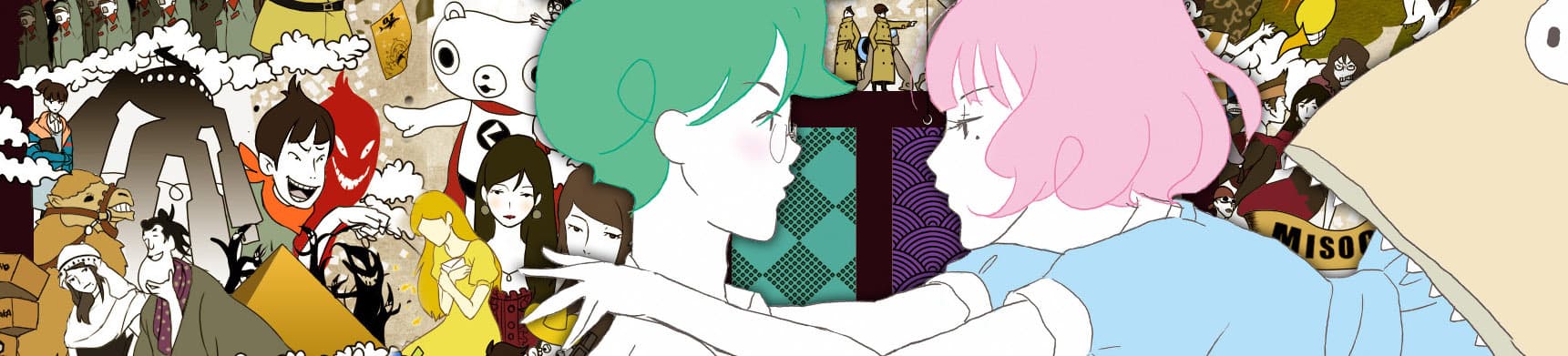

The animation genre continues to grow in popularity and techniques since its creation. Its market is full of different styles, such as 2D, stopmotion, CGI, and even a mix of all these previously stated. One of its strongest advantages is how you can explore fiction and even reality in a unique way, one that could never be accomplished with a mere live-action.
The biggest proof that animation can be more expressive than reality lies within The Tatami Galaxy, an anime that illustrates in a comical, bizarre, immersive and mature way the matter of facing reality, as it uses everything animation can provide to pass on its message through an unforgettable experience.

A LOOP OF DOUBTS...
What could be a normal story about life and repeating the same period again and again in different ways to achieve a “perfect dream” ends up being more than that thanks to a spectacular direction in all possible aspects. The Tatami Galaxy is based in the novel of the same title by Tomihiko Morimi, released in 2004, and it’s fair to say that the series not only brought justice to its source material, but also created a clean and new identity to this deep, outstanding story.
Composed by eleven episodes, Tatami Galaxy starts taking so many risks right out of the gate in its introduction. Its textual part has a big role, something notable when we see characters “shooting words with machine guns” right in its first scenes, all of them with a lot of meaning and thoughts, which is something hard to grasp as the story’s introduction. Along with this avalanche of words, we have a non-stop pacing when introducing characters and the settings, a pacing that ends up being tiring in its first few episodes. The fact that the story re-introduces the nameless protagonist’s life (let’s call him Watashi) again an again with many differences (some completely exaggerated, but intentional) will certainly make some bored at some point.
Now, if you thought that everything said above was a harsh criticism to the story, you are absolutely wrong. Everything written were praises, and the sincerest ones.
The diretor of Tatami Galaxy, Masaaki Yuasa (Devilman Crybaby, Keep Your Hands Off Eizouken), integrates all uncommon narrative resources that fit with the plot to give it a fresh air, risking the confusion and boredom of its audience (something that he intentionally tries to do at many points). Don’t get it wrong, the direction is not doing something bad on purpose: instead, it’s trying to make you get used to all these peculiarities naturally and “with time”.
In Tatami Galaxy, we see Watashi’s misadventures in a three-year loop as he tries to find his ideal college life. As the series is told from his point of view and experiences, every resource such as “a machine gun of words” and “a pacing that doesn’t breathe” tries to present exactly what the protagonist feels according to the events that surround his story and life. Of course there are moments where Tatami Galaxy stops and breathes, as it tries to “understand its audience” and the audience tries to understand the series: the direction knows when the story has to rest or not according to Watashi’s energy (and in case you haven’t noticed yet, his name means “I”, as if the spectator is the central character of the story), while the audience tries to understand the logic and meaning of the plot and slowly gets absorved by its bizarre yet charismatic world.
Even if the series does get tiring when it repeats the same three years (that means, the same episodic formula) again and again only in different circumstances, Tatami Galaxy’s direction knows when to change things enough to make the experience unique and continuous.
Basically, the “time travel” aspect of Tatami Galaxy is actually a character, and that character would be the changes of episode. Each episode introduces the same cast (sometimes with new characters) in different lives, but with similarities and connections. We see a life of a movie director, of smiles, planes, forbidden love… yet, the same core is present in each of these storylines, that is, the same character. “Time” is integrated in Tatami Galaxy in such a subtle way that it’s difficult not to paise it. The repetition of events is made to leave the audience (and the protagonist) tired. Since the story is told from Watashi’s POV, a logical conclusion is to make the spectator pass through the same repetition as him, and not only get a few crumbs of each event.

... A LOOP OF SURPRISES...
Although Tatami Galaxy’s direction is amazing by its own, credit should be given to its writing and characters as well. Even when we see the same events again and again, the series manages to implement a sense of progression along these continuous loops.
The progression and foreshadow of the plot are subtle, but not that subtle to not be felt. Even when you don’t notice it at first glance (and might only notice when you’re looking for them or when you re-watch it), you will unconsciously understand everything that happens later, an evidence of an amazing writing.
Along that, all of Tatami Galaxy’s characters besides Watashi either have a great personality or a strong presence (sometimes, even those two). Characters such as the malefic Ozu, the beautiful girl with sharp tongue Akashi, the mysterious and old fortune teller, the wise master Higuchi… the list goes on. Even when a character has a toxic personality, they still play a fair and important role in its story, even when they’re not likeable at all. Each interaction and dialogue of Tatami Galaxy’s cast make you more invested in the misadventures of each one of them, even when many of them are left aside in many scenes and key moments of the plot. They are responsible for the gold humor of the series, bringing strong and remarkable laughs as the story goes “forward”… or when it repeats.
And of course... Tatami Galaxy wouldn’t be what it is without its main message.
Have you wondered why the series is called “The Tatami Galaxy”? A tatami would basically be a type of mat used as flooring material in a traditional Japanese bedroom. What does a bedroom have to do with a story that, according to the introduction of this review, is about “facing reality” and “searching for the perfect life”?
Such questioning is something that can’t be explained. At least, not with the same impact that Tatami Galaxy leaves in its audience with its final message and thoughts about its themes. Everything in the production of this series is made to make you reflect about the message in a significant way, and talking about it with someone that didn’t experience would be an offense to the anime. All parts of its writing, direction, art and soundtrack are made to stimulate you to eventually have fun and get emotional. And speaking of stimulus…
... A LOOP OF EMOTIONS...
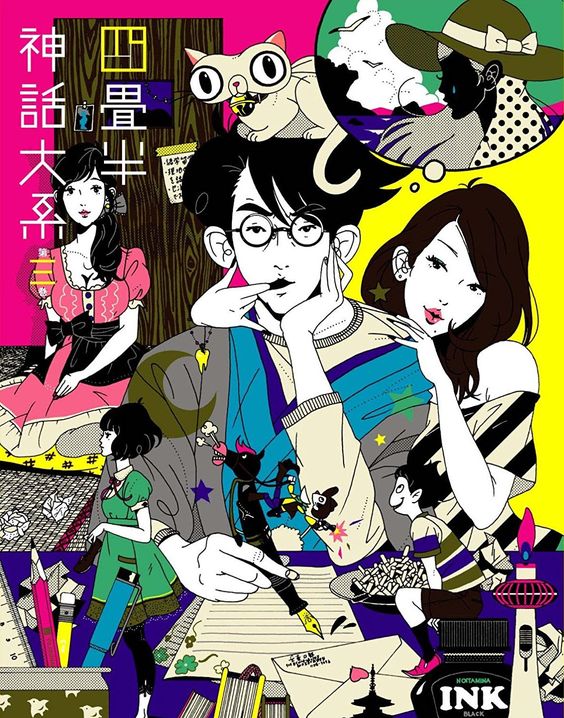
The artstyle of Tatami Galaxy is simply phenomenal. No more, no less.
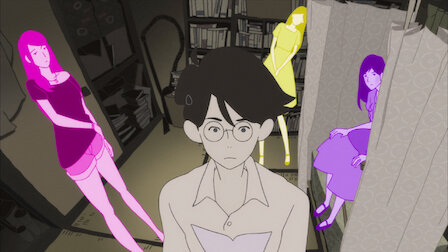
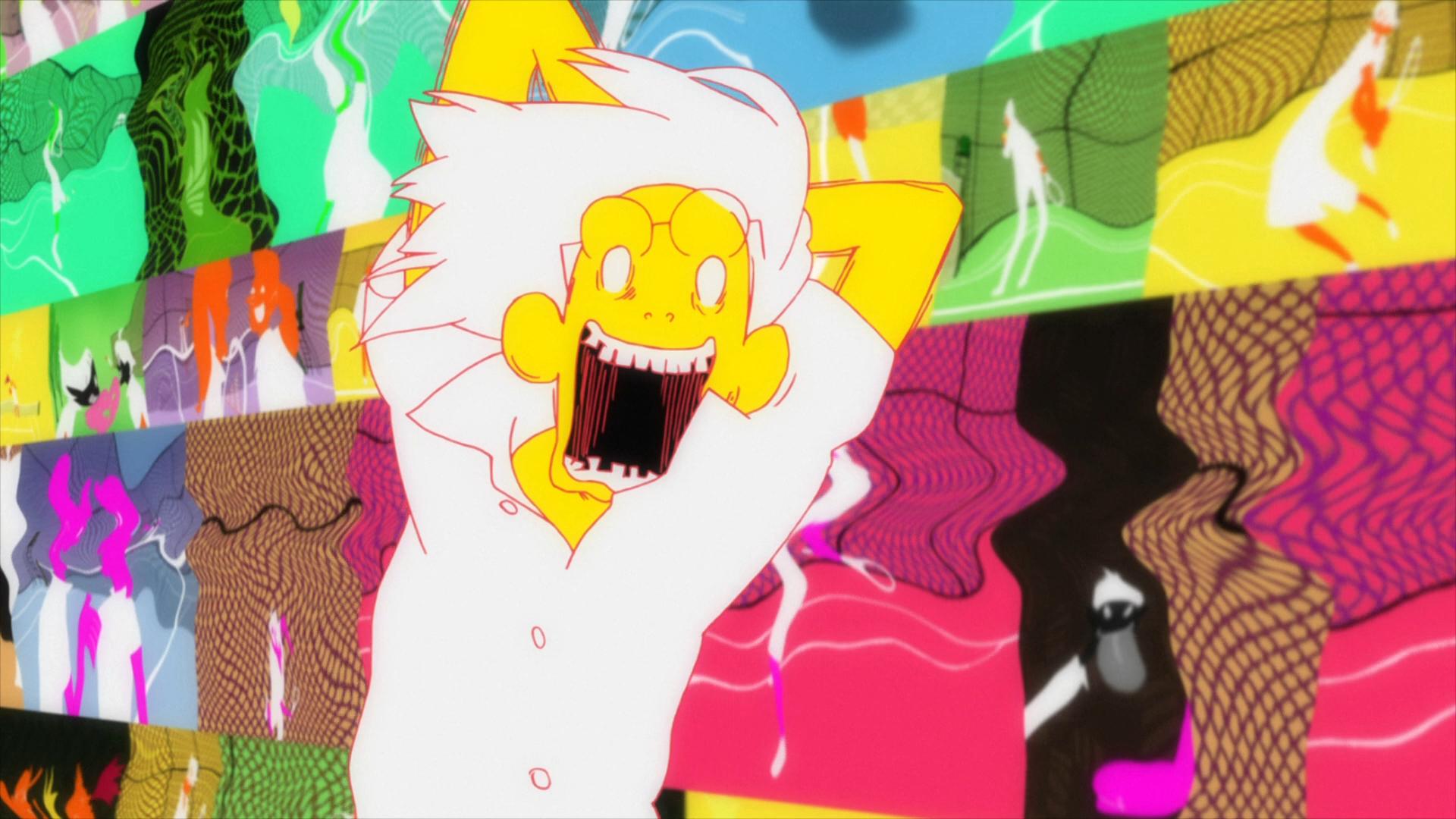
Tatami Galaxy knows exactly when to use the right colors. Whenever it is to provoke a visual confusion and a mix of emotions, or to represent the romantic view and the idealized, or even to show the lifeless, the dead in soul… the anime’s composition is admirable in every way possible. It’s even possible to affirm that each frame of the series could be put as a poster, as a background for an electornic device… it’s something that makes you feel even when you don’t know the context behind it.
Along its diverse colors and visual boldness, the anime uses an uncommon artstyle, one that’s more cartoonish and minimalist to fit its avalanche of colors. Such artstyle is more than welcome, as it matches perfectly with the series’ fast-paced and expressive anime. From this mix, the visual identity of Tatami Galaxy is born.
Do you remember when the review was talking about the expressive possibilities that animation can provide, possibilities that aren’t present in a mere live-action? That sentence was talking exactly about what was cited in the previous paragraph. Through its different shots, colors, corporal expression of each character… the feelings of each character, the tone… everything in Tatami Galaxy’s storyline is passed on to the audience with such care in a exaggerated and quick manner… but even so, it’s still sincere in the best way possible.
Once again, words are not enough to describe the wonders of Tatami Galaxy. So, a few frames of the anime will describe the rest of this section for you.

And obviously... it’s not possible to talk about Tatami Galaxy without citing its wonderful soundtrack, one that mixes instruments to give so many emotions that perfectly fit the series’ story and tone.
Songs that celebrate the hopeful triumph and the innocent expectations of someone entering the place of their dreams, a strong dramatization of disappointment (with a more sincere and less glorious counterpart), a theme that expresses sarcasm, sagacious, the rascal and the evil, the enormous and continuous tension along the confusion and pleasure… the list is huge. All songs are expressed in the sincerest way possible, sometimes even using a single piano, sometimes using a multitude of violins and harps, like a glorious orchestra… the praises are endless.
And all of that without counting the lyrical songs, that is, the opening and ending. The opening is just a happy rock song, one that does fit the story’s arguments considering some points… but the ending is something simply special. Not because of the wonderful song, but also due to the visual segment alongside it. The analogy of the ending along with its connection that (kind of) breaks the fourth wall… it’s valid to call it a “visual ASMR”, if such term even made sense. To put it simply, it’s one of the best parts of each episode of Tatami Galaxy.

VERDICT
Even without reading the original novel, anyone can have a wonderful and special experience with Tatami Galaxy, an anime that dares to use of its advantages as an animation both in its visuals and narrative to bring an unforgettable story about reality and dreams.
The Tatami Galaxy does begin in a confusing way and with a formula that won’t please anyone at first. But when you end up getting more and more into this deep, colorful and comedy-gold anime, get ready to meet a wonderful series that can be life-changing for some.
FINAL SCORE: 10/10
[This review is not meant to insult anyone and their hard work on the production of this series, as it’s only meant to be a critical and fair analysis of it.]