

Writing a review of Nausicaä is like writing a review of Star Wars: A New Hope. Where do you even begin with a film this foundational and influential?
Should you watch it? Absolutely! Not only is it a tightly written, riveting action-adventure, you’ll recognize shades of its imaginative post-apocalyptic world in dozens of other anime titles and Japanese video games. It’s also a vivid portrait of its creator — Hayao Miyazaki circa 1984 — and his interests in flight, pacifism, Marxism and industry, presented with the emotional impact of a “kamikaze attack”, as his friend and peer Mamoru Oshii once put it.
To limit the size and scope of this review, I will be focusing on the film’s relation to Miyazaki’s worldview. (This review will describe numerous plot events.)

Through unfortunate happenstance, the idyllic farmland of the Valley of Wind, a pocket of civilization in an otherwise uninhabitable world of poisonous fungal forests and giant killer insects, comes into possession of an ancient weapon of mass destruction. A formation of immense airships from a distant empire descends from above, deploying a small army of imperial soldiers who storm the castle and slay the local lord. Princess Nausicaä, the heir apparent, submits to the occupying forces to prevent further bloodshed. The Valley soon finds itself caught between two great, hostile powers, thus setting the Princess off on a quest to save her home.
Miyazaki, like several other notable names in his generation of anime creators, is a child of the war and the leftist, anti-war and anti-occupation protest movement. As the war ended with an atomic bang, Japan became a pawn in the subsequent Cold War. The parallels in Nausicaä are apparent, but the film is more than an allegory for American occupation.

While resembling something of a religious epic with the messianic journey of Princess Nausicaä to discover the meaning of the toxic forest, the film also translates the creation myth of communism into genre. With their farming tools, the proud working class of the Valley of Wind rise up against the dopey imperials in a humorous action setpiece.
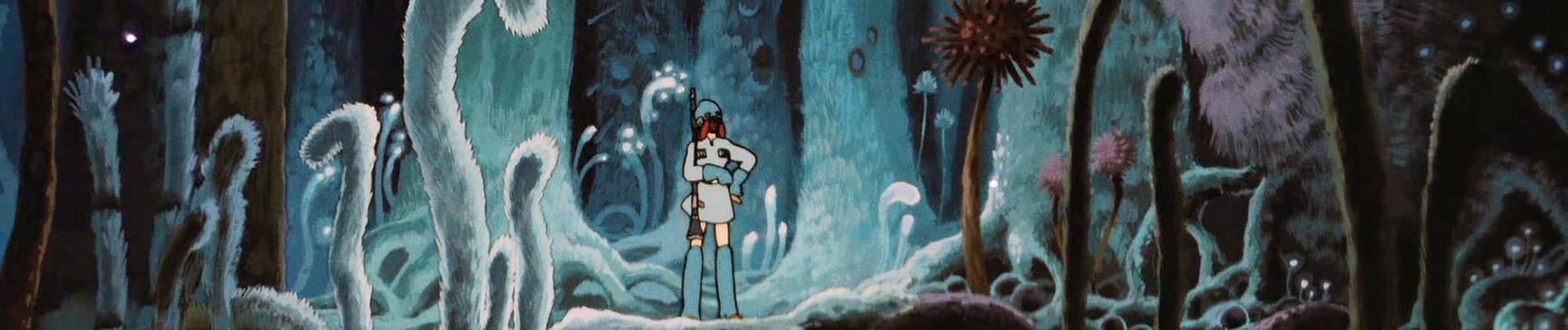
Miyazaki’s feelings on industry and pacifism are encoded into the film. The occupying empire’s chunky airships and armors are crude and dehumanizing, while the Valley’s modest assets, made from super-strong materials harvested from the toxic forest, exude personality and dependable craftsmanship. The Valley itself, as with many charismatic locales in numerous Ghibli films, exists in harmony with nature. However, the imperial warmongers seek to destroy the forest with the WMDs of old to dominate the natural world once again.

Princess Nausicaä, being something of an insect whisperer, continually defuses conflicts between the monstrous creatures of the wasteland and the panicked imperials. With her penchant for pacifism, she journeys deep into the toxic forest and prophetically returns to her people with the means to salvation. Likewise, when the WMDs of the great powers threaten to destroy the Valley, she throws herself onto the gears of war in a desperate attempt to stop it. In Nausicaä, industry is a slippery slope to violence against nature and against one another. Harmony with nature and with mankind form a unified, pacifist ideal embodied in Miyazaki’s titular champion.
Over time, Miyazaki’s belief in Marxism would fade, and likewise the impact of anti-war messages in a significantly advanced, postwar consumer economy. His subsequent films would shift emphasis and tone away from the heroic bombast of Nausicaä. But anime is a medium for the senses, and Nausicaä remains his most sensational film for its passionately believed ideals and its madly designed fungal wilderness and fantasy airships. It remains my favorite Miyazaki flick because it is the most Miyazaki flick.
