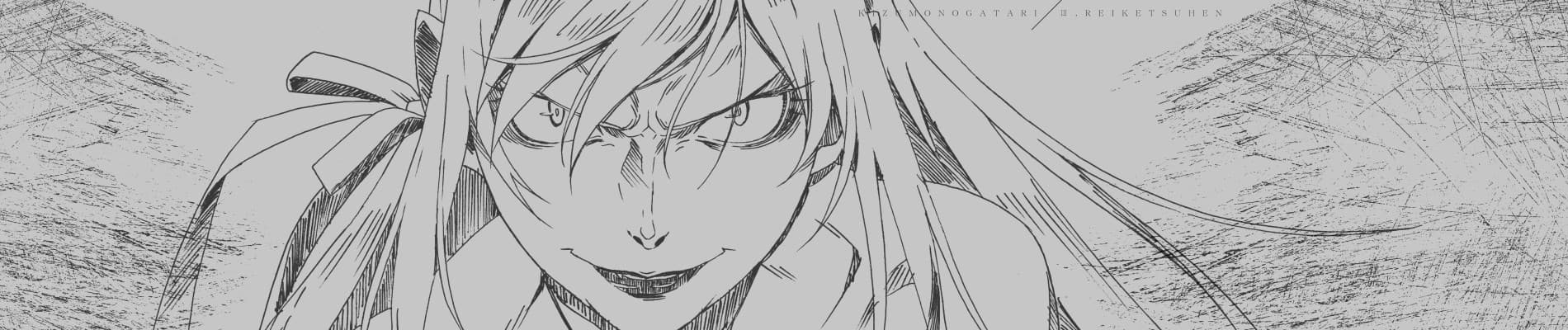
Kizumonogatari Part 3: Reiketsu
a review by kathelynn

kathelynn
5 years ago·Sep 15, 2020
95
/ 100
a review by kathelynn
5 years ago·Sep 15, 2020
#####(Updated the review. To see how far I've gone from evaluating animes, check this out.)
The thing is that I am personally not into the Monogatari series (not to be confused with Monogatari Series Second Season). It is quite a clever one, probably the best I've ever seen; I wouldn't know. But despite how amazing it is objectively, it never won me personally as much as Bakemonogatari, despite it being the series introduction and having significant flaws.
Though to be honest, flaws or without flaws don't mean perfect in a sense. Though literally, perfections mean that there are no imperfections. But a layer deeper and you could say that you can't make something perfect without having faults or that you can't call out something as imperfect if perfection was just as uncountable as individual hair strands, as both are just concepts that one can only ever use as a hyperbola and nothing else.
The series reminded me of Puella Magi Madoka Magica. What made it such a great show for me was that at first thought, it was just a cliche show and generic at the surface. And the issue here is that for some reason, cliches are a must-avoid. For me, great writers don't rely on cliches so that they don't seem like an unimaginative person, but that incredible writers use devices in the best way possible to make the best package.
And here's where we start to break the mold.
Seasoned writers always have to compensate by following plot structure for a reason, to go through a library of tropes. The reality isn't so much about creativity as it focuses on what makes the nest best-seller; what readers could follow on. Hell, even amateurs can make a very imaginative story. The difference is just writers that studied the language, semantics, and trend for years. Tropes too if you will (;
The issue with Monogatari isn't about the other flaws as much as the problem in the narrative. The "what have I learned today?" become "could I remember everything I learned today?" There are just so many things going on, and that becomes a problem. Information overload makes the point that story pacing is incredibly fast to follow.
The distinction between the original series and the movie is that it prefers visuals to dialogue. Not only that, but we also have
Like, why you ever think an anime studio would even bother making something like this?
There's a reason why, and it's not just about the pretty visuals themselves.
"Actions speak louder than words," sometimes. The movie differs itself from its dialogue-heavy counterparts by enticing you to look into the image much more. Even with more information to take in, ironically, you could still keep up with the visual cues as there isn't a whole lot.
As an included bonus, they don't even have to include random off-topic sequences to keep the viewers interested. It is two birds in one stone. The same reason the above could be a potential issue is that something like the signature head tilt becomes a distraction.
Something I could relate to this issue is Tatami Galaxy. Don't get me wrong. Tatami Galaxy is a great series, even with this issue. But as they say, convey the story as simple as it can; otherwise, it would sound like the sentiment of a writer and nothing else.
Again, nothing of them is wrong. Reading a review on the internet like mine is a personal take, never objective. But the thing is, I don't think TV series ever got rebroadcasted live in a short time, and that's the difference between a novel medium and an anime project. This distinction approaches consuming both media differently.
In reality, there is not much theory for fiction works in general. What I generally do is praise people for bringing amazing things. I am referring to ones that can have a meaningful impact and a message to give. Any writer knows this very well, and even so, their stories can leave unintended detail as well.
The first part of this review felt like there wasn't much of a reason for it. It does make it on its own, but it doesn't contribute much to this review. It is just as how Monogatari (before Kizumonogatari) felt, at least.
And so you could even think that it contributed to the review just now. The TV series does a great job of introducing you to the characters, better in any way than the movie itself. Without that, the experience would've felt lacking and unmeaningful. And to add, it only makes sense if you finish all three parts of it. It feels very dependent - but you can watch it independently if you are willing to start the series chronologically, which I would not recommend.
If you are willing to watch the series, please follow a watch order guide. I'll link one right here.
48.5 out of 53 users liked this review