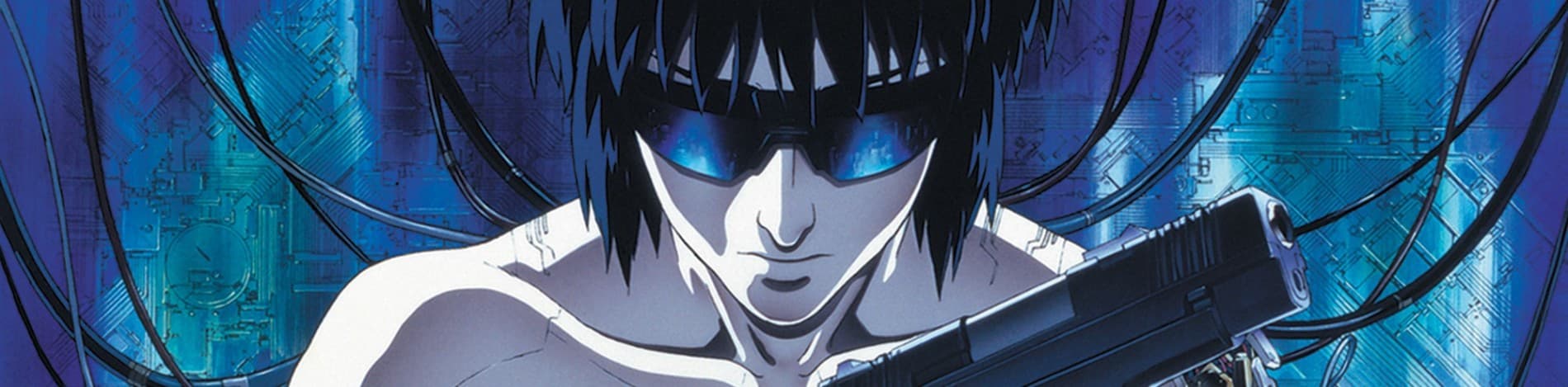


Spoiler-free review
Review in brief:
Ghost in the Shell takes itself far too seriously, and in turn ends up spreading its considerable aesthetic focus thin across a soulless plot and a theme that it can’t wrap its own head around. With a self-imposed split between its story & its presentation made worse by its frayed structure, it’s not hard to figure out why it’s known more for being complicated than compelling.
Review in full:
Ghost in the Shell loudly presents itself as serious, deep, and thought-provoking. While it’s clear that many of the people involved possessed the skills to match this appearance, the direction mixes its quality elements into the anime equivalent of a pretentious college student; the sort of person who tries to one-up the professor by constantly attempting to disprove the class lectures or thinks they've unlocked the world's greatest secret because they've recently become an atheist. Such a person isn’t necessarily bad or lacking in constructive traits, but they tend to believe their oft-basic qualities have a far higher value than most other people would and come off as annoying or shallow because of it.
That is the way Ghost in the Shell acts in its execution, time and time again. It features a number of skillfully choreographed action sequences and needlessly draws them out to show off its animation. It contains expertly crafted & stylized visual and audio design but dumps most of it into lethargic montages that not only render much of the rest of the movie quiet, barren, and full of dry exposition (especially in the later half) but also could be cut by 95% and still deliver their meaning. It has the bright idea to flesh out its world through character interactions but in a world that is effectively just Hong Kong with robots and characters that may as well be robots themselves (the "twist" could have been that every human was actually a soulless robot the whole time and I would have been 100% unsurprised). It has the basic elements of a thrilling conspiracy drama but squanders it by diving into monologue after monologue centered around unrelated minutia, crowding out all of the room the narrative would need to flesh out such a story properly.
The driving purpose behind all of this is to explore transhumanism, and how it does so is a large part of why it falls apart. Transhumanism isn’t a difficult concept to understand, and so it’s not hard to explore in depth. Ghost in the Shell rarely seeks this depth however, instead straining itself over the base concept of what it means to put a person in a machine. Yes, that’s what the title refers to and no, there isn’t much to it here past “ghost = mind, shell = body” besides repetitious ponderings and shallow monologues on questions that don’t actually have to do with transhumanism, as if prefacing them with the concept was all that was required.
In fact, there’s a multitude of concepts tacked onto the already bloated discourse that this movie struggles to understand. It heavily ties individuality to having an observably unique face (whelp, guess identical twins aren’t individuals then!), postulates that people can’t prove their humanity without physically observing their own brains (so is trepanning back in style?), and drones about the importance of reproduction & evolution shortly after making a show of a depiction of the tree of life (i.e. a representation of reproduction & evolution) getting defaced with bullet holes in a robot vs. human fight.
Saying all of this doesn’t justify the frustration this movie imbued in me, because the real frustration was getting such a vapid experience from something with clear potential. Yes, this movie does feature some top-notch 90’s animation, and in the few moments it’s used to show the story it does so very impressively. Were those moments not so few, they would have stood out more against the dull & static imagery that dominates the film. The sound is at a more consistent quality, with voicework that does everything it could have to bring life to the movie and a standout soundtrack whose only weakness is its limited quantity. The effects work is often mismanaged, but in the handful of moments when it all comes together (most notably, the Making of Cyborg sequence early in the film), the aspiration that went into the production is made readily apparent.
 For every moment where the animation comes out in full force...
 ...there’s one that contents itself with slow panning shots or still images. Take a guess, which of these moments is needed by the plot?
Spoiler, click to viewclick to hide
The panning/still shots, there wouldn’t be so many monologues if the story was animated enough to tell it.The story, when not totally buried under overbearing thematics, at least shows itself to be a respectable idea. It has a conspiracy drama angle that is intriguing on its own and would have been an acceptable element for the movie to lean on if it wasn’t pushed to the side for much of the movie’s first half and unceremoniously uprooted & unveiled shortly after. There are implications of an interesting origin for many of the major characters that would have done wonders to flesh them out if tapped into beyond Batou bluntly exclaiming “The Major and I go way back!” late in the film. The two real criminal investigations that go on are rather well thought out from a structural standpoint, even if given less focus than they deserved.
All in all, Ghost in the Shell has many good qualities but thinks far too highly of a handful of its traits and uses them in such a masturbatory way that it detracts from the experience as a whole. There's a reason the term "creative limitation" exists, and this movie exemplifies the opposite to a startling degree. Putting less work into the nigh-pointless montages would likely lead to condensing them rather than drawing them out. Doing the same with the action scenes and quickening them would create a bigger rush when there is action. Accepting that the movie's world and theme are rather basic would allow the narrative to lessen the focus on minutia around them. From there it could display the world in the background and allow the character interactions to instead develop the characters themselves. Most importantly, if this movie didn’t hold the definition of transhumanism as sacred and explored where the concept leads better, perhaps it would have had more to do with itself on the whole than style, robots, and a naked cyborg woman beating up villains.
Verdict:
A brooding film that wants to be deep and thought-provoking but has a drive so shallow and a progression so slow that the only thing it manages to do is drag itself to the next overly drawn-out action sequence every half hour or so. It had everything it needed to be compelling, yet squandered it all so thoroughly it’s like it was directed by robots as a facsimile of human pondering. Fitting, sure, but not fulfilling in its inert execution.