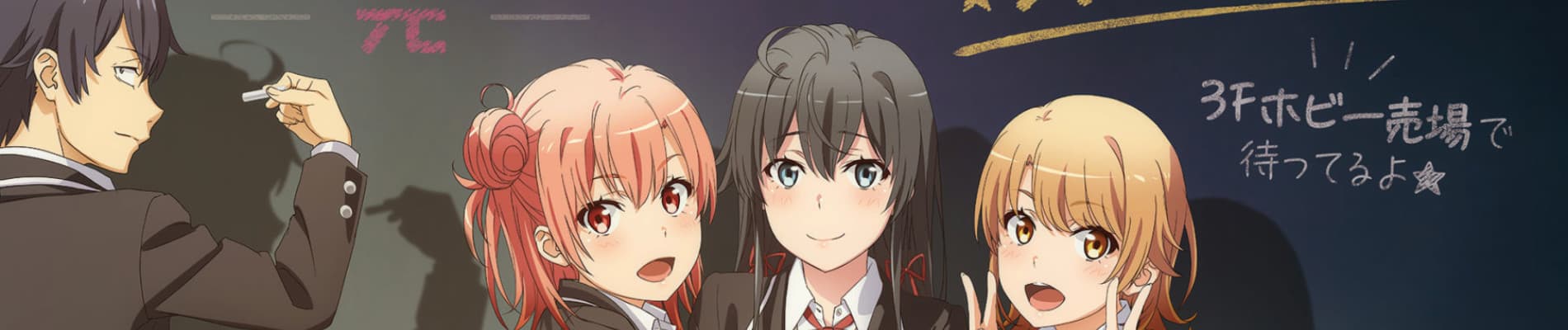
It’s the anime that got me into anime, for better or for worse. SNAFU S1 showed me that these seemingly simple Chinese cartoons could have far more to say than the tropes advertised on the tin. Zoku defied my expectations again by turning the genre subversions of an entertaining first season into an intimate character exploration that ranks among the most compelling arcs I’ve experienced across visual and written mediums. A pair of pretentious intellectuals and a hyper BFF’s struggles with actualizing their wants and needs opened my eyes to brand new ways of appreciating stories. Challenging my understanding of texts and the world around me, Oregairu has perhaps been the piece of media most formative to my growth as an audience member.
And at long last, it has arrived at a climax.
I’ll keep things spoiler-free for S3, but be sure to catch seasons 1 & 2 before going further. Skip ahead to my Tl;Dr if you wish to go in blind. Let’s finally bring things to an end…
Oregairu S1 made waves with its trademark joke delivery, utilizing every weeb’s favourite loner, Hachiman, to provide jaded commentary on SOL genre conventions. While the comedy was hit-or-miss with audiences (a hit for me,) the series also took time to lay the foundations for a stellar second season. The eye-opening S2 turned its caricatures into characters, its sarcasm into introspection, and its “parody” into a drama on its own right; all while maintaining the quirky wit that characterized so much of its predecessor.
The thoughtful experience built in seasons 1 & 2 deserved a continuation in the form of closure. The series opens immediately following the climax that was S2’s finale, as if the 5-year gap between seasons never existed. The relationship between our Service Club members remains as uncertain as ever. The search for something “genuine” is a burden that rests heavy on the hearts of Hachiman, Yukinon and Yui. Unlike the many subplots about students coming to the Club for help, this time our beloved trio face the task of helping themselves. Understanding how to reject the superficial impasse within the other cliques in school, fighting against expectations imposed by others, and making the inner desires of their hearts known.
To achieve this end, the Service Club sets their sights on a single goal: organizing a school prom. This final arc looms large over the course of the season. Previous instalments of the franchise would cover two or three of such subplots at a brisk pace; S3 is a slow-burn that commits to paying off its threads on one last journey. The more-measured pacing has sparked audience discussions about what makes the prom such a huge deal. But the plan to get the prom off the ground isn’t important, rather it’s the varying character motivations amongst our trio that creates room for this story’s subtext and drama. The competition between Hachiman and Yukinoshita that brought the Club to where it stands today enters its final round; the outcome will decide the future of their friendship. The prom setup is a backdrop and metaphor for the inner feelings of 8Man and the gang. Unearthing the subtext between these complex individuals and their interactions has been incredibly engaging. Ideas and themes built up in S2 get expanded upon and explored in greater depth. Adding on to the payoff are well-written visits from familiar faces, as Hachiman makes his rounds and seeks help for the tasks at hand. Moments of character introspection are a common occurrence, as Kan shows its hand and lowers the defenses of several cast members. Getting into the heads of characters other than Hachiman further enrichens the story and caused me to look at things from different perspectives. Reinforcement of themes and payoffs cumulate in immensely satisfying fashion. Episode 8 of S3 is a triumph and arguably my favorite 20 minutes of anime this Summer. Heck, I’d go as far as to say that this episode deeply affected me as much as the Genuine Scene itself.
And it’s in those aspects that Kan falls short. Most striking is how quickly the show shaved off its comedy tag. Fans of S1 tend to dislike the more serious tonal shifts of S2, and S3 brings even less of that to the table. Certain attempts at gags feel tired and forced retreads of older material, such as the spiritual sequel to the “Logical Thinking” bit. Somber undertones are present in most scenes, holding Kan back from hitting the comedic highs the series is known for. That’s not to say this season doesn’t pack any laughs; pick any scene with Iroha or Zaimokuza and you’re bound to get a few chuckles. Also a step-down are the visuals, in my opinion. Other than a slew of lighting effects, Studio .feel doesn’t add anything substantial in this regard. In the OP (once again performed by Nagi Yanagi,) a frame-rate drop towards the end gets pretty distracting after repeated viewings. Character designs and facial expressions also look a tad off at times. Another area of concern would be moments in the show that can come across as unrealistic or unintentionally silly at times. When the show leans too hard on driving in subtext and parallels, the surface-level interpretation can be pretty ridiculous to take in. Slow pacing of certain episodes is yet another issue. It takes a while to really get going, and I found myself getting frustrated at the first three episodes for its relative insignificance. This issue is exacerbated by the show repeating itself at certain junctures. Plot points are stretched and some scenes are essentially rehashed. For example, I found the first 15 minutes of Episode 5 to be a recap of ideas adequately explored in the last 5 minutes of Episode 4, which shares a very similar ending to that of Episode 6.
Adaptations are a tricky business, and sometimes a show has only so much time to convey the key narrative that made its source material special. RELife is one example that comes to mind, being allocated a meager 4-episode OVA release to wrap up upwards of 50 chapters' worth of material. I found it that OVA series to be a success and the high-point of the anime series, because it had a strong focus to close out its story without throwing in arcs that have no chance of resolving in a satisfying manner. Unlike another high-school contemporary in Summer '20 (one that may or may not involve gods,) S3 rarely plays out like a hastily slapped-together highlight reel of its source material. I’m confident in saying that S3 handled its adaptation well, even without having read the manga, on the basis that the story presented in the anime holds up on its own. Aside from one tease of a line in Episode 8 with Haruno and Hayato, Kan remains true to its refrain to deliver on a strong narrative, and that’s enough for me. That being said, the LN/manga readers I’ve shared discussions with agree that plenty of content they consider “essential” got left on the cutting floor, and I won’t contest that. But I assure you that if you were to go into this season with an open mind and appreciate Kan as its own story, you will not come away disappointed.
You would have noticed that I haven’t brought it up at this point, and truth be told I’d love to bring up my Best-Girl biases and opinions on how it’s handled in the anime. I’ve always thought the unofficial Waifu War could be built up a lot better, and like plenty of viewers I have my qualms on the outcome Kan went with. But personally, I’m not upset at how things played out, even if it came across as rushed for some. Because to me, S3’s titular climax is not one to do with resolving romance. Rather, it has everything to do with the friendship Hachiman, Yukinon and Yui share. This was the outcome they all wanted and needed – to think, to writhe, to struggle together. This was the closure they deserved, one that brought out their truest desires.
Oregairu Kan is a triumph. The season deftly packs subtext and builds upon themes introduced in seasons prior, setting off the search for something genuine. Admittedly S3 is the weakest instalment in the trilogy, not quite managing to capture the comedy of S1 or the compelling character arc of S2. Content cut from the source material may concern fans of the original source material. Still, Kan achieves the goal it set out to do – providing a thematic and profound conclusion to the enigmatic franchise.
My Youth Romantic Comedy Is Wrong, As I Expected is a story about challenging the norms. It mocked the mundane and transformed it into a unique, endearing experience. It got me to question the reality of friendships and what it means to share genuine intimacy with others. SNAFU will forever have a place in my heart, and I’m so happy that it’s over. Thank you, Oregairu, my wish has been fulfilled. 7/10~
-- Really sad about the show not premiering in Spring, but I do sympathize with the animators and team involved. Taking the extra time to deliver on a project so near and dear to this audience is commendable, especially during such difficult recent events. What does tick me off, however, is the promotion of S3. It went strong even up till a week before the proposed season premiere, misleading me into thinking it would survive the COVID production delays that plagued so many shows this year. On April 1st a PV debuted, which was basically the main PV for the show entirely dubbed by Zaimokuza’s VA in-character. While I understand it would have been a shame for such a topical gag to go to waste, it was very upsetting to hear that the trailer got a green light. I find it unlikely that the people managing the show’s promotion were unaware of the show needing more production time so late in the game; and if that really was the case it was highly irresponsible to overestimate the capacity of the team tasked with bringing this season to life.
-- If I had a can of Georgia coffee for each time I saw a can of Georgia coffee on-screen, I’d have as many cans of Georgia coffee as the vending machine in Episode 4. Here's a montage of Georgia coffee cans in each episode:
-- Never knew we needed a Kawasaki ship, but we sure as hell got one!
-- Iroha was super perceptive and even pulled an 8Man on 8Man himself on many an occasion. She stole the show in every scene she was in.
-- As did Hiratsuka. Someone PLEASE marry her already, or I will.
-- Copious lack of Totsuka this season, maybe that’s why I rated it lower than the other two.
-- Gahama-mama is amazing. Enough said.
-- The world would be such a brighter place if everyone had a little sister like Komachi.
-- Haruno was still the more interesting of the Yukinoshita sisters for me. Really appreciated how they humanized her in Ep 10, almost all her screentime before that portrayed her as a Ryuk-type figure who observes Hachiman’s silly schemes. Really glad they grounded her character at the very end.
-- And Yukinon was… well, Yukinon. Never took a fancy to her in the anime, and that’s putting it politely. I’ll admit I did warm up to her a lot more this season, keep your pitchforks down. I also heard she gets far better treatment in the LNs/manga, so I’m keen to give that a shot some time.
Last but certainly not least:
-- BEST GIRL: Yui. Yui Yui Yui. The beating heart of the club. I’ll always love my Genki Girl, no matter how annoying people say she is. Her role in the story is vital; the club could never exist without her. Even her most ardent of detractors will find something they like in S3; she pays a penance of sorts for her selfish act in S2’s finale, easily redeeming herself in my eyes.
Welp, that’s it! Those of you who know me know I’ve spent an unhealthy amount of time talking about this season. I’m happy to say that I’m ready to put that to rest and move on. Thanks so much for sticking around during that strange and enriching journey, I took a lot from this show over the past few weeks. If you happen to like my verbose rants, feel free to check out my other reviews for seasons past and present, peace~
202.5 out of 227 users liked this review
