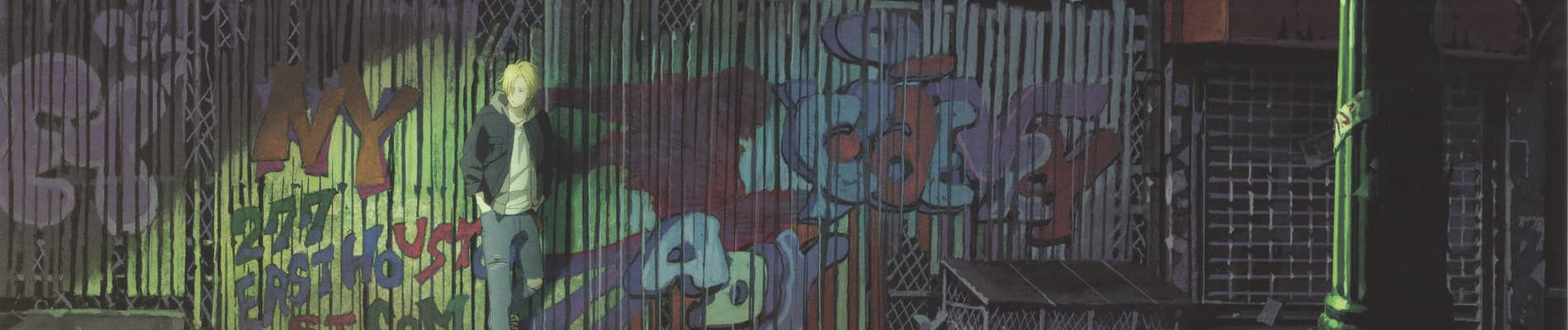
BANANA FISH
a review by Meistro
a review by Meistro
Trigger warning due to mentions of sexual assault, but I won’t be going into explicit details.

The above lyrics pretty much sums up what Banana Fish is about: a traumatized kid meeting someone that heals his heart with love, thus leading the two of them on a quest to protect each other.
Banana Fish is not an easy anime to talk about, not least because of its mature content about rape, child trafficking, and pedophilia. In spite of its lack of blood and gore that many anime viewers mistakenly associate with “maturity,” Banana Fish can still be an uncomfortable anime to watch because it explores the effect of the trauma the characters endure. Yes, the effect of it, not the trauma itself.
Something unique about Banana Fish that separates it from similar anime about rape is that it doesn’t really show the act itself in any exploitative manner. It shows just enough for the audience to know what happened, but it’s more interested in showing the aftermath and the way horrific acts like these would change a person.

The anime is about a young gang leader in New York named Ash Lynx who become involved in a conflict over an eponymous drug, “banana fish.” He meets a young Japanese pole vaulter named Eiji Okumura who has come to America to recuperate from his injury. Over the course of the anime, Ash comes to appreciate Eiji’s innocence from a world of violence like his home, and he would confide in him his past trauma of abuse that turned him into a cold-blooded killing machine. Eiji feels sympathies for Ash and seeks to save his soul from damnation, and Ash in return wants to protect him from the ugly world he’s familiar with.
Beyond the gun action and urban warfare, Banana Fish is a tragic but endearing tale of two kindred spirits who find a greater purpose of living than their own trauma. Even in 2018, it’s uncommon for mainstream anime to feature romantic relationships between two men, though “boys’ love” was far more common among ’80s manga. However, Yoshida has stated that Ash is not gay, and there hasn’t been any explicit evidence that Ash and Eiji share a homosexual relationship. There is a kiss in one episode, but its context is technically not a romantic one and is done out of necessity.

There are less significant characters that feel more like a typical boss in a video game one has to defeat, such as Eduardo Foxx who shows up in the last few episodes of the anime without much development or build-up. His existence and the gang war storyline of the anime are some of the things I’ve found to be superficial compared to the more interesting development between Ash and Eiji. In fact, during the second-half of the anime, instead of exploring the dynamics between the two and how they affect each other’s lives, the story becomes more of a tug-of-war with one party kidnapping or attacking another party’s members, becoming something of a generic crime drama that’s so ubiquitous on American television. In its defense, some parts of this gang war are utilized to develop Ash and Eiji’s character, in that Eiji is shown to be Ash’s one weak link in spite of being this overpowered and seemingly invulnerable protagonist.
And that’s another thing I’m bothered by: the super-human skills of the characters that sometimes break my suspension of disbelief, particularly Ash and Blanca. While I could buy that some of these people were specially trained armed forces armed with top-notch military tactics, the characters sometimes feel like they’re protected by plot-armor and couldn’t die until the plot allows them to. Having seen my share of military anime like “Black Lagoon” and “Jormungand” (not to mention the many, many American military media), this familiar trend of superpowered soldiers does get a little stale over time, becoming the equivalent of a Dragon Ball character who lives and dies as the plot dictates. But to be fair, characters are written realistically enough that they do still die, and if they do survive, they become overpowered by the suppressing fire of the opposite party who has a lot more guns and bullets. They don’t really utilize the kind of brilliant strategies seen in other anime like “Death Note” or “Legend of the Galactic Heroes” (with other characters often attributing their moments of brilliance to some magical talent they have), but that’s probably expecting too much from an ’80s shoujo manga.

The biggest controversy, however, has to be the ending, where a certain bad thing happens to a certain character whom I shall not name. A lot of fans were left confused and even infuriated by such an action, but Yoshida’s defense was, “Because he’s a murderer that deserves to be punished.” (I’m paraphrasing to avoid spoilers) It’s an odd way to write a character that way, as if it’s some sort of propaganda to impart a moral lesson on its readers, but it makes a lot of sense in the context of Japanese culture, which encourages its citizens to put up a positive image, especially towards foreigners (and presumably media that would be accessible to foreigners like Banana Fish). On an unrelated note, it’s also where the myth of Japanese politeness comes from.
For what it’s worth, I wasn’t as bothered by how the ending turned out until I found out the context behind its execution. I thought that it made a lot of sense, that the character couldn’t have easily achieved happiness because of what he went through, and his choice appropriately mirrors Salinger’s novel, calling back to the title of the show. It wouldn’t have ended any other way. I knew of that the moment I found out what the novel was about.

Banana Fish could’ve been something more.
16.5 out of 22 users liked this review
