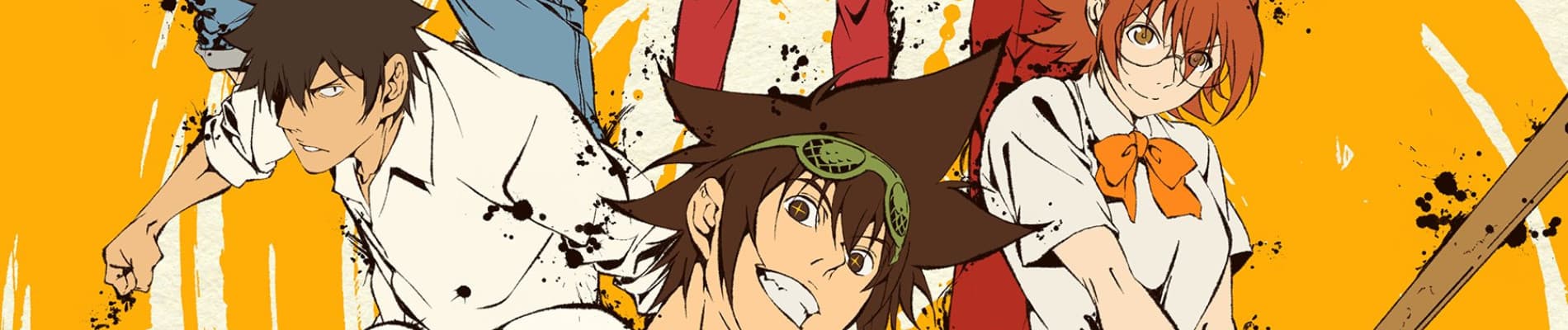
High energy. That’s what propelled God of High School (GoHS) off to the races from the get-go. Everything from the early-2010s dubstep of a bombastic OP to the cast of manic martial-artists were engineered to deliver fist-pumping fun. Oh, and the action was spectacular too. For some audiences, such hype was all that they could ever ask for in a show. But for others, the train goes by oh-so-fast with far too little room to breathe. One has to ask if the ride was worth all that much to begin with. Mild spoilers ahead regarding the premise of GoHS, so feel free to skip ahead to my Tl;Dr if you’d prefer to go in blind.
Fighters from all over the country stake their lives in the ring, all for the prestigious title of "God of High School." Not that it’s actually affiliated with a school or anything, I’m not sure what academic institution would sign off on having minors battle in a no-holds barred cage fight. And these fights really don’t hold back; competitors are pushed beyond their human limits thanks to nanobots that act as augmented “hitpoints,” repairing the body mid-combat and ensuring that brawls leave fans on the edge of their seats. This was essentially an underground fighting ring getting the widespan attention of a major sports championship. Sounds looney as all hell – and I was all for it.
The first episode strode with confidence, with a pilot putting ass-kicking adrenaline action on full display. Lesser studios would kill to pull off this level of sakuga just once in a season; MAPPA staged those setpieces every odd week. A lot of those scenes weren’t all style and no substance either; creative visual storytelling choices, expressive key frames, and even motion-capture techniques were incorporated to deliver scenes that got audiences hyped and talking. Sure, there were definitely concessions made in giving backgrounds or in-between frames the same degree of attention, and secondary characters were written like those of the fighter video game campaigns GoHS took inspiration from – one-note, deranged, and ready to jump into battle faster than you can say “Fatality.” But hey, I like awesome animation as much as the next weeb. I won’t complain if the show asks me to turn my brain off and revel in the chaos. Unfortunately, as engaging as the action was, that’s not exactly what the show’s going for.
Maybe I started this off wrong, let me try again.
a scrappy taekwando pro eager to prove his strength and reunite with his long-lost grandfather. He meets a couple of friends in the tournament: Mira, a martial arts student hoping to breathe new life into her antiquated fighting style, and Han, a bare-fist brawler participating to keep his friend alive. Perhaps this Korean WebToon was well-suited to get the traditional anime treatment after all. It’s your classic shounen – the show is literally built around a tournament arc, for Pete’s sake. I’ve been meaning to find a shounen title I could get invested in, and it seems like I could do a lot worse than GoHS. Our main trio were gonna be the underdogs, training hard to be the very best and learning the importance of friendship along the way. We see shades of this in what is probably the series' high-point, Episode 5. Han and Jin's duel was a great blend of character growth and epic action. It's a little more serious than I previously expected, sounds good to me.
Except… that’s not what the show is going for either. An entire tournament arc that could have taken place across the entire cour was rushed out in the span of 5 episodes. How? By having little-to-no meaningful buildup or development take place outside of the fighting. It really is just fight after fight back-to-back. The show throws countless punches, but none of those blows carry weight behind them. There’s no time to show our cast struggle from the very bottom as they work their way to the top. No training montages or hard-earned lessons against tough opponents.
The show also does the core relationship between Jin, Han and Mira no favors. While GoHS preaches the importance of friendship, the close "bond" chosen to represent this ideal boils down to our trio travelling to the stadium and threatening to beat the shit out of each other every 10 minutes. Sure, somewhere in those death threats is an endearing interpretation of this competitiveness, as they urge each other to overcome their hurdles. And I’d be inclined to agree, if these characters could demonstrate their connection in any other way. The writers are rarely capable of showing this “friendship” outside the context of sweaty combat. Every helping hand offered always comes with a caveat that reads: “The only one who beats you in a fight will be me!” Their connection in the anime is two-dimensional and repetitive. It’d be too much of a stretch to deem this relationship as negative or toxic^, that implies some risks taken in portraying our three stooges.
Oh, and all three of them are immediately the best fighters of the preliminary rounds, diffusing most of the tension for a good half of the season. The author threw in a magic power system into the mix, one that only 4 of the "martial arts" preliminary's competitors tapped into. Guess who three of those fighters are. I actually laughed when Mira, having been disarmed, won the fight by slicing the air as a ranged attack, leaving a flesh wound (this happens multiple times in GoHS.)
Wait, this magic system is part of the lore… of course! So that’s the point of the show.
Ok, I think we’re finally getting somewhere. Third time’s the charm?
A world defined by a massive power struggle – a battle of godly proportions. Two factions are deeply rooted in conflict over a mythical Key that possesses power to rival that of deities themselves. These factions tap into a magic system known as “Charyeok” for their uncanny abilities. The God of High School tournament is really a front to handpick Charyeok users and hopefully trigger the awakening of the Key. It sounds overwhelming and way more complicated than what I signed up for, but we’ve seen this storytelling work before. Calling GoHS “the next Evangelion” would be a stretch, but there are parallels between the two. A charismatic leader (Park Mujin) goes up against a shady organization (the cult) in taking control of a mysterious force through taking advantage of mentally unstable teenagers. Heck, it’s even got some complicated worldbuilding of its own. Surely this has to be what GoHS is going for?
Nope, really missed the mark on that one. Normally alongside this large chaos in the background, you’d get a more focused character conflict in the foreground. GoHS does attempt to maintain this balance but fails to derive anything meaningful from its convoluted context. This show is so hell-bent on one-upping itself in its lunacy because it barely gives the audience any reason to care about the characters experiencing these events. What then occurs is a perpetuating cycle where the crazy plot has to compensate for its shallow character interactions by going all-in on its silly ideas, further sidelining the cast and making their appearances on-screen comedically asinine. They didn’t even make this magic system a new hurdle for our already-OP heroes to overcome; each of them master their abilities roughly two episodes after these powers were formally introduced. Jin grows so quickly capable that he can perfectly replicate new combat moves after seeing them performed once. None of this makes sense to me, nor do I have any incentive to care. In Episode 9 Han’s entire arc was to get anxious over the missing Jin, getting ready to leave the stadium in search of him, getting jumped in the bathroom by a crazy competitor who picks a fight, getting kissed by that same lunatic, and forgetting why he was about to leave the stadium in the first place. The main cast’s importance to the story is cut-down to the point where most attempts to give them screen time are plain stupid. I made a comparison with Eva earlier, and that’s a story that knew how to balance its “macro” lore with its “micro” internal conflict. There was a thematic and symbolic interplay between these ideas, making them important in the grand scheme of things. May I ask how introducing “Charyeok,” Jojo Stands/Personas, ancient relics, a stereotypical cult, clones à la The Matrix, the Sharknado villain, a Naruto Nine-Tailed Fox, CGI Buddha & King Kong falling out of the sky, and teddy-bear-laser-guns are important or meaningful in any way?
It simultaneously wants to be a goofy action anime and a more serious show. It wants to tell you how powerful friendship can be without putting in the legwork to making that relationship look remotely convincing. It tries to be this overstuffed blockbuster while falling comically short of having its disparate elements say anything. This whole review I’ve asked what the point of GoHS is, and the only answer I’m satisfied with is that it’s a glorified commercial. A soulless adaptation speedrunning through the highlights of its source material. This series feels about as haphazardly paced as the live-action anime remakes we as a community have come to detest. Both give off the impression that they’re checking off corporate boxes, well-aware that none of what you’re seeing makes any semblance of sense unless you read the manhwa. This approach to storytelling means that even the few strong moments in the series are tainted by the suspicion that what you’re watching is just another “item on the list.” These are quite heated accusations to lob at the show, but all signs point to this mismanagement of story. Why else would this single-cour attempt to adapt more chapters (roughly 100) than most 23-episode seasons, when just the first arc alone could have been enough for viewers to get invested for the long-term?
What a mess.
God of High School is an action-packed extravaganza. If you’re willing to invest your time under those grounds alone, go for it; but don’t expect the show to do anything else. GoHS got the “live-action anime remake” treatment; with its horrible pacing, laughable drama and two-dimensional characters. As much as GoHS puts in admirable effort into making its fight scenes some of the best you’ll witness all-year, the team behind the project can’t quite erase the fact that it has “READ THE MANHWA” written all over it in bright bold letters. There is reason to believe that this was a corporate cash-grab, but with an abysmal second half the show fails at being a commercial too. Because having sat through this painfully stupid experience, I’m now even less likely to give the WebToon a read. 2/10~
-- ^Actually, I take that back. Han actually DOES beat the shit out of Mira in Ep 4, leaving her heavily injured and unconscious. While this story choice does lead to the only good arc in the show, I find it uncomfortable how quickly the three swept this under the rug and moved on. No one in the group ever acknowledges the fact that one of them almost murdered another. I guess whatever happens in the ring, stays in the ring? Yikes.
-- The BIGBANG segment is the Korean knockoff of Big Shot from Cowboy Bebop.
-- I’ve heard a lot of people saying that GoHS was pulling a “Tower of God,” and I don’t think that comparison is fair. Whilst ToG could be pretty hard to follow, it handled its worldbuilding far better than GoHS ever did. Having seen both WebToon adaptations so far fall below expectations is something to worry about though, so here’s hoping Crunchyroll keeps its act together for Noblesse.
“How you do drama or how you create tension… it’s very different in anime versus manga… so how do we make it so that people won’t get confused when they get into it? And how do we not lose certain aspects of the story that really mattered?”
--12 episodes in and I don’t think either of us have the answer.
-- BEST GIRL: Maybe Seungah. A lot of the secondary characters felt like clones really, but she seemed pretty wholesome.
-- That’s it from me! This review was admittedly more harsh than others I’ve shared so far. But I hope that, unlike the show, the points came across clearly. If you happen to like my verbose rants, feel free to check out my other reviews for seasons past and present, peace~
170 out of 188 users liked this review