"Humankind cannot gain anything without first giving something in return. To obtain, something of equal value must be lost. “
~Alphonse Elric(FMA/FMAB)
What makes us alive? What makes us human? Is it our consciousness that allows us to reason from many different standpoints? Or is there something even more abstract and intangible, like the soul? We can all agree that emotions are vital in what makes us feel human and alive, and no matter how much we resent a feeling, we would never want to be empty and devoid of emotions. Our soul/conscience is very important in that manner, and either of these is driven by desire. So in a way, we can say that to desire, is to be human; more so if the desire is irrational and unattainable. Even ascetics who are renowned to be desireless, are in eternal servitude to their desire of being desireless. All our actions are motivated by desire even if most of them go unfulfilled or change shape as we journey towards our end. And wishes come with a price; be it may necessary actions or latency. But sometimes even they won’t be enough due to the laws of the universe and the absurdness of the desire . Though what if we lived in a world where even those wishes were granted? What if wishes in general were all sold to people for an irrevocable price? What form of payment would such a wish demand? Implication of a spoiler
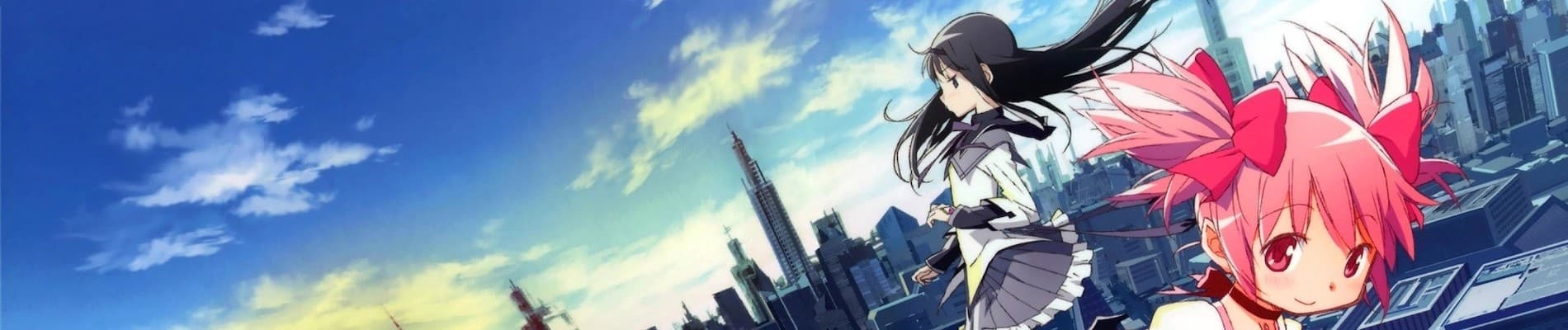
Madoka Magica, in a word, is deceptive. It keeps everything simple and elegant through contradictory elements.The plot is dark and gloomy, yet thrives with the ‘pretty’ animation with the befitting score blending them both.
The plot is very intricately driven forward in a step by step manner,though making us question the characters-especially Madoka, the main character a lot. But in due time, we understand why it is written in that manner, and why the characters acted the way they did. The story begins with Madoka Kaname, dreaming of a fight in a world that appears very distorted from her own. In her school, she finds the same girl, Akemi Homura, joining her class as a transfer student. Homura tells the befuddled Madoka to be content with her happy life and not risk it for anything else. Later that day, Madoka and her friend Sayaka save Kyubey, an entity that looks like a cat, from Homura and immediately find themself trapped in a bizarre setting. They are saved from it by a magical girl(also their senior), Mami Tomoe. Kyubey offers Madoka and Sayaka, each a wish, the scope of which is within the limits of their potential, for which in return they both will be turned into magical girls, who need to risk their lives fighting witches(unisex) which distort reality and cause suffering. Mami reveals that Homura is also a magical girl and advises both Sayaka and Madoka to think carefully of the consequences before making a choice, and tells them both to accompany her while hunts down witches and then make an informed decision. The plot then builds upon Madoka understanding more and more of what it means to be a magical girl, and the necessary sacrifices they need to make for their wish. It should be noted that Madoka Magica does a fairly amazing job with often misinterpreted scientific concepts by being concise and superficial, and crafts Kyubey’s ambition and reasoning for his actions,in a very neat manner. The characters in the story are only a handful, but the archetypes they represent are complex, realistic,diverse and are exceptionally developed..Almost every character introduced has an impactful role to play and make us question our own desires and introspect . Madoka Magica does not have a central villain, but conflict is the emotional turmoil almost every character undergoes, where the goodness in the characters only worsens the situation.
The animation is really unique for a plot as dark, but amazingly fits and creates an enthralling experience. The color palette is diverse and transitions itself quite well to fit the ambiance as the overall art-style becomes more and more grim to suit the seriousness of the story while maintaining the initial pretty look. It is singularly beautiful in the way it depicts the differences in the domains of the witches, with the art similar to that of Picasso’s. I don’t think I need to say anything about the music. It is after all composed by the legendary Yuki Kajiura. The distinct unintelligible vocals she uses and the generally serene poignancy with a hint of innocence in her tracks perfectly fits the theme and animation of Madoka Magica. I, in fact, watched this anime especially for Yuki Kajiura’s soundtracks-curious on how they would shape the anime. Each track is meticulous in crafting the varying ambience, fitting the animation and the plot, and often being the singularity they both require to meet. The Japanese voice actors had also done a pretty seamless job in conveying the necessary depth and personality to the characters in the anime.
Puella Magi Madoka Magica, is overall wholesome, and breaks stereotypes and other standards set by anime of the same genre.This very anime is exemplification to those who don’t give anime a chance, under the notion that it's childish without knowing the dark thematic conflicts it could contains. All the elements in the anime seem to blend in yet seem to also compete with each other to be the most prominently seen.The erratic turns in the plot that contrast the animation, right from the beginning is very appealing to the mind and should be experienced.
~~~~~~
23 out of 27 users liked this review