Vinland Saga
a review by Joe
a review by Joe
_
I've had a deep interest in history for as long as I can remember and in this regard, a year ago I launched myself in search of historical seinen that had a plot, a graphic style or at least an element of novelty that could somehow catch my attention. When I approached the first volume of Vinland Saga I wasn't quite sure what I was about to read, but the sublime drawings, the setting, the characters and the spectacular battles had already captured me. And let's face it, a manga about Vikings has a certain appeal regardless of everything. In this sense, I was pleasantly surprised by Vinland Saga, a manga written and drawn by Makoto Yukimura, former author of the popular and acclaimed Planetes, as well as unique of its kind in terms of setting.
The story begins in the midst of a siege: in northern France, an army of Nordic warriors is preparing to support a local squire in the conquest of an apparently impregnable stronghold. The enterprise is completed thanks to an unexpected stratagem and the precious contribution of Thorfinn, our lethal protagonist. The young fighter seems to have an unfinished business with the leader of his gang, the cold and calculating Askeladd, so much so that he insistently asks him to challenge him to a duel: however, much to Thorfinn's frustration, it is always his superior who wins. A child robbed of his innocence with only vengeance left in his heart, and a man that embodies what any Viking would want in a leader: persuasive, charismatic, clever and calculating. Thorfinn is willing to partake in anything Askeladd asks him to do, if it means getting closer to his head, he’ll do it. But much to Thorfinns unbeknown, he’s just a pawn in the greater game that Aksleadd is playing.
In a sad moment of reflection, the boy plunges into memories and a brief yet majestic flashback illustrates his past, revealing the dark reasons behind the ferocious thirst for revenge against Askeladd. At this point the manga begins to take off. Quickly returning to the present, we observe the various characters presented so far, but Yukimura does not give us a breather and always introduces new and fascinating ones: the gigantic and deadly Thorkell and the taciturn Prince Canute, just to name one pair. The author shows an innate ability to outline credible, expressive and never out of place characters with extreme naturalness. A dense network of intrigues, merciless battles, deceptions and surprising twists leads us, with a fast pace, to the textbook climax of the eighth volume. The subsequent developments of the plot, whose narrative quality does not diminish one iota, lay the foundations for a wider story yet to be discovered.
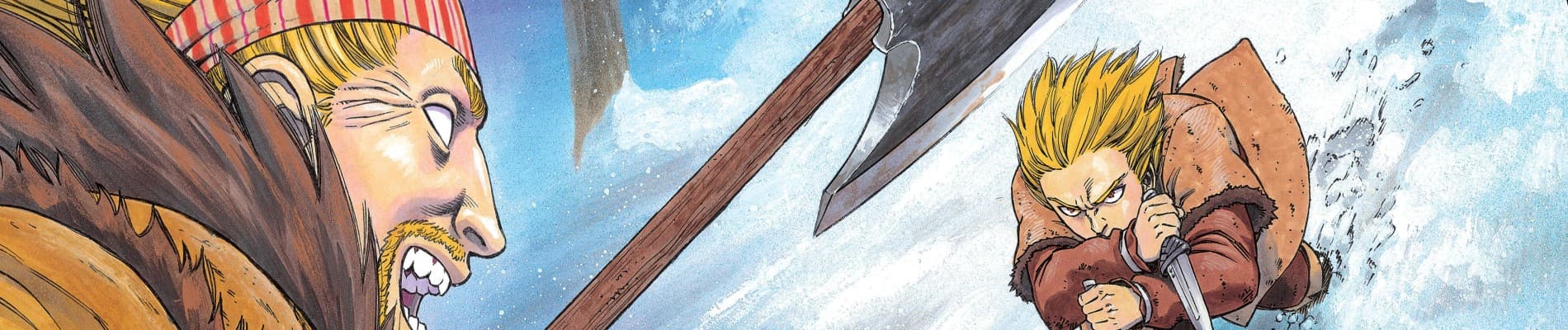
Speaking of art style, Vinland Saga is really well done, the drawings are realistic and very detailed, but at the same time evocative and dynamic when needed. The scenes of the great battles will strike for the number of warriors who clash and their theatrical, but after all quite realistic, brutality and the clashes between Thorfinn and the other Vikings, always impeccably directed and always reasoned and exciting. The most reflective, evocative or even dreamlike moments will impress with their aesthetic beauty, solemnity, grotesque and sometimes even the simplicity with which they are sometimes represented on paper.
Even writing wise, the manga is not far behind. The amount of relevant characters for the plot and for the protagonist is truly remarkable, above all because they are all psychologically characterised in a different way, each with their own goals, their own character and their own evolution, which is often also accompanied by a change in their physical aspect.
At first, this statement comes in as quite unusual and contrary to what most people’s conception of a warrior is; a brute, gruesome and fearless fighter who is not afraid of anyone and anything. So how is it that the warrior that we know of is someone who doesn’t fight?
After being sold as a slave to Ketil's farm, It is here, that after a few years Thorfinns spiritual conversion takes place which leads him to deny his violent past as a killer in search of revenge by embracing a philosophy of absolute non-violence, setting himself as a new goal: the utopian creation of a place on Earth where war and slavery are not tolerated. Yukimura's work is above all a great criticism to violence and, at the same time, its glorification, albeit not trivial or blind, of peace and love for the next, for other human beings. Viking culture is completely based on war and therefore on the warrior, on the military, just think that in the Norse religion the equivalent of the Christian paradise, Valhalla, is accessible only by those who die in war in a glorious way or by those who have proven themselves as a valiant warrior.
Giving this work a setting linked to this culture to convey a message of peace and love was a brilliant choice, and the medium through which this message reaches us is mainly Thorfinn. After years spent in the midst of the horrors of war, becoming in fact one of them, blinded by hatred for Askeladd, when the latter dies not by his hand, Thorfinn will find himself a slave and without a purpose in life, forced to face the his conscience after all the mistakes he made. The memory of his father dying for him, in order not to kill the men who were attacking him, and of his teaching on the meaning of being a true warrior, added to the devastating remorse and guilt that emerges from his subconscious.
This is how he resumes his life, setting himself as a new goal the creation of a sort of earthly paradise without war and without slavery, its direct consequence, in the conviction that no human being has enemies, so as to atone for his sins. Objective that he decides to achieve without violence in the most absolute way. As Thors would say in fact, a true warrior does not need a sword to achieve his goals, because the true warrior is the one who finds strength and determination in his principles and not in weapons. All this, however, while he is surrounded by people who live by killing others, just as he once did, believing that in this way they will go to Valhalla or even more simply because they have fun doing it. It is therefore clear how difficult it can be for Thorfinn to pursue his goal while remaining faithful to his ideals and Yukimura, makes this difficulty really evident and increasingly heavy chapter after chapter, putting Thorfinn to the test, physically and mentally, on the other hand it is not even assuming that non-violence is always the right way.
This is the tale of Vinland Saga, an epic blood drenched narrative that plunges you into a world of gruesome bloodshed and battle-hungry warriors. But also, a tale of love, compassion, revenge and most importantly, redemption. Vinland Saga is one of those manga that aims to leave something deep in the reader, an important message and concrete emotions, not just entertainment. A wonderful example of how Japanese comics, however mainstream, can be a complete artistic product worthy of the name. So much so that there is still a lot to say, the themes to be examined are many and each main character deserves an in-depth study in itself, but after all, the work is still incomplete and you never know what might come out of Yukimura.
80 out of 82 users liked this review
