__May contain spoilers;
Feel free to agree or disagree with what is written.__
Enjoy your reading.
Houseki no Kuni, or Land of Lustrous is a fantasy seinen produced by Orange studio, being adapted from the manga of the same name, illustrated and written by Haruko Ichikawa. The anime has only 12 episodes and was released in October 2017, being the surprise of the fall season.
There are 28 jewels (at the time the story begins), each with their own duties and responsibilities. The jewels care about each other, creating a brotherly feeling, additionally some have stronger bonds with others.
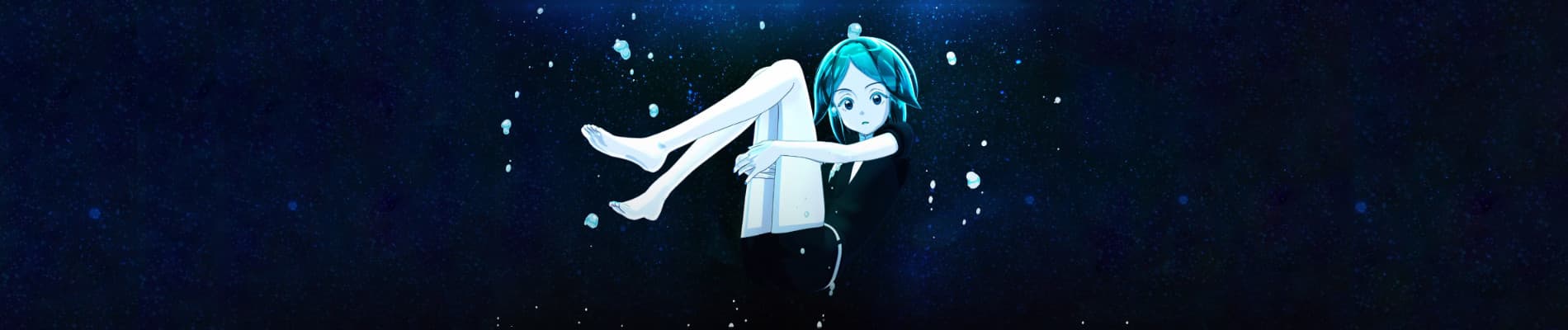
Phos: Have a hardness of 3.5. They are immature, lazy, and short-tempered, and is sometimes considered useless by them companions. They want to fight, but is not skilled, so they are assigned the mission of making an encyclopedia, but is not interested. Phos begins to bond with Cinnabar and later with Antarc. Phos' development during the course of the story is remarkable, so much so that the Phos at the end of the anime is totally different from the Phos at the beginning.
Cinnabar: Possesses hardness 2. Due to the poisonous silver liquid (mercury) they release, killing everything around it, Shinsha lives reclusively and away from the other jewels. For this reason they make the night guard, feeling lonely. Despite your low hardness, they are mature and smart, unlike Phos.
Antarc (Antarcticite): Of hardness 3. Responsible for winter chores, due to its rare condition of recrystallizing at low temperature. Since during the winter the other gems go into hibernation, Antarc does your tasks alone, which doesn't bother Antarc. They form a duo with Phos, but don't take the idea well. Antarc have an important role in the story, since they influence (indirectly) the evolution of the protagonist.
Dia/Diamond and Bort: Both with hardness 10. They are the diamonds that do the work of patrolling and are considered the strongest. Although they are a duo, they are complete opposites. Dia is cheerful, friendly and "kawaii", while Bort is harsh, crabby and serious. Dia always thinks are a burden to Bort, yet they care for each other.
Kongo sensei: Calm and serene. He is the father figure to the jewels, always wanting the best for them, and giving lectures when necessary. This one is a real mystery, it is not known what he is or where he came from, and he hides secrets.
Houseki no Kuni is rich in philosophical and religious themes (not that this is exclusive or unique to this anime), but they are present in a subtle way, besides not being necessary to be understood to have a good use of the story, they are only one more factor, but if they are understood the experience becomes more interesting. Comprehending the anime universe is a bit of work, because little is said, and when it is said, it sounds fragmented, because each character tells his version or just a piece during the course of the story. The three parts that come from humanity even have a certain logical basis. The flesh is the only part subject to death. In our body it is the part that decomposes. The bones, represented in the anime by jewels, which are minerals, just like the bones of the human being that are formed mainly by crystals of Hydroxyapatite, a mineral constituent, and other elements (inorganic part). Like jewelry, bones do not decompose, unlike flesh. The spirit represented by the Lunarians, is considered eternal. As religion and some philosophers say, it is the immaterial part of the human being.
The anime also tries to reproduce some properties of real jewelry, such as the Mohs Scale (goes from 1 to 10, talc and diamond respectively) to create a "strength level". Cinnabar which uses mercury (Hg) as a weapon, reflects that from cinnabar Hg is extracted, or can be released by the mineral under certain natural conditions, and is a toxic element to beings. Alexandrite changes its coloration according to light, being green in natural light and red in incandescent light. Alex changes the color of your hair (green to red) when sees a Lunarian. The Amethyst twins, depict the twinning of a crystal, which is the rational intergrowth of 2 or more crystals. The names 84 and 33 refer to the angle (84°33") of connection between the crystals.
Beyond these inferences, Houseki can be summarized in a single word, change, which echoes throughout the story. Phos is a clear analogy to the paradox of Theseus' ship, used in psychoanalysis in studies about identity. The paradox posits that if an object (in this case Theseus' ship) has all its parts replaced, is it still the same object? Because it is a paradox, there is no correct answer. Phos is constantly losing parts (and its memories), and being replaced by other inclusions, so much so that it changes itself externally, and also internally.
_Phos: "Living things change at such a rapid pace, don't they? Scary."
Sensei: "You too"_
Although jewels are living and thinking, they are not subject to natural laws. They do not age, they do not feed, they do not reproduce and they do not die. The dialogue becomes more concise when we notice that even the oldest jewels have not changed, at least not significantly. Along with the change of Phos, the seed of doubt begins to germinate, and questioning arises, such a phenomenon is inherent in human thought. In philosophy, doubt is synthesized by 3 steps, estrangement, questioning and search for the answer. The 3 are used by Phos in the walk of the anime.
Phos: "I just...I want to know the truth"
This truth can be interpreted by aletheia. Heidegger uses the term to define the attempt to understand the truth, he attributes to it meaning of unveiling (taking away the veil or that which hides something or something). From this moment on Phos seems to go against the current, being able to change the established state of things.
Padparadscha: "Pure, unbridled truth can change things in ways never before imagined".
The change that the protagonist experiences is portrayed symbolically. At one point in the anime, Phos are inside a box, at which point it is implied that the character does not believe in yourself, that they are not capable, and that they are afraid. However, during a certain event, the character changes your conception, then the box opens and takes the form of a Lotus Flower. The flower has many meanings, but I think the most fitting one for the situation is rebirth. Phos after leaving the box abandons your old self and "reborn" as a different individual. There are other symbolic inferences in what surrounds the protagonist. Phos loses parts of your body, being replaced by inclusions, which are nacre (a substance found in shells) and later by gold alloy. These materials make reference to the Seven Treasures of the Buddha, being gold (suvarna) and shell (musāragalva). As far as the Lunarians are concerned, these look like bodhisattvas. Beings who are moving toward enlightenment or who are on the path to liberation, but have not yet attained it, being subject to worldly things. Additionally, they and Kongo sensei share a strong Buddhist influence.
Although Houseki has significant depth, it is not 100% serious. There are many hilarious moments that are provided by the characters, especially Phos, however as the episodes go by events take on a more serious air, possibly not pleasing to everyone. The little bit of world biulding or world exploration can bring a sense of emptiness. The anime also makes it difficult to understand the universe that has been established. The little bit of world biulding or world exploration can bring a sense of emptiness. The anime also has lack of information to explain some issues. Houseki comes to an end when the plot begins to take on a fascinating aspect.
52.5 out of 55 users liked this review