Rent-a-Girlfriend
a review by TGK94
a review by TGK94
“How big is your love?
How much would it be worth if I had to buy it?
And if I have lost the option, please tell me...
How much does an illusion cost?”
—Héctor Lavoe, "¿De Qué Tamaño Es Tu Amor?" (Translated from Spanish)
This is an in-depth review of Kanojo, Okarimashu (abbreviated as Kanokari from here on out). If you have not seen the show, I would recommend watching it first before reading; there are only light spoilers here, but you will likely be somewhat confused if you are not already familiar with the story and characters. Otherwise, enjoy!
#Introduction
Kanokari is… not hard to understand. If you’re a horny teenager, or, like me, you still share some of the sensibilities of horny teenagers, it should be obvious where the show succeeds. Any of Crunchyroll’s assorted clips from the anime easily capture its straightforward charm. There are cute girls, exciting romantic (and sometimes salacious!) hijinks, and attractive visuals. What's not to like?
Of course, if you’re a smug anime-nerd, or, like me, you can’t help but entertain a little bit of that cynicism sometimes, then it should also be obvious where the show falls short. There is a laundry list of easy criticisms, including the deeply hokey premise about a smartphone app for renting girlfriends, the plot built on complicated misunderstandings, and the scenarios which hit many of the same beats that harem and rom-com anime have been hitting for years or even decades at this point. Moreover, its main character, Kazuya Kinoshita, is a profoundly unlikeable little shit—so much so that he has risen up as a sort of anti-christ of awful anime protagonists. Read any review of this show, and by the end of the first paragraph, you can count on seeing some witty turn of phrase disparaging Kazuya and his role in the show.
Let me make myself clear immediately: I think that this cynical view of Kanokari is mostly agreeable, particularly in its criticisms of the main character. But regardless of these failings, I did ultimately find that this show managed to compel me more than I expected. So, in this review, I aim to put forth a rather... half-hearted defense of the show. I will examine where Kanokari succeeds and fails as a harem-lite anime, using Kazuya as a sort of throughline, emphasizing the ways that his peculiar writing as a protagonist reverberates out to affect other elements of the show.

#Kazuya the Destroyer
Kazuya Kinoshita is a 20-year-old college student with a tumultuous romantic history. He’s a little socially awkward and he likes to masturbate. At the risk of sounding rude to this show’s audience, I think it’s fair to say that on a basic level, Kazuya is not a terrible attempt at a relatable protagonist. Most of the audience for harem-lite anime, myself included, are going to be a bit socially uncomfortable, romantically inexperienced, and yes, probably enjoyers of a good wank from time to time. Here’s the rub, though: Kanokari's mangaka, Reiji Miyajima (remember this name—I'll be mentioning him a lot), exaggerates Kazuya’s straightforward characteristics to the point of unpleasantness. Imagine the painful blubbering awkwardness of To LOVE-Ru’s Yuuki Rito combined with the intense horniness of School Days’ Makoto Ito. Now sprinkle in an additional unhealthy habit of stalking women and a genuine addiction to masturbation and you have Kazuya. It’s not hard, I think, to see why this character has proven so divisive.
In fairness to Miyajima, it’s a reasonable impulse when writing a rom-com anime like this to exaggerate some of the characters. After all, they bring the story to life and keep it cartoonishly enjoyable in all the right ways. The problem is, in Kanokari, everything is exaggerated. The scenarios are exaggerated. The supporting cast is exaggerated. The main character is exaggerated. Viewers are whipped from one extreme situation full of extreme characters to the next, and all the while their only lens into this madness is the most extreme character of all: Kazuya himself. Of course, a story doesn’t need a viewer-analog protagonist to succeed, but it does need something grounded. Let’s take an example. Death Note has an extreme protagonist who does things viewers would (I hope) never dream of doing, and it’s full of absurd scenarios that are far removed from reality. Crucially, however, it has a supporting cast of characters who react rationally to the events of the story. Whatever mad plan Light Yagami is concocting, viewers can count on his father and the police to react like normal human beings. This need for some kind of “ground” is a seemingly simple element of storytelling, but one which is endlessly important. Now, Kanokari is a very different kind of story from Death Note. Since it is a rom-com with harem elements, absurd scenarios and a supporting cast of love-crazed girls are expected and, indeed, welcome. But it needed at least one major grounded character to prevent the narrative from drifting into looney rom-com la-la land. In fairness, as I will describe later, the main heroine Chizuru does her best to fill the role of “grounded character,” but for much of the show, her best is simply not good enough. This is the crux of the issue, and indeed, the crux of almost every issue with this show: Kazuya is too extreme for the show to handle effectively.
Kazuya’s problems extend beyond the simple fact that he’s extreme though. Part of the issue is the bizarre and sometimes outright offensive way that he is extreme. Perhaps the worst offense in this regard is his love of masturbation. I'll get straight to the point here: I’ve seen many, many raunchy anime in my day, but none (outside of hentai, at least) have contained as many overt references to masturbation as this show. At first blush, I’m actually not terribly against this decision. I’m no prude, and I have to admit that I have been annoyed in the past by hardcore ecchi shows that are willing to show episode after episode of unabashedly lewd escapades but for some reason draw the line at acknowledging that masturbation exists. If anything, there’s a kind of refreshing honesty in seeing Kazuya’s trash can full of jizz tissues. I have to admire the audacity of the show doing away with tired shorthands like the bloody nose and instead willingly proclaiming that he goes cruising for an oozing every time he thinks of a hot girl. …That being said, after further consideration, I think I mostly lean towards the anti-masturbation side in this debate.

One issue is that Kanokari is not well-equipped to pull off the kind of serious character development that seems appropriate with this territory. There’s a particularly infamous scene from episode 5 which best illustrates this problem. Having recently returned from the beach, Kazuya whips out his phone and decides to choke the chicken to some new swimsuit photos of Mami, his ex-girlfriend. This is—let’s be honest—already a pretty weird thing to do, but it immediately gets exponentially weirder. We see that Kazuya keeps getting distracted by thoughts of Chizuru, his new rental girlfriend, and has to keep chanting Mami’s name to keep his lewd fantasies about her at the forefront in his mind. At the end of this scene, we learn—and I deeply regret to inform you of this, but alas, it is the truth—that this is the moment where Kazuya realizes that he loves Chizuru. Not while talking to her. Not while sharing an intimate moment with her during a summer festival. Not even while holding her hand. While masturbating to a different girl.
Once again, I’m not a prude. I’m not bothered by the fact that Kazuya masturbates, but I don’t think I’m unjustified in saying that this particular scene is a tad heavy compared to the lightweight romantic silliness that makes up most of this show. We don’t need a full Evangelion-esque descent into a depressive episode, but surely we deserve at least a little exploration of some shame or introspection upon Kazuya’s part. Instead, we get nothing. In the next scene, Kazuya is back to normal and the only takeaway is that he likes Chizuru now. No self-reflection whatsoever. It’s obvious why this is the case: the narrative is written as though he’s a viewer-insert protagonist and therefore requires no meaningful development over the course of the series. After all, the show’s bread and butter is zany escapades and wish-fulfillment scenarios. Where does thoughtful character writing fit into all that? There’s nothing inherently wrong with this setup, of course. Shows like Nisekoi and To LOVE-Ru are perfectly successful without more than a scene or two dedicated to protagonist character development… but they also have the wisdom not to feature scenes where their protagonists masturbate to beach photos of their ex-girlfriend. Simply put, if Miyajima wanted to write a scene like that, he should have been willing to grapple with the consequences.
The masturbation focus also causes trouble when it comes to Kanokari’s ecchi content. There are panty shots here and there, two beach episodes, and a hot springs episode, but I would be hard-pressed to call Kanokari a particularly hardcore ecchi show—that is, except for the masturbation scenes. To be clear, there’s no right or wrong amount of ecchi for a harem anime to have. It is irritating, however, when a show fails to effectively create expectations in this area. Well-implemented ecchi is all about setting expectations. If the viewer expects fanservice and doesn’t get it, they’ll be disappointed. On the other hand, if they don’t expect fanservice and they do get it, they’ll be shocked and put-off. This is the real issue with the masturbation scenes: they lead the viewer to expect that this show will be a full-on no-holds-barred mega-raunch-fest, when in fact, it’s usually only mildly horny at most. If you showed me the video for Kanokari’s ending theme (an admittedly hilarious thinly-veiled visual metaphor for masturbation) and then asked me how much ecchi content I thought the show had, the answer would certainly be at least an order of magnitude more than the show does have. I think the reality here is that Kazuya was probably written this way because Miyajima couldn’t conceive of a better way of expressing the right level of horniness without Kazuya coming off as an unlikeable pervert. The disappointing result is that the show ended up skewed heavily towards ecchi in a few brief instances and away from it in nearly all others, creating an annoyingly unbalanced experience. And to make matters worse, Kazuya does come off as an unlikeable pervert anyway, so the whole enterprise was a failure. This is an understandable writing mistake to make, but unfortunately, it isn’t Miyajima’s last blunder in this regard.
For another blunder, look no further than Kazuya’s bizarre habit of stalking women. Most of Kazuya’s characteristics are simply normal behaviors exaggerated to an unpleasant extreme, but this one seems very strange on the face of it. Why would Miyajima, who is presumably trying to make a relatable main character, write him as a stalker? It’s not hard to see why this has ended up as one of the most controversial elements of this show. It comes off as insulting to the audience, but more than that, it just doesn’t make very much sense. As with the masturbation addiction, this strikes me as a bit of misguided writing. Kazuya needs to see what other characters are doing to progress the plot, so he follows them around. This would be fine, except that it ends up severely clashing with the goal of Kazuya’s invisibility as a protagonist. The viewer can’t see themselves in a man who follows women around without their consent and then acts surprised when they are offended. Again, there’s no rule that a good protagonist has to be relatable, but in a series so clearly built on viewer wish-fulfillment scenarios, it’s bizarre to see a protagonist with so much unexplained emotional baggage.
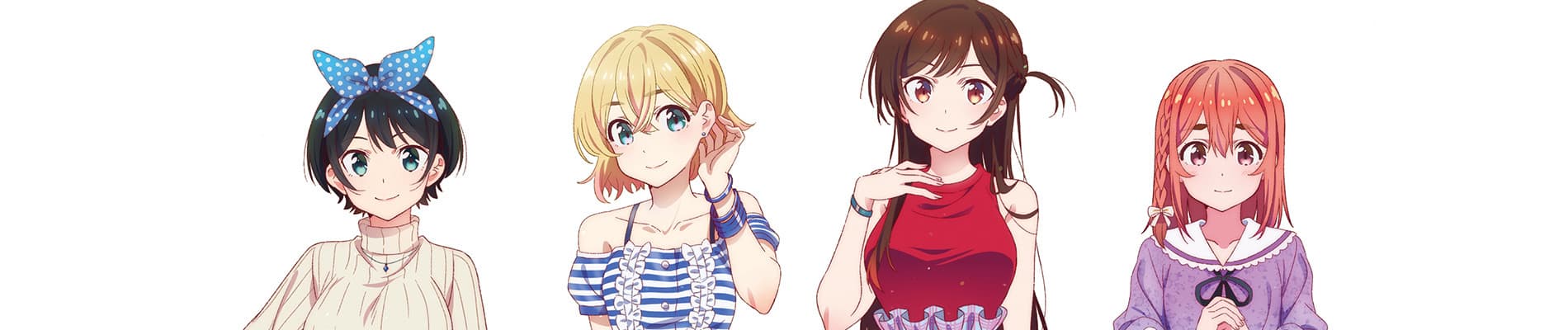
What I want to avoid here is moral judgment. A lot of reviews of this show will focus on why Kazuya is a loser or why he is a creep. You’re free to think those things, of course, (I certainly do!) but they are not my main concern here. Kazuya is not a bad character because he is a loser, or even because he masturbates to beach photos of his ex. He’s a failure as a protagonist because he’s in the wrong story altogether. Kazuya is simply too heavy of a protagonist for a story that has its hands tied with trying to create a wish-fulfillment fantasy about hiring girlfriends. To be clear, the point is not that rom-com stories cannot do serious character development. Look no further than Toradora! or Oregairu for shows that pull together thoughtfully written characters and romantic comedy. The point is that this specific approach to the rom-com, built (as I will describe later) on contrivances, lighthearted hijinks, and viewer-insert scenarios, is ill-equipped to pull off a character like Kazuya. In fact, I think it’s no coincidence that Kazuya doesn’t appear on the cover art for this show. He clearly wasn’t intended to play as large a role in the viewing experience as he ultimately does.
If there is a story for Kazuya out there, it is a story about him, about why he is the way he is. To put it bluntly, he doesn’t belong in a story about hiring a girlfriend at all; he belongs in a story about hiring a therapist. In the former story, he is irritatingly awkward and out of place, but in the latter, he could get all his psychosexual baggage unpacked like he so obviously deserves. Maybe this Rent-a-Therapist would be a great story. We will never know. Instead, we have the far clumsier Rent-a-Girlfriend.

#Narrative Contrivances and Why They Work
For a so-called “defense” of this show, this review has been resoundingly negative so far. Mostly this is because Kazuya is by far Kanokari’s largest problem, and most of the show’s other failings relate back to him in one way or another. Thankfully, now that we’re done discussing him I can move on to the parts of the show which I think are more successful, beginning with the plot. Now, if there is an area beyond its protagonist where Kanokari has been most routinely lambasted online, it is certainly its plot—specifically its reliance on contrivances. Let me begin, then, with my most difficult argument to swallow: in my view, these sorts of plotting gimmicks are a necessary, or at least reasonable, concession to get the protagonist to feel appropriately minor.
This probably sounds like hogwash, so allow me to explain. First, we must remember that a protagonist will be defined most strongly in the viewer’s eyes by the choices they make. Other attributes—appearance, mannerisms, etc.—are important, of course, but as that famous Harry Potter quote goes, “it is our choices…that show what we truly are, far more than our abilities.” Second, we have to consider that Kanokari is a harem story. As such, one of its main goals—and I mean this without judgment—is to give the viewer vicarious enjoyment by seeing the protagonist engage in fun escapades with attractive girls. How can Miyajima most successfully achieve this goal? Simple: make Kazuya alike to the viewer, or more specifically, make his choices correspond closely with what the viewer thinks they would do in his place. The fundamental question, then, is this: how can Miyajima make Kazuya’s choices most similar to the viewer’s?
There is an obvious answer and a not so obvious answer to this question. The obvious answer is quite boring: have the protagonist make simple choices with answers so clear that the viewer can’t help but agree. This is barely a solution at all. Simple choices do not make for particularly compelling storytelling, especially in the world of anime rom-coms, where crazy antics reign supreme. A better solution, then, is to tip the scales as far as possible in the other direction. Make the protagonist’s situation so absurd, so complex, so far removed from reality that viewers cannot reasonably discern what choices they would make. An example from the show: what would you do if, while on a family trip, your girlfriend, who forced herself into a relationship with you for reasons you do not fully understand, threatens to tell your family that a different girl they think is your girlfriend is actually a hired professional who you’ve been lying about for nearly a year? There’s no clear-cut answer, which makes Kazuya’s decision (lying, as he often does) much more palatable than it would be in a grounded situation.
Moreover, while Kanokari builds its plot on contrivances, it builds it towards the sort of absurd peaks that can make a harem show like this so entertaining. Broadly speaking, the appeal of this genre is not in a realistic and normal romantic progression between two well-adjusted people. That’s boring. Viewers are here for something sillier and less grounded. All these plotting gimmicks actually help in this regard, by lending the story a sense of immediacy. Thanks to the gimmicky storytelling, Kazuya is already in a sort of off-kilter relationship with Chizuru by the end of the first episode, and already getting into all kinds of wacky romantic shenanigans not long thereafter. I can see why it’s attractive to criticize this show for its contrived nature, but to me, the contrivances are worthwhile in service of the ultimate goal of getting the story to its delightfully preposterous heights as quickly as possible.
Not every contrivance is a success for the show though. The premise, in particular, is hokey in a bad way. Superficially, it has some merit. “A smartphone app for hiring a girlfriend” is a satisfyingly modern take on the rom-com formula, and it does successfully put Kazuya in the presence of an attractive girl in a romantic context very quickly. The problem is, it simply raises far too many unwanted questions. Compensated dating (Japanese: enjo-kōsai) is a real phenomenon in Japan, although it is decidedly less zany than Kanokari makes it out to be. Real-life “rental girlfriends” are typically much younger than their customers and often are also pressured to perform sexual acts. It’s a deeply messed up practice, widely reviled both in and outside of Japan, so it’s very odd indeed that Miyajima chose to write a story which evokes it. Kanokari does sidestep the age gap issue, albeit somewhat inelegantly, by almost never showing rental girlfriends with anyone markedly older than them. Thanks, however, to Kazuya’s unhinged horniness, the sexual issue hovers ominously over the show’s events. How often are rental girlfriends coerced into sex with creeps seeking to abuse the Diamond app? What kinds of measures are in place to prevent this? Maybe most viewers are not asking such questions, but the fact that they spring up so easily from the premise is a bad sign. With a willingness to ignore these questions, the premise becomes quite effective for what it is, but viewers shouldn’t have to ignore the implications of a show’s premise to enjoy it. If anything, thinking deeper about a show’s story should be a more satisfying way to experience it, not a less satisfying one.

The reliance on complicated misunderstandings is another contrivance that often backfires. On the one hand, I’m convinced that many of the viewers who say that they would simply “tell the truth” to resolve the situation underestimate just how difficult it can be to undo such a convoluted web of lies under so much pressure. But on the other, it is fair to say that if so many people see Kazuya’s inability to resolve the misunderstandings as a problem, then it is interfering with his ability to function as a viewer-insert character. In this sense, a great harem protagonist is not necessarily someone who makes the choices the viewer actually would make, so much as they are someone who makes the choices the viewers wish they would make. It’s a small distinction, but an important one which Miyajima would have done well to be wary of.
Taken as a whole, Kanokari’s plot does seem to tend more towards good than bad. It’s easy to criticize the show for its reliance on nonsensical situations, but ultimately such criticisms strike me as lazy. Anime should be taken on their level, judged against their own aspirations and not on some abstract scale. Kanokari is a harem-lite anime and its aspirations are romantic escapades with attractive girls. With this in mind, it seems clear that its preposterousness is not a flaw: not only does it play well into the minor protagonist framework, it also pushes the show towards its ultimate goal of silliness. It may be tempting to be condescending here, but honestly, there is no shame in a show which unapologetically tries to be lightweight fun. The world can always use a little more lightheartedness, especially these days…
That being said, I do think it’s a worthwhile thought experiment to consider the ways that the show might have been more thoughtful without discarding its silly core. The rental girlfriend premise, hokey though it may be, does set up decently for some interesting themes about the difficulty of finding authenticity in a profession that requires emotional labor. If we’re willing to stretch a bit, we might even say that it could serve as a jumping-off point towards social commentary about the gig economy. In fact, to some extent, this stuff is already present. When, for instance, we find out that Chizuru is an aspiring actress, it raises interesting questions about performance. How much of her “girlfriend” persona is acting and how much of it is her genuine personality seeping through? If that performance is the only side of her that some of her customers see, is it not, from their perspective, in some sense real? …I have, in fairness, been known to overthink these things from time to time, but I do think there are noteworthy questions here. I just wish there were more of them to ask. Granted, with too much of a focus on complex themes, Kanokari’s dedication to silliness could have suffered. It is fair to say, however, that there was more to be gained through a slightly more thoughtful approach to storytelling than would be lost. I like Kanokari’s plot for what it is, but there’s no good reason that a lighthearted show about cute girls can’t also make the viewer think from time to time.
#Chizuru the Redeemer (+ The Other Girls)
And what about these cute girls I keep alluding to? If you’re like me, then you probably were drawn to this show because of the four girls’ character designs plastered on all of its promotional material. Let me come right out of the gate and say it: I think this show’s character designs slap. Like, they slap my entire body. With great force. Repeatedly. This metaphor is getting kind of weird now, so I’ll stop, but I think you get the point. Obviously the goal of every harem anime is to have attractive heroines, but Kanokari definitely hit the ball out of the park in this regard. In an effort to stop sounding like more of a creep than I already do, I will spare you the rundown of why I think the girls are attractive. At any rate, you’ve probably already reached your own conclusions about that without my help. Instead, let me go into a bit of detail about their personalities and the ways they succeed and fail in playing off of Kazuya’s extreme personality.

Let’s start at the start, with Chizuru. Chizuru is easily the strongest character Kanokari has to offer, and one of its strongest assets outright. Her positive qualities are quite numerous: she has great emotional maturity; her position as a rental girlfriend raises interesting questions about her authenticity; she has a disarmingly straightforward demeanor which makes her deeply refreshing in a show full of misunderstandings; her voice is provided by Sora Amamiya of Aqua from Konosuba fame; ...and the list goes on. Most importantly, her maturity and straightforward demeanor make her one of the only elements of the show that is well-equipped to play off of Kazuya’s character. Where Kazuya is immature, Chizuru acts like a self-assured adult. Where Kazuya is prone to compulsive lying, Chizuru is forthright with her thoughts. Granted, she lacks real romantic chemistry with Kazuya, but I think that’s something the show can safely build up to with later seasons. Part of the fun, after all, of a good long-running rom-com, is seeing characters grow to care about one another over time. As things stand, she’s an essentially perfect heroine for this show. In fact, I would wager that a great deal of Kanokari’s popularity hinges purely on the fact that Chizuru is introduced early and featured often. She’s truly great.
There are other successful characters too. Mami lacks Chizuru’s immediate likability, but nonetheless stands out as a great addition to the cast. She’s manipulative and conniving in a way that is rare for a rom-com heroine. Combine her with Kazuya’s oblivious personality, and you have a recipe for some delightfully one-sided character interactions. Several of this show’s most entertaining episodes revolve around Mami toying with Kazuya’s emotions and adding an element of chaos to the already preposterous plot. It is true, perhaps, that she doesn’t fit in the harem framework of fulfilling fantasies about “girls that you, the viewer, want to date” (I assume that most viewers don’t fantasize about having an emotionally manipulative girlfriend. Then again, I’ve been horny for weirder things. What do I know.), but she does inject worthwhile drama into the narrative, so it seems short-sighted to complain about her inclusion.
Our third girl, Ruka, is largely on the same level as Chizuru and Mami, but as I will discuss further on, she has one key issue which makes her ultimately less successful than them. Her backstory is contrived as all hell: she falls for Kazuya because she suffers from a heart condition, and only he can make her heart beat fast enough to help (yes, seriously). As already mentioned, though, I’m loath to complain about contrivances when they build towards appropriately absurd shenanigans, as they do here. Moreover, I have to give credit for how shockingly well the anime handles this backstory. It’s introduced during a montage which serves as the ending theme for episode seven, and this montage is downright fantastic. In particular, it makes great use of color, incorporating a subdued blue and black color palette (mirroring the bow that Ruka wears) which turns to full color at the end as Ruka realizes her love for Kazuya.
Backstory aside, her role is standard harem stuff. She spends most of the story trying to get Kazuya to come clean about his fake relationship with Chizuru so that he can get with her instead. For the most part, it’s an effective setup, mostly because she is pushier and more combative than the other girls, which makes her ideal for placing some much-needed pressure on the protagonist to stop spinning this web of lies. But here’s her one major problem: the protagonist is Kazuya. It’s one thing for a random attractive girl to fall in love with a viewer-insert protagonist; it is another thing entirely for her to fall in love with Kazuya. For one thing, Kazuya is not relatable in the slightest, so the viewer is robbed of whatever satisfaction they might have gained from imagining that they were in his position. For another, Kazuya is Kazuya, a man who needs to deal with several deep-seated psychological issues before any woman would ever think of willingly coming near him. This is, in other words, another case of Kazuya’s status as an extreme protagonist clashing with Miyajima’s clear attempts at writing an enjoyable wish-fulfillment story.
Our last girl, Sumi, is a bit of an oddball. Conceptually, she falls close to any number of comically shy anime girls you have probably encountered before. This is a character type that I’m very fond of, and combined with this staggeringly cute character design, she should have been an easy winner. Should is the operative word here, because while Sumi is adorable in the few scenes she appears in, she doesn’t arrive until very late in the game and therefore fails to make much of an impression. We are told that she uses her job as a rental girlfriend as a way of overcoming her intense social anxiety, and, less believably, we are told that Kazuya helps her to achieve this goal by going on a date with her. Like many aspects of this show before it, “protagonist helps shy girl to overcome her shyness by dating her” is a more than decent harem anime setup, but it is weakened somewhat on the basis that Kazuya is the protagonist in question. With a less extreme protagonist, the viewer might imagine that they could help a shy girl with her shyness, even if, in their heart of hearts, they knew that this probably wasn’t true. It would make for a pretty fantasy. On the other hand, I neither want to believe nor do believe that Kazuya is capable of such an act. Yet another promising idea made all the worse because of Kazuya’s poorly-thought-out involvement.

#Sound and Vision
Now that I’ve returned to complaining about Kazuya, you may rightfully be wondering why I finished this show at all, let alone, why I have set out to defend it. Beyond the mild defenses I have given to this show’s plot and heroines, the main thrust of my reasoning here is surprisingly simple: the production is fantastic. Kanokari, for all of its story flaws, never fails to present that story in a compelling fashion. Director Kazuomi Koga has spoken in interviews about how the production process for this show was unusually relaxed, which, in an industry notorious for tight deadlines and terrible working conditions, is immediately a great sign. So far as I can tell, Koga doesn’t have any noteworthy directing credentials, and, indeed, the animation here does nothing particularly visually inventive, but it also doesn’t really have reason to. Where it counts, Kanokari looks great, rising far above the standard for most anime rom-coms. Visually, most scenes are varied without being chaotic, filled with closeups (see below), gag shots (see the Chizuru screenshot above), humorous floating text (see the Sumi screenshot above), comically exaggerated expressions, and other simple tricks to constantly keep things interesting. Moreover, thanks to a combination of deliberately fuzzy backgrounds and the already mentioned excellent character designs, characters look vivid and are enjoyable to watch even when the show does nothing at all to embellish the visuals. Most rom-com anime are lucky to look this nice for the occasional scene, let alone for an entire show.
Visuals are not the whole production, though; sound also plays a key role, and once again, Kanokari hits this out of the park… er, mostly, anyway. But more on that in a little bit. The soundtrack is deeply adequate, and I don’t mean that in an insulting way. It sets the mood appropriately and is never grating nor out of place. Would I go out of my way to listen to it? No. But that’s true of 99.9% of anime soundtracks, so it’s not a big misstep. The opening and ending themes, on the other hand, I have gone out of my way to listen to many times. In the two or three intervening days between when I finished this show and when I started writing this review, there was barely an hour where one of these two incredibly catchy songs didn’t somehow worm their way into my head. Full disclosure: I am a bit of an opening fiend (I never skip openings and have never met an opening I didn’t like), so take my opinions here with a grain or two of salt.

I already briefly touched on the ending, 『Kokukahu Bungee Jumping』 by halca, earlier, but to make myself clear: I love it. Despite being somewhat misleading in terms of the actual show’s ecchi content, the obvious innuendo of the girls cheering on Kazuya while he shakes a can in an… all too familiar motion certainly got a good laugh out of me. It’s rare for an ending theme to make much of an impression, so the fact that Kanokari is able to craft something so memorable with such limited animation is thoroughly impressive, even if it is only memorable for how openly puerile it is. Meanwhile, the opening, 『Centimeter』 by the peggies, is great for more conventional reasons. From the beginning, it bursts to life with guitar and escalating vocals, before reaching the now-famous selfie/dance section during the instrumental break around fifteen seconds in. It’s a simple concept—show each of the four heroines performing a brief dance in the vein of what one might see on TikTok—but it is remarkably effective. Chizuru’s dance is choreographed and confident, Mami’s is cool and collected, Ruka’s is earnest but slightly clumsy, and Sumi’s is obviously stilted with embarrassment. In seven seconds, the opening informs us about the characters while simultaneously tying into the story’s modern/social media slant and syncing perfectly with the music. It’s the kind of immediately compelling moment that other openings wish they had, and it’s especially surprising coming from a show which otherwise tends to struggle to set itself apart from the pack. The rest of the opening is less memorable. Most of it consists of shots of Kazuya trying and failing to reach Chizuru while other characters make token appearances along the way. Still, combined with Kanokari’s great animation and art direction, along, of course, with the absolute banger by the peggies that plays under all of it, the relatively standard parts of the opening nonetheless manage to feel satisfying to watch.
If there is one area where Kanokari’s sound can be said to fall short, it is, predictably, with Kazuya’s voice acting. It’s hard to be angry at voice actor Shun Horie, who surely did as well as he could with the script, but as I’ve been over a hundred times by now, the script does Kazuya no favors. So much of the series is spent with Kazuya stressed from woman-induced anxiety, misunderstanding-induced anxiety, social anxiety, or just general anxiety that Horie rarely gets to use most of his vocal range. Instead, he often has to mumble a few words, pause anxiously, and continue. “We agreed… [awkward pause]… on a trial period… [awkward pause]…, but now… [awkward pause]… I want to make it… [extra long awkward pause]… official,” says Kazuya in episode twelve, taking what might have been a nice monologue and turning it into a series of constipated grunts. To reiterate: Horie renders these grunts brilliantly. He is truly one of the best constipated-grunt-makers in the industry. But, maybe, just maybe, it would be nice if he could spend more time speaking like a normal human being. Maybe. All the other VAs perform their roles admirably and also have much better material to work with, so once again Kazuya mars an otherwise excellent element of the show’s production.
#Conclusion
When all is said and done, Kanokari is not a great show, or even a particularly good one. It is mediocre and in the most frustrating way possible. Some mediocre shows are a little bit subpar in most areas and not particularly good at anything. It’s hard to be angry at these shows because they never do anything worthwhile anyway. Kanokari, on the other hand, is downright great in a few key areas (production, character designs, opening) and good in quite a few other areas. Nonetheless, it is critically bad in one area—so bad that this badness ends up reverberating out through everything the show does. It didn’t have to be this way. Tone down Kazuya’s horniness and social ineptitude, remove his habit of stalking women, and you have a good harem-lite series on your hand. So much potential is thrown down the drain because of one fixable writing misstep.
Even so...
I would be lying if I said that I didn’t like the show anyway. The fact of the matter is, Kanokari has a simple appeal—the same appeal as many harem and rom-com anime before it: zany romantic hijinks. Despite Kazuya’s best efforts to ruin the rest of the show, I don’t think even he can seriously damage the silly joy at the core of the production. After all, at the end of the day, a great deal of this silly joy comes not from the script, but from the seemingly secondary elements of the show: the animation, the art direction, the character designs, the music, and the voice acting. The elements, in other words, which this show nails. I think there is a tendency among anime fans to hyper-fixate on a show’s narrative and characters and ignore every other aspect of a production. It’s not hard to see why this is the case: these elements are the easiest to discuss and the most immediately obvious to new viewers of the medium. As I grow older, though, I begin to wonder if these elements are as all-important as they’ve been made out to be. In a media landscape dominated by formulaic storytelling and characters, sometimes a nice sheet of paint is all a show needs to feel worthwhile.
I think it will help if I make a comparison. 5-Toubun no Hanayome (I don't know if an official abbreviation exists for this title, so I’m going with 5-Toubun) is an anime from last year which shares much in common with Kanokari. 5-Toubun tells the story of Futaro Uesugi, a normal high school boy who ends up tutoring a family of five cute girls his age, while, predictably, wacky romantic situations occur left and right. Like Kanokari, 5-Toubun is not a great show, or even a particularly good one. It suffers, however, from decidedly different problems. Futaro is an ideal harem protagonist: slightly awkward, clearly romantically interested in the girls without coming off as a creep, and willing to stand up for himself without appearing combative. On a production level, though, the show looks painfully mediocre. It has sparse backgrounds, bland aesthetics, and animation which could charitably be called “uninspired”. I think the temptation here is to say that “actually it’s what’s on the inside that counts; a good script with a mediocre adaptation is clearly better than a lacking script with a beautiful adaptation.” I want to believe this, but deep inside I really don’t. In the world of harem anime, aesthetics reign supreme. Kanokari may be a worse premise led by a far worse protagonist, yet if you asked me for a rom-com anime recommendation, I’d likely pick it over 5-Toubun. Perhaps, breaking it down rationally, 5-Toubun has more going for it than Kanokari. But in terms of what I want to watch, what I think other people want to watch, I’m not sure that matters.
People aren’t always rational consumers of media. Sometimes we want to watch a middling wish-fulfillment story with a hokey premise and an unlikeable protagonist just because it has nice animation and cute girls. We might even like it anyway. I certainly did.
Thanks for reading! Here's a bonus existential-angst Kazuya for making it to the end:

103.5 out of 110 users liked this review
