Bakemonogatari
a review by magnifico
a review by magnifico
This review contains minor spoilers.
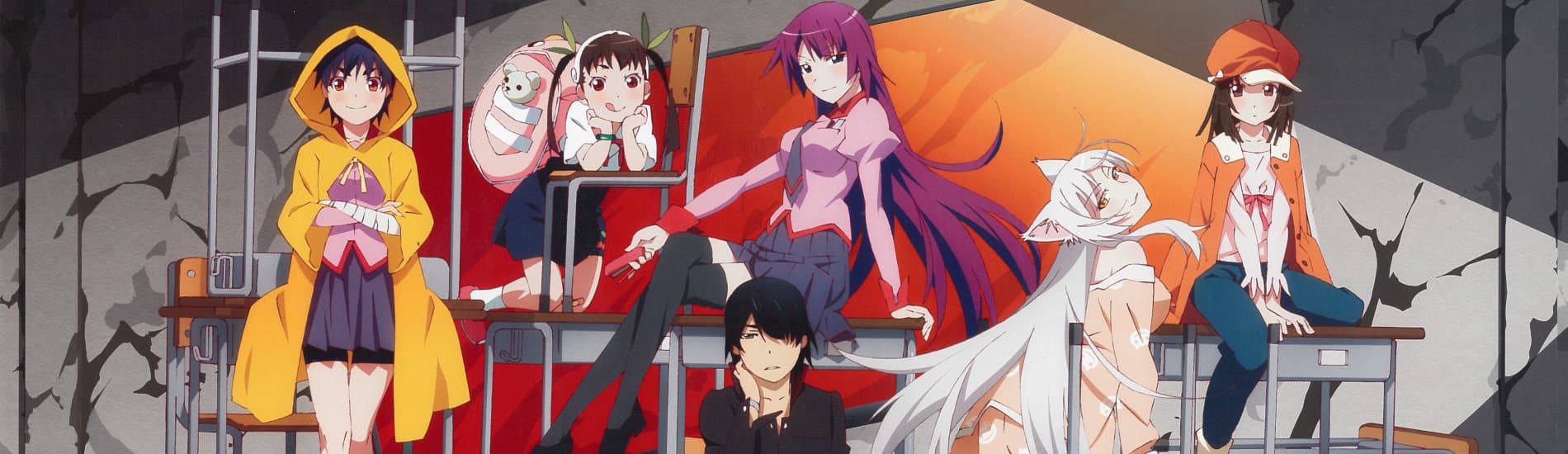
It is impossible to disregard Bakemonogataris legacy in the Anime Industry. A renowed success with, today, many other titles in its franchise, the series is the byproduct of an innovative communication method that became a phenomenon in the industry. Identified by its use of super-stylization, Bakemonogatari is fresh to the eye, artistically inspired, and terribly innovative.
As an adaptation, the show serves its purpose in an almost-perfect manner. However, the tireless use of its own tricks and knacks brings about multiple issues in pacing, scene impact and screentime use. Shine apart, Bakemonogatari does NOT work as a singular title. Without assuming its relationship with prequels and sequels, Bakemonogatari is incomplete, drowning in its own presuppositions, completely based on the suspension of disbelief, incredibly chaotic and tenebrously implausible.
Bakemonogatari is not an anime for new adepts. The incessant use of scene cuts, thrown writings, wordplay, puns, satire and comic relief (many that only make sense in otaku and/or Japanese culture) makes the show essentially exclusive – its own content only able to be totally understood/appreciated by a small parcel of people – which are refined and confident in many cultural pre-concepts. The franchise is limited not only in streaming availability, but also in streaming quality. Bakemonogatari is every translator’s nightmare, fansub or not, that owns the rights to capture the vast non-verbal language in a legitimate form.
Watching Bakemonogatari subtitled was, more times than I`d like to admit, a distressing experience. Although the show looks slow-paced – surrounded by extended dialogues, enlarged in contextual episodes and linearly-ordered – its pacing is, in fact, too fast, too chaotic and huddled with compact information that is not always relevant. While the false feeling of calm is established in its many long and intelligent scenes, the spectator is bombarded with states of thought, occult reactions, visual-play, environment panoramas, incredibly surreal minutia and elucidation flashes that almost force your hand to pause.
The super-stylization, that was meant to capitalize the important scenes in the plot, capturing the viewers attention, fulfills exactly the contrary – it diverges attention to the visual minutias at the expense of the effectively important information for the development of the story. The untimely fan-service, that is unforgivably used and abused in Bakemonogatari, also lets go of the seriousness of many impact scenes in question. Almost always inopportune and out of purpose, the fan-service warps the notion of "impact scene" as it retracts the plot focus to the exaggerated sexualization of its female characters – which the show ironically declares as minors.
The "innovative visual communication" doesn't serve what its own name suggests – a communication medium – but as its OWN message and its OWN content. It enters in abnormal discord with the plot pieces – mainly if the viewer doesn`t have any previous notion of Japanese animation stereotypes, and is watching the content subtitled.
With miserable 15 episodes, Bakemonogatari doesn`t make good use of screentime to develop the fanciful universe it implies. At the contrary, the series uses a semi-episodic structure to introduce many characters and small, individual conflicts – that our protagonist Araragi owns the responsibility to resolve. Bakemonogatari merely cites the past facts that, while completely relevant to the overarching plot, are totally disregarded during the resolution of these small conflicts in question.
Bakemonogatari's universe, without this kind of conceptual basement, turns implausible. The society around the protagonists, completely unexplored in the series, seem to disregard any supernatural evidence, being as empty as a ghost town. Even if the story is clearly located in an urban center, Bakemonogatari's visual solutions couldn't include even one passing pedestrian in the animation budget. The main characters are teenagers that hardly know what they want to become as an adult, but are dragged around these supernatural conflicts without any questioning, becoming completely fearless, ignorant to any risks they may be taking.
While Araragi's bloody corpse extends itself on the asphalt during the beginning of Suruga's conflict, Senjougahara remains irreducibly foreign to the gravity of the situation, and incomprehensibly naive to Araragi's secrets. In a most ignorably irrational manner, Senjougahara puts aside any scene impact when it stands above Araragis body so the protagonist can have a limited moment of happiness looking at his girlfriend's underwear. The succession of facts presented, while clearly creative, are absolutely lacking in plausibility. For the viewer to find entertainment in such moments, it`s necessary to give up to this ignorance that spark in the main characters line-of-thinking – clinging to suspension of disbelief at every moment.
Even while crowded with such inplausible scenes, most of the relationship development between characters is ironically realistic and incredibly entertaining. I dare to say that, if the series didn`t oblige itself to cling to its supernatural aspects, the result would be much more solid, and the story would be much superior.
70.5 out of 121 users liked this review
