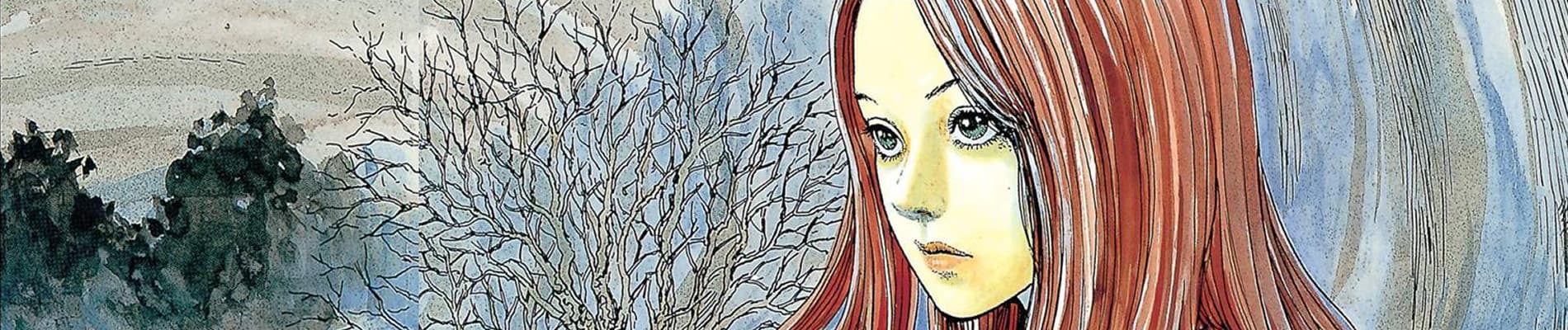
Uzumaki is, conceptually, a masterpiece, and it is evident almost from the very beginning. It outclasses essentially every other comic or manga within the horror genre because Junji Ito thoroughly understands just what the titular Spiral means to him. He demonstrates a total mastery over his central motif in a manner that is often rare even in contemporary literature. The Spiral is not only a literal pattern, but a pattern of behavior, a pattern upon which relationships and stories are structured, and, most notably, a thinking character within the narrative. Its literal usage is fairly obvious, but, importantly, it is consistent. The physical manifestation of the Spiral does not only exist for use in one-off jump scares, but rather, appears on nearly every page, hidden away within a background, curling a blade of grass, swaying the waves of the river, or shifting the very clouds. Sometimes it is subtle, sometimes it is not. However, either way it makes the visuals of the story much more mysterious and, at times, alien, thus creating a more compelling panel-to-panel experience.
Then, there is the more figurative meaning of the spiral, its ability to suck things in. Ito abstracts the simple visual mechanics of a spiral, that it brings the viewer’s gaze towards its center, to create a template for the behaviors and actions of those infected by it. Again, consistency is key to the success of this idea, and again Ito delivers. Characters infested by the spiral can be easily pointed out due to their desire to, in some way or another, suck things in. This often manifests through characters taking great strides to “suck in” the attention of others in increasingly esoteric fashion. Other times, this behavior is much more literal, as with the mosquito mothers of chapters 10 and 11, who only desire to “suck in” the blood of others to feed their unborn children. This brings me to a more minor, but still relevant use of the spiral as a symbol: as a facilitator for bestial analogy. The mothers’ specific case of spiral madness is contracted from the bite of a mosquito (whose probiscuses are spiral in shape) and their behavior is derived from the biological nature of the mosquito (who drink blood to nurture their unborn) which also compounds the abstraction of the Spiral’s visual mechanics. In addition to this, the specific mode of infection (via mosquito bite) also connotes the spiral’s spread with something like a disease, something typically carried by insects and vermin, thus lending credence to the Spiral as a physical phenomenon affecting the town, as well as emphasizing its near unstoppable ability to spread and contaminate. In this single example of spiral infection, Junji Ito manages to pack 3 distinct layers to the Spiral motif: A behavioral abstraction of the spiral (in the mothers’ need to suck in blood for themselves), the literal symbol of the spiral (in the probisci developed by both mosquitos and the mothers), and an expansion of the Spiral as a symbol through its newly formed association with plague and disease.
This is not to mention the separate meanings behind the mushrooms and infants within chapter 11, which represent a detached, yet still relevant, case of spiral infection, with separate behaviors and connotations. There are further specific cases where this same analysis could be applied, and while it is irrelevant to go through each one, what matters is to note that this level of care and detail is channeled into nearly every Spiral infection. Admittedly, Ito can be, at times, rather hamfisted with his presentation of such themes. It is fairly common to see Shuichi directly explain how the spiral is affecting specific individuals both figuratively and literally. However, this is more a result of Junji Ito being a creative mind and artist, as opposed to a traditional author. This becomes especially apparent in Kirie Goshima, who somehow manages to remain oblivious to the dangers of the spiral despite her near constant encounters and warnings with it, she is fundamentally a static character, meant to represent the reader’s bewilderment with the happenings in town. Unfortunately many other characters can also be seen to fall into stasis as the story goes on, occasionally to near comical extent. While these are clear detractors in terms of the writing of the manga, they constitute an area that I find to be of minor importance within the overall context of the narrative. The purpose of Uzumaki is not to provide an in-depth analysis of spiral-related trauma and character drama, but to fully explore how something as simple as a shape would work as an antagonistic force, meant to evoke H.P. Lovecraft’s signature cosmic horror. Overall, it presents a fascinating, abstract conflict with an amount of care and detail that I have yet to see in any of its contemporaries.
There was more I wanted to say about this but you get the idea and I got bored.
23 out of 24 users liked this review