White Album 2
a review by Peng
a review by Peng
WA2 follows the story of Haruki Kitahara in his senior year of high school. Haruki’s a diligent, determined, straight-A student and the class-rep to boot. He’s also a guitarist in his school’s light music club. Issue is all the band members have left. So, in preparation for the upcoming school festival, he recruits the help of the series’ two heroines: Setsuna Ogiso, the kind, demure, resident glamour-girl and Kazuki Touma, the stubborn, anti-social musical prodigy.

Right off the bat, it’s clear that we’re not exactly in unfamiliar territory. We’ve seemingly got all the archetypal characters, from the Gary Stu male MC to the enigmatic tsundere. We’re in high school (complete with the usual seating placement), we’ve got a K-On club and a school cultural festival. And of course, there’s the love triangle.
These are elements ostensibly present in nearly all anime nowadays, and, unsurprisingly, the vast majority of these, as the age-old adage goes, are shit. And when you’re recycling the same, uninspired, overused tropes, cardboard-cut-out-characters and plot devices, it’s to be expected.
So, despite being so incredibly standard, what sets White Album 2 apart from every other harem romance bullshit produced since the inception of everybody’s favourite eroge studio Key back in 1998?
Simple. It does something every romance should do, but inexplicably very few have done.
It has believable characters.
Rather than letting initial appearances define and pigeon-hole the series’ characters into unimaginative, pre-determined roles that only serve to frustrate the viewer with their blatant lack of substance, White Album 2 actively cultivates and develops its characters such that they break the very archetypes initially imposed upon them. Ultimately, the result is perhaps one of the most endearing, sympathetic and nuanced main trio in romance anime history.
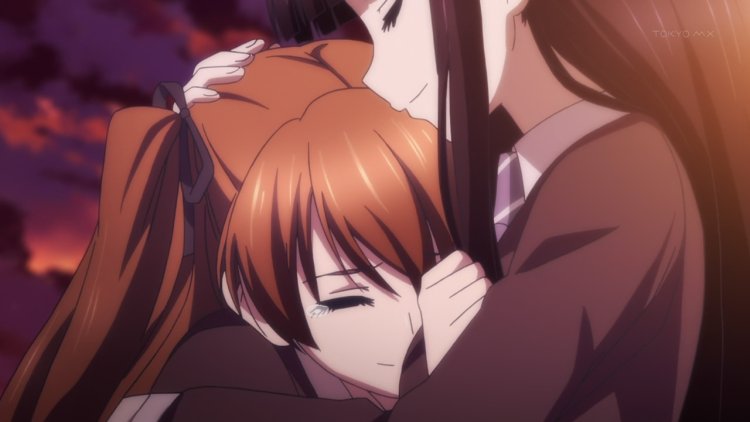
Above all else, they’re surprisingly human.
All of the primary three have their faults, just as they all have admirable qualities. However, instead of being hyperbolised to the point of absurdity, these respective traits are treated with an unprecedented degree of subtlety such that they come off as realistic as opposed to forced. In fact, the more tenured viewer is likely to identify with the struggles and mannerisms of at least one, if not all of the main trio. All three contribute equally to their successes in their own, individual ways, just as all three are equally culpable for their failures due to their unique flaws. You will be frustrated, charmed and saddened by all three. Just as in Nana, the characters in WA2 don’t feel like characters. They feel like people. Real, fleshed-out people, complete with their grounded quirks, foibles, self-contradictions and merits. You won’t necessarily approve of all their actions (in fact, I can guarantee you that you won’t), yet simultaneously, as you struggle to unravel their individual motivations, you will come to realise the justification and reasoning behind said actions. And that’s the thing: whilst no one is overly altruistic or selfless, no one is exactly narcissistic either. They each have a (somewhat admirable) lucidity and self-awareness such that the person they’re most embittered by is themselves.
Make no mistake, these characters are perfectly aware of their hypocrisies and faults, it’s just amending them that’s the issue. They know that some of the dreams (a nicely integrated motif) they pursue are an unrealistic and counter-productive ideal, but then again, it’s only human to dream, and to chase these dreams when they seem so close.
In much the same manner, White Album 2 does not hesitate to portray love as equally as fickle, if not more so, as its characters. The harder our main trio struggle and the more they attempt to manipulate the tides into their favour, the more intertwined and entrapped they become, such that ultimately, the damage is inexorably of the collateral variety. In some aspects, the series is just as focused on lust (and not the good kind) as it is on love. WA2 does not sugarcoat romance, nor does it smother it in ludicrous amounts of soppy melodrama, although some is undeniably present. Rather, it treats the matter as it does its characters: with maturity. Sometimes, love hurts. It’s a slippery slope indeed.

However, as aforementioned, the series – hell, even much of the plot for that matter – is heavily uninspired. It falls into and plays out like any other high school romance, save for some key moments. It’s a shame really, that a series with such well-written characters would voluntarily stifle itself with such bland content. Chances are you’ve seen it all before – just not with this level of craftsmanship. I think that it’s because of this reason that I was never fully emotionally invested in any of the characters; sure, I was sympathetic towards and conflicted by them, but I was never able to ignore the fact that the tribulations they endured were just so generic, and to a very minor extent, somewhat contrived.
The series glosses over some unexplored plot points (what was the deal with Setsuna’s dad, or Touma’s for that matter?) and the numerous secondary characters serve little to no purpose. This was especially irritating with one such character that exhibited a potentially game-changing degree of perceptiveness and intuition, but was forcibly (and quite literally) relegated to the backdrop. Pacing isn’t an issue, although it picks up quite a bit in the final act.
Visually, White Album 2 wasn’t exactly impressive (Satelight isn’t renowned for their animation), but it was by no means unappealing. There were also some clever visual details that foreshadowed later plot points.
The soundtrack, on the other hand, was great. To be fair, you’d hope as much for a series where music plays such an important role, and doubly so for one with a title that I can only assume is a reference to The Beatles album. Most of the OST is mellow and sombre, if a little conventional, which complements the atmosphere perfectly.
Note that only the first (of three) chapters from the visual novel have been adapted at this point. That said, the story in the anime is complete as it is.
Minor plot oversights, shortcuts and an unambitious story prevent White Album 2 from reaching its full potential. However, the anime reaches a stratum of character nuance and realism practically unheard of in the romance genre. This captivating level of character believability alone warrants my fullest recommendation, doubly so if you’re a romance fan. Sometimes, all a show needs is a well written character. Or two. Hell, try three.
20.5 out of 23 users liked this review
