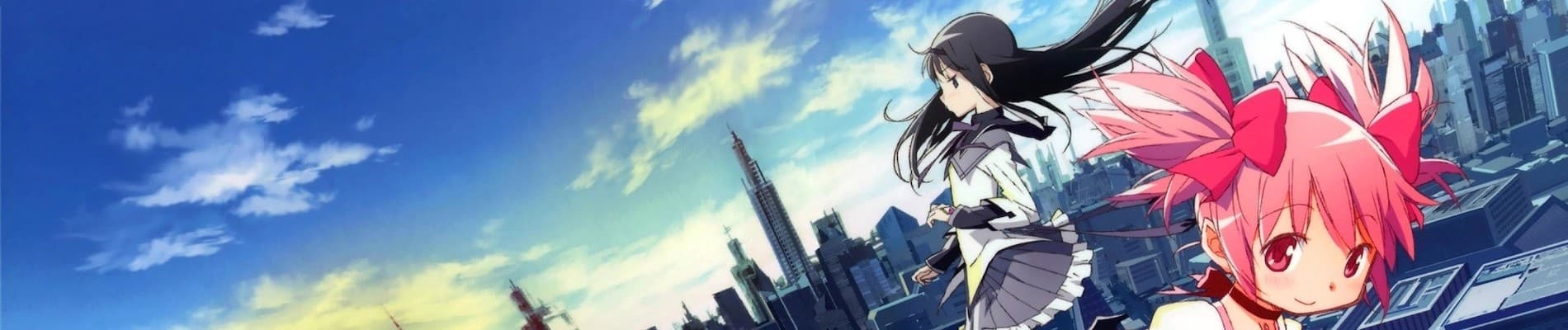

Everyone wants to fix a mistake.
Throughout life they are ever constant. You might’ve messed up on the job and gotten fired for the littlest thing, upset someone close you, lost a chance to make a new friend, got out of a bad argument with someone close to you, failed a test, hoped you would’ve planned your time out better, or faced some sort of intense tragedy.
While it’s unlikely that anyone has experienced all of these problems, it is likely to think “if only I could”. It’s the second chance, the renewed opportunity that could ignite a spark in someone’s mind. People want to have faith life rolls their way, so why not take the chance, if only once, to make something so much better? Today’s topic, Puella Magi Madoka Magica, one of the most popular anime of the last decade, and the anime that personally got me into full time anime watching, takes that upon itself, explore the reach of intense decision making, taking and the caveats of consequence in a form many are all too familiar with, a bright, vibrant and cutesy Magical Girl series. Although the show’s writing tends to go too far in some places and not far enough in others, the endeavor is largely a success.
Spoilers for the entire series in review/analysis:

People love to call this show a “deconstruction” because of the fact that it takes the Magical Girl, something that seemed to be a black and white idea, and flips it on its head by having each girl deal with the consequences and fallback of their wishes, and the ignorance of seeing the world in rainbow colored glasses. In some cases, this excuse is basically used as a way to say that it doesn’t fall into the same trappings as what it is subverting, and while occasionally it does, a lot at the beginning and somewhat at the end, the promises and consequences of the idea are examined.
While many shows of the Magical Girl genre are known for having atmospheres that are lighthearted, inviting or candy coated, Madoka does a very solid job of building suspense for itself (even when one point is quite literally candy coated). Fear is constructed in three ways, fear of the unknown, fear of the uncanny, and fear of the self. Fear of the Unknown comes from the Witch realms the heroines encounter. Scattered throughout their city, they have a variety of different effects, sometimes can be easy opponents but can at other times appear as tricksters. You never know exactly how these encounters will go down. In addition, the uncanniness of these, as well as different art design choices show how off-putting the experiences are for the lead characters. Fear of Self, however, is the most important, I feel.

Madoka is very much revolving around its plot to get characters to provoke reactions at certain times, moreso than some of its older contemporaries like Princess Tutu and Utena, which use character writing a lot more to shape their story. In terms of the plot, the pacing is mostly on point and there’s a certain meticulousness to the overall structure that shows it was very adequately planned. There is barely a whiff of filler, everyone and everything that happens has a point to it. When watching the show, and even more on a possible rewatch, you'll notice a lot of different hints and thematic allusions that may pertain to current plot points, and while a viewer may not think too much of them at first, in the long run, their utilization really pays off for the sake of the narrative. The show toys with a lot of interesting concepts, and generally, I got the feeling that it knew what it was doing, when to properly place its events and why they are concepts originally made elusive to the audience.
What can be less effective is how these are conveyed, what they sacrifice, and what they do for the world at large.
Anyone who watches the show will know that Mami Tomoe, one of the main 5 characters of the series, dies after just 3 episodes of screentime. It is only near the end of that time, right before she perishes, that you gain insight to development/backstory to make her more than what she seems as the big sister mentor archetype. To many, this might feel last minute: those not vulnerable to shock value especially likely won’t feel lost weight. However, it serves the plot greatly. It presents doubt to Madoka through a current scenario and the fact that Sayaka does NOT hear Mami say she was putting up a front assists Sayaka’s arc in ways very much like a play, where she ends up believing in a figure that wasn’t entirely real to begin with. And bringing back Mami in episode 10 reinforces the “front” aspect of Mami’s character even further.
This happens as well with two of the biggest reveals in Sayaka’s arc. The purpose of Soul Gems, feels very much like overly specific setup to get certain notions in place, and the second involves Hitomi, Madoka and Sayaka's unaware friend, having a desire to want to go to the next level with the boy whom Sayaka accepted the consequences of being a Magical Girl to save. The fact that it was brought up at such a critical point in the corruption of Sayaka’s character can seem forced at times. However, the strength of the consequences feels very much Shakespearean in its execution. If one recalls the ending of the original Little Mermaid (not the Disney film), or Cassius’s fate at the end of Julius Caesar, you come a similar idea here with Sayaka, albeit with less time for it to grow.
Near of the end of the series, Kyubey expositions a ton of information regarding his motivations, entropy, and the past. All done at one time. While you could easily argue this as intentionally disorienting, it still feels like a massive dump of information designed almost specifically for overthinking at the outset.

Thankfully, what IS sufficiently explored, as well as the major plot events when looking at Madoka, are given the proper handle. These include: the reaction to Mami’s death, the ever growing uncertainty a wish holds, the characterization and growth of Kyoko Sakura, Sayaka’s corruption, Homura Akemi’s fruitless struggle forcing her to try her damndest to manage emotions, and the meaning of the ending. All of these have satisfyingly emotional payoffs, though I’ll elaborate more on that in the characters section. The writing can sometimes have its problems in a lack of elaboration, some convenient setups or speeding through certain developments, but for most of Madoka’s run, the core ideas of the plot are presented very well.


In regards to characters, although in several cases they feel reactive to the plot rather than proactive, or have the foundation of simple traits inherent in the genre, the best of the bunch still have plenty of growth that stems from their existing character arcs, rather than shock value alone.
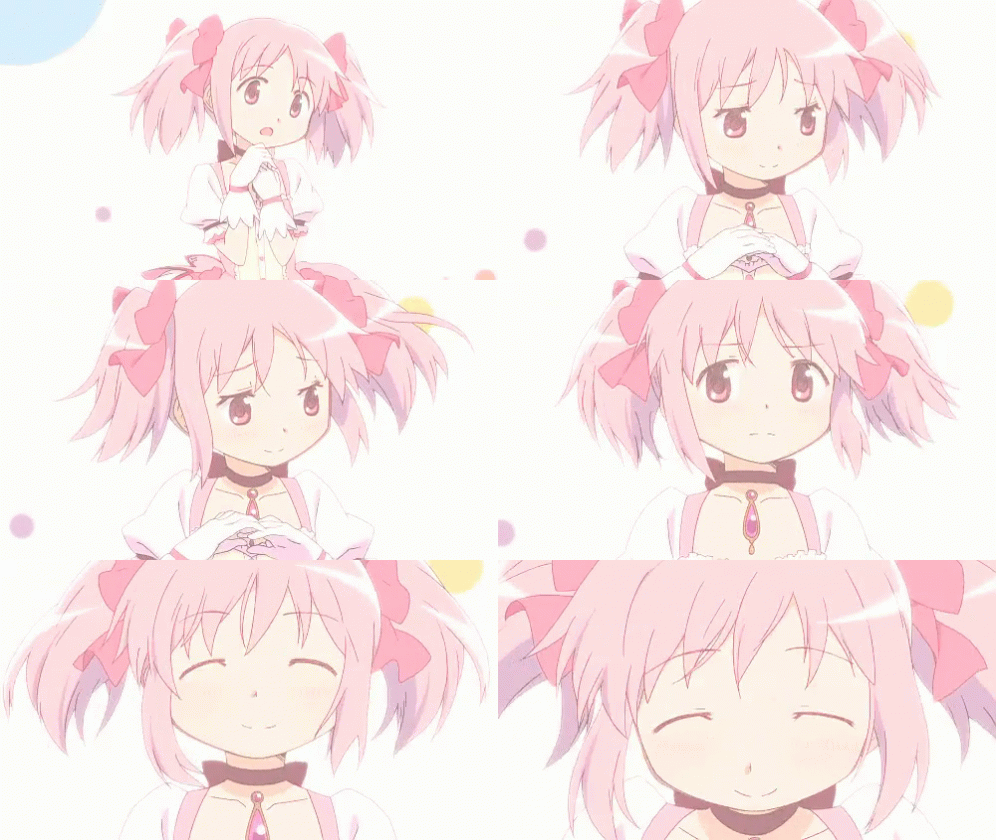
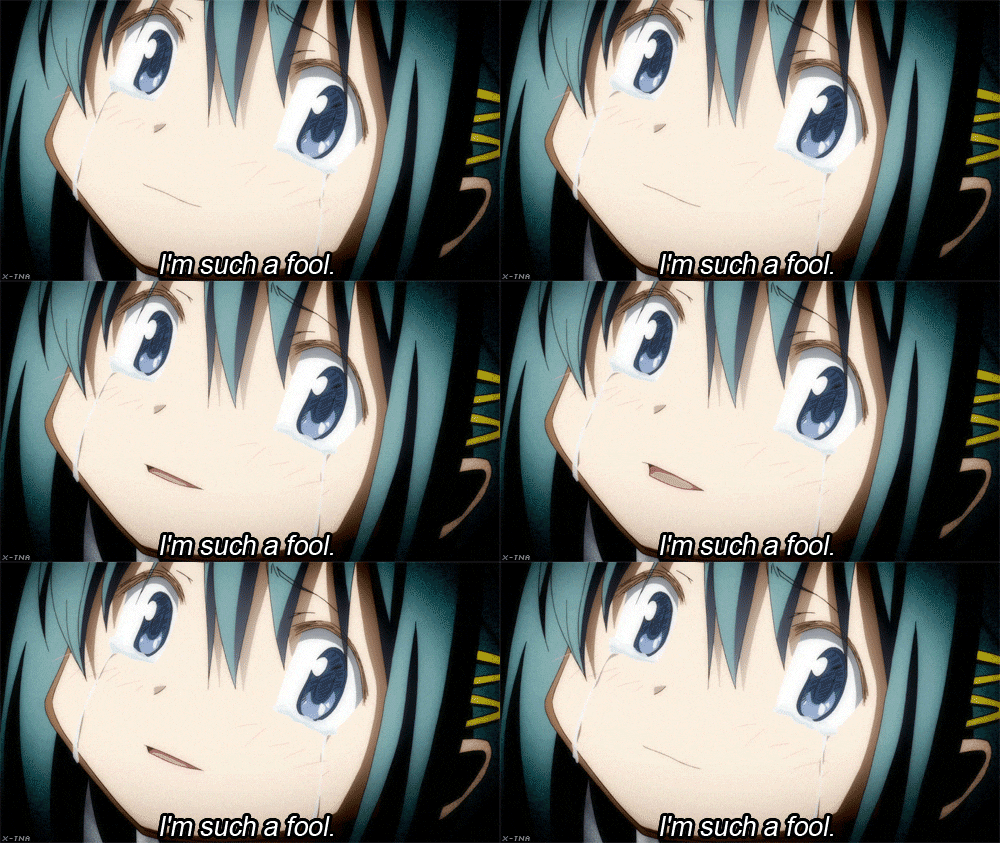
When presented with the opportunity “if only I could fix this critical mistake”, one that haunted her since she was young, she takes it up because of how Mami seems to embody the ease of consequences. As I mentioned in the plot section, it is of critical importance that Mami only revealed her personal weakness to Madoka, because Sayaka goes on believing in a symbol that never was, for a want desperately to be a hero. With so much increasing insecurity, combined with the futility of her current form (being a zombie in a shell), Sayaka finds she can't reconcile her fantasies with reality, as her inspiring motto becomes a dark mantra by the absolute. The drop in mental state can be seen through her battling, starting calming and rhythmic before becoming increasingly reckless, brutal and sickeningly sadistic, greatly conveyed with the stylistic visuals. By the end, this inability to deal with flaws believably breaks her when everything surrounding her ethos collapses in front of her. It’s easy to feel like everything has to go your way, and with all of the circumstances Sayaka’s perfectionism entails, it’s heartbreaking to see what she has to go through and yet, important to learn as well. Determination can be made into a weaknesses, and then, acceptance and acknowledgement makes you stronger than any magic power will ever be, and that, thinking of a future other than her own, lets her die in peace in the end. She gets the bulk of screen time, and thankfully, her transition from a inspired heroine to miserable wreck was presented to enough of a degree to be believable tragedy.

 Thankfully, Kyoko Sakura is much better. Although, like Mami, she also has a moment where she basically tells another character her history, it isn’t used just as a sendoff, buit rather a way to contrast her past scenario with Sayaka. It’s not quite nihilism, but her character helps to show what living a continued life betrayed by care would result in, for her sake and others who wouldn’t take it following in her footsteps. Kyoko sticks around, at first as a pretty fun rival character with a unique chain spear weapon, but then becomes someone who ultimately empathizes with Sayaka’s attempted hope when it became too late, even with her view tinted thanks to some plot revelations. The attachment, and resolution, feels very sweet in the end, yet satisfying in how it coalesces overtime.
A young girl without friends, without purpose, quietly shifting through life until one day when Madoka talks to her. That one interaction, combined with encouragement changes her life. She has friends, a life with purpose, something to look forward to.....until it comes crashing down. A simple thought “if only I could save her”, brings her through time loop after time loop. It seems happy, she gets to be with her friends and becomes capable in the process...but the quest is futile. Every time she tries....failure, failure, failure getting attached to Madoka and friends only to see them die in front of her over and over and over again. The show again shows stubborn determination again sees a weakness and in one loop, she is forced to KILL the friend she loves for her own sake...that shatters it. Don’t let them in, don’t create unnecessary complications, do it for her, hiding all your care. It's not merely an afterthought, but extensively shown without overdoing it.
Her characterization sheds a new light on all other encounters with her before, giving the series a wonderful heft of rewatch bonus. Talking to Kyoko? In hope for Sayaka to avoid her fate. Telling Madoka not to accept the contract? Hope she’s never have to see her closest friend die fighting. Seeing death before? Yes, many times indeed. But even then, she still can’t take it. Her breakdowns in episodes 8 and 11 feel even worse knowing the circumstances. There are some things you just can’t conceal, it all has to come out, realizing futility is the ultimate pain.

Aside from these six characters, everyone else is mostly a glorified prop. Except for Madoka’s mother, who honestly has a really solid moment confronting her daughter on the necessity of consequences with a bit of a push, for the sake of helping someone. It’s a very well handled scene, and how it follows helps Madoka’s growing character. For everything else though, you’re mostly following the aforementioned six, four of which having really solid characterization and the other two really helping to sell the themes of the plot in exchange for limited personality and screen time. That said, it’s no Baccano, but for 12 episodes, having at least 3 different characters have full arcs is definitely impressive.
Ultimately, one of the biggest takeaways from the show’s writing is that Madoka is a dramatic romance of characters. Underneath the symbolism and plot driving actions is stressing interconnected relationships. Why does Mami die? To show Madoka and Sayaka that Magical Girls can die very easily and it's not what they expected. Mami didn't get enough time to really make much of her character, but she played the important role in the girl's character development. The romance of Homura and Madoka is powerful. Homura is literally driving her mind off the deep end, every time she resets the timeline. The love that Kyoko grows for Sayaka is important for Kyoko's character growth. She learns to open herself up to Sayaka, who has become deranged as a result of her own failing relationships with others. And when Sayaka dies and turns into a witch, Kyoko helps Madoka, not because she really cares too much for Madoka, but because she cares about Sayaka. She's fallen in love with her, and now the only person she opened up to is gone. Which is why she allows herself to die along with giving the Witch Sayaka a sweet release from existence as a lich creature.
As the show reaches its conclusion, there exists elements of tragedy to it, but it is ultimately hopeful. Madoka may be gone, but now Homura is carrying the burden of protecting the world, just what Madoka wanted. Continuing the theme of immense consequence, it presents how in spite of making things slightly better with the girls not becoming their own enemies, deathly consequences, satanic deals and the hypnotic allure of these creatures will always exist. The best people can do is try to live life, work through it and carry on both for their sake and the sake of others close to them. In fact, the entire show effectively uses the concept of mistakes quite well through almost every major character. In her personal journey, we see Madoka understand the toils of the present through the fates of those close to her, while having such a responsibility can be a great burden to bear, how death results from the unexpected and the tragedy of not living up to unrealistic expectations. She learns about the past through Kyubey; in understanding how this cycle, as a flawed system, continued for so long overtime, earnest desires to fix things destroying them. Finally, the future, through how Homura’s efforts literally break apart in front of her, the fact that fate seems continuous, and the fact that there’s nothing at the end of the rainbow the way events are transpiring. All of this kept Madoka’s mind in flux, what makes up the best decision she can think of for the sake of all time, even if it has its own consequences, the ease of mistakes would cause less suffering. And that is what Madoka leaves us with............an appreciation, knowing that in a world full of awful, horrible events that hope is possible even under constant strain. That, is what causes Kyubey to put up some questioning regarding the worth of humanity even under such stressful odds. With Madoka, Urobuchi has used elements of fear, tragedy and powerfully struggling romance to craft this intriguing tale off of one simple conceit.
Conclusion
A bit of background here. This was actually the anime that got me into full time anime watching. Yes, THIS anime. I’d vaguely heard of stuff like DBZ and Naruto but knew they were too long to actually start. It was around a time when I was obsessed with essentially “fractured innocence” storylines, and based on what I’d heard, this show had a lot to hide behind it’s cute and cuddly exterior. Thankfully, in watching the series, it really paid off, enough to see the great potential of anime and invest into hundreds of titles over the years.
To say the series was enjoyable and involving would be an understatement. Despite problems when it came to pacing, worldbuilding, and some contrived setups here or there, I really felt I got to know each girl (except Mami) well enough before their demises. Homura's arc was especially well handled and intertwined with Madoka's arc rather well, Sayaka's arc was an interesting tragic hero arc with an understandable sense of emotional progression and the problem coming from her character flaws of not seeing the harsh truth of her situation, and Kyoko and what becomes of her still makes me cringe (in a bittersweet way). Kyubey, while I hate him, was an effective villain in how purely logical he was, the concept building of how magical girls work was creative, and overall, while it was a deconstruction of magical girl stories at first, it became its own thing for other people to appreciate.
Puella Magi Madoka Magica is not a perfect show, not by any means, and while one could make the argument that being emotionally blinded could cause me to forget about supposed “bigger” problems, I feel like the towering heights the series reached shine bright enough to understate the occasional unsteadiness of its building blocks. With evocative atmosphere, strong character writing when it counted, an interesting take on the idea of understanding past mistakes with heavy consequences, dazzling visuals, an incredible score and a great takeaway message, the show, by itself, stands its ground years later as a beloved popular anime of the past decade.