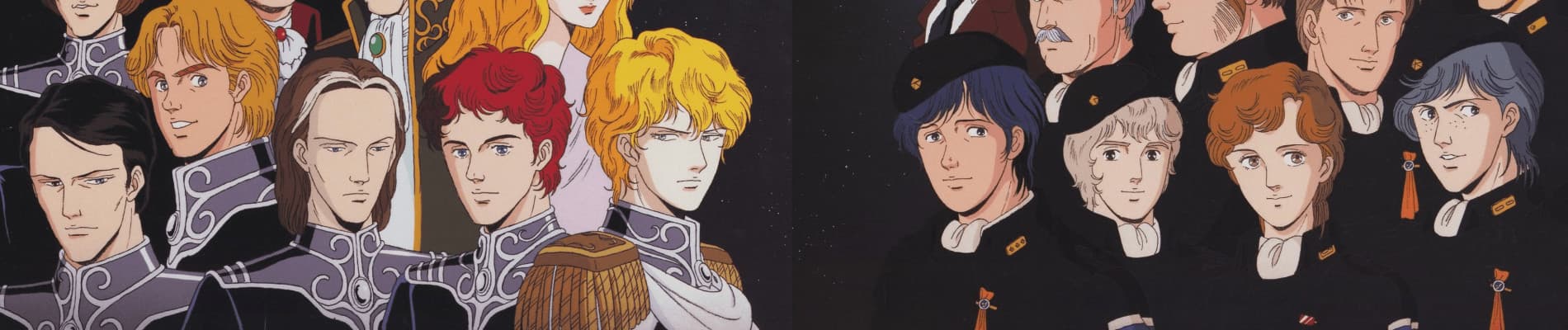

If you’ve been watching anime for a while, chances are you’ve heard of Legend of the Galactic Heroes. Chances are you’ve heard some pretty good things about it too. The 110 episode OVA series is perhaps one of the most lauded in the industry and has garnered a hefty, dedicated, cult following. So, does the series live up to its reputation? In many ways: yes. And yet, it's far from perfect. Simply put, Legend of the Galactic Heroes could and probably should have been deserving of that coveted title as the medium’s crème de la crop. Despite this, it was not without its flaws. And, few as they may have been, they have a lingering presence on the viewing experience such that they simply cannot be ignored. It’s unfortunate, really, that such an astounding, grand and finely handled show is tainted, however so slightly, by unsavoury elements that really should have been avoided.


▶ Video
Legend of the Galactic Heroes is based on a series of novels written by Yoshiki Tanaka, author of another recently adapted series in Arslan Senki. It plays out like a history documentary, where indeed, one of the recurring themes of the series is the cyclic nature of history and the self-destructive tendencies mankind is seemingly never able to relinquish, regardless of the era. The OVAs were released between 1988 and 1997 and were directed by the late Noboru Ishiguro (Space Battleship Yamato, Macross) and was predominantly animated by Studio Artland (Mushishi).
Enter the 36th century. The galaxy has been split into two major powers: the autocratic Galactic Empire and the democratic Free Planets Alliance. The autonomous planet Phezzan, a commercial epicentre, is also heavily involved in subterfuge. The Empire and the FPA have been engaged in an arduous war of attrition for the last two centuries. However, this might change given the meteoric rise of a certain ‘blond brat’ within the Empire – an ambitious young fleet commander of a lesser noble heritage and a battlefield strategist of unprecedented brilliance: Reinhard von Lohengramm. Conversely, a legend has emerged from the ranks of the FPA in recent years – the ‘hero of El Facil’, the ‘magician’ and a military genius who simply wants to nap away his afternoons with a healthy dose of tea and brandy: Yang Wen Li.
The first thing that hits you regarding Legend of the Galactic Heroes is its scale. The narrative is grand and, despite its length, engaging. The plot twists may be a tad predictable, but that rarely detracts from their impact or the viewing experience. This is space opera and war epic at, well, its most epic. Although not quite at the ridiculous magnitude that Gurren Lagann reaches, the sheer gravity of the space battles is almost palpable. In fact, it’s difficult to come to terms with just how large the numbers involved are. It’s all kinda cool to watch. It’s important to note that many of the battles and strategies employed are based upon actual, real life events, such as Napoleon’s conquests or the Manstein Plan of WW2, and as such, the number of battleships is more reflective of the number of infantry troops in such historical conflicts. The number of ships involved is well into the tens-of-thousands. The number of human casualties per battle can well exceed the millions. Such monumental figures really have a solemn, almost quieting effect, and as you come to realise how extravagant the loss of life is, the futility of it all becomes increasingly apparent.
That said there are some minor yet somewhat irritating flaws regarding these battles. The tactics employed can seem overly simplistic at times. There is an extremely heavy emphasis on the psychology of battlefield commanders and troop morale (although who am I to question the importance of such factors in actual wartimes scenarios?). More so, there is a disappointing neglect of the fact that space is three-dimensional. Given their historical inspiration, the space battles play out more like land battles than they probably should. Similarly, a certain suspension of disbelief is required to accept concepts like space corridors, the use of battleaxes in the 36th century and the godly powers of Zephyr particles.
Then there’s the politics and philosophy. Simply put, the core philosophical conundrum the series poses is which of an effective autocracy and an ineffective democracy is the preferable system. The OVAs go to painstaking lengths in exploring the benefits and faults of the respective political styles, as well as the parallels and juxtapositions between them. In a similar vein, the issue of morality is diluted to the point of near-terrifying realism. Very rarely are things black and white. And yet, whilst characters frequently enter lengthy philosophical debates, these themes never become burdensome. Rather, they’re handled with such a degree of finesse that they are only provocative and somewhat enlightening as to the challenges any political institution faces. Ultimately, it all boils down to history, and in some respects, the points raised are presently more relevant than ever.
But perhaps the show’s greatest strength is its immense cast of characters. There are too many to count and obviously, some are far more memorable than others. And yet, majority of those that form the main core of the series are all fairly well-written in their own right. This is particularly the case with the primary duo and those who immediately surround them. The contrast in circumstances, motivations and beliefs between Yang and Reinhard renders them incredibly nuanced and empathetic in their own individual ways, and simultaneously highlights the similarly tragic nature of their existences.
Yang never wanted to be a soldier and bears a strong distaste for both the destructive nature of war and the politicians who proliferate it alike. Yet his love for democracy, coupled with his tactical powress, forces him into an unwanted position where he must both ironically engage in warfare and fulfil the oftentimes foolish wishes of the government as the FPA’s best hope.
Reinhard is egotistical and short-tempered (he’s like a tamer version of Gilgamesh) whilst his ambition begins to overwhelm him. All he ever wanted was to reunite his family (it’s not as cliché as it sounds), but this simple desire soon gains so much momentum that it morphs into an uncontrollable lust to topple the dogmatic Empire and seize it all for himself.
Although not necessarily as complex, the secondary characters, FPA and Imperial alike, are mostly memorable, complete with their individual strengths, foibles and quirks. As mentioned, some get a lot more screen-time than others, and subsequently are a lot more fleshed out. That said, it’s impressive how empathetic so many of the characters became. You really do care for many of them.
Also, Cazellnu’s family is adorable.
If there’s one area in which Legend of the Galactic Heroes falters, it’s the ‘villains’. I’m hesitant to use that word, as the series is quite thorough in establishing an overarching sense of moral ambiguity. However, it can be applied to one faction in particular: the Earth Cult. The modern parallels are pertinent, yes – they are reflective of religious extremist groups like ISIL who, despite having an undeniable presence on the geopolitical stage, are perhaps not as righteous and powerful as they make themselves out to be. And yet, the ‘Terraists’ were handled so poorly. They were heavily caricatured do the point that their portrayal was downright laughable. In a similar vein, I felt as if they served as a convenient plot device the writer would resort to as a means of stirring up conflict when no other major faction had believable justification to do so. To a lesser extent, I also thought Rubinsky and Truniht deserved some more attention, as their characters and motivations were never adequately explored.
The fourth and final season also had a particularly disappointing arc which dealt with one of Reinhard’s prime followers, Reuenthal. Without spoiling anything, I thought as if his character was twisted in an extremely contrived and reductive manner, as to spark a conflict which probably wouldn’t have occurred. Too much emphasis was placed on a single aspect of his character to the point that it was bloated to almost silly proportions. Similarly, the reactions of those immediately around him were nonsensical.
Speaking of spoilers, don’t watch the episode previews. Also, the narrator has a tendency to not-so-vaguely hint at future events.
The animation and art is somewhat dated. That said there is a noticeable improvement as the series goes on and the space battles are always fun to watch. Having said that, there's a pervasive element of unbridled class about the show's visual design. Aesthetically, there is a sense of maturity around nearly all the show's various aspects that you just don't get in anime today. In this way, the visuals help create a sense of timelessness as far as look and feel are concerned. Also, gore. Like, surprising amounts of it.
The music is solely orchestral which, although not stuff I’d necessarily listen to for personal enjoyment, contributes dividends to the grand, space operatic vibes the series so gracefully achieves. A couple of the OPs/EDs left some to be desired. Not 'Sea of the Stars' though. That song's baller.
Whilst its flaws cannot be dismissed, Legend of the Galactic Heroes is a phenomenal achievement for the anime medium. It handles war, politics and morality with a finesse that most other shows can only envy. It presents a vivid narrative and generally well-written characters, which is all the more impressive given the scale of the story and cast. It is grand and alluring, a true testament to the potential of the space opera and war epic genres. It is ultimately fitting that a series about history has had such an historical impact on the medium itself, and although it dropped the bar at times, it raised it for anime in general.
‘In every age, in every place, the deeds of men remain the same.’