BEASTARS
a review by ElicePhilips
a review by ElicePhilips
Anthropomorphism has been a part of cultures in various forms since the prehistoric age. When it comes to stories, it's often been used as a tool by writers to disassociate their messages from humanity so they become analogies, instead of direct teachings or statements. In case of Beastars, the same does ring true too. It allows for a very simple and understandable conflict within the society in the story and keeps it from being openly political. Besides that, the tone also remains reasonably light as a result.
But what I really like is how the author's genuine passion for the animal kingdom is visible. Well, I mean, she wears a chicken mask in real life, so...
But there's a huge amount of details that aren't necessary from the wider perspective of the whole story, details that just pertain to the species of animals (humans are animals too, I know, by the way) and make the manga feel full of life. But I'm grateful to Paru for including them, without them I could see the story feeling too blunt. The charm of the manga lies in there. But so, to conclude this opening segment, I feel the anthropomorphism is less of a technique and more of a style when it comes to Beastars.
Now, before delving into the actual narrative and the story, I should say that I highly recommend reading (or maybe watching since the anime is great) Beastars if you're into character dramas or psychological stories. Although the quality doesn't remain consistently great and drops off a lot in the final big arc of the story, it's probably worth it to just check it out.
BEWARE OF SPOILERS FROM HERE ON!
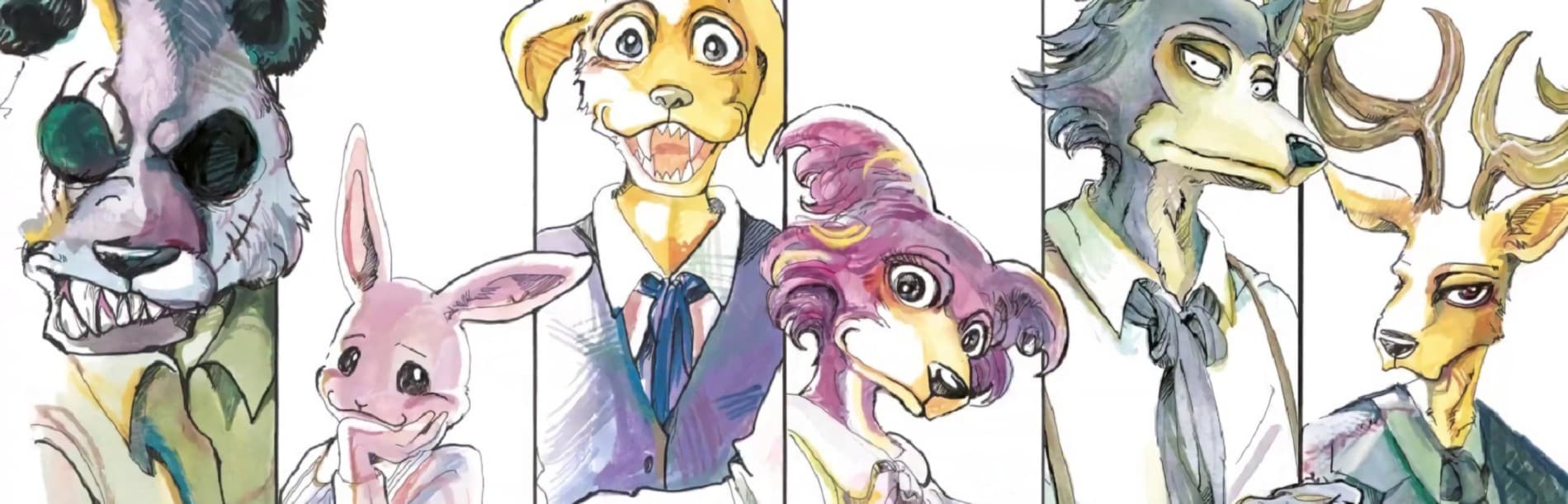
For me, the highlight of Beastars is definitely the character-writing, hence the list of characters whom I relish is pretty long: Legoshi, Louis, Haru, Juno, Bill, Sebun, Aoba, Gosha... and even the very minor characters such as Ako and Airdo. While they're fleshed out and/or contribute to the thematic core, a common aspect between them is that they're unhappy with their species.
Legoshi feels unjustly big and strong next to herbivores and loathes himself for being a wolf. He doesn't see any value in himself — a creature that's biologically meant to prey on others.
Louis craves confidence and puts on a facade to climb above others and get a feeling of control so he could escape his instinctual fear of predators and his fragility as a deer.
Haru wishes that people would treat her as an equal, but is patronized and everyone acts as if she needs protection. She sees herself as someone who'll be inevitably eaten and forgotten, but she continues to cling onto life for the moments that she cherishes.
Bill is proud of being a tiger but is frustrated by the responsibility that comes with his immense strength. He tries to shine in the spotlight but finds that just raw power doesn't cut it.
Gosha can never relax because he needs to always mind himself so he wouldn't hurt anyone with his venom by accident.
Beastars explores self-esteem and dissatisfaction with oneself. The problems the characters face are amplified though. By the harsh expectations and taboos of society. It's really engaging to see them struggle but mature and discover that they're not to blame individually. The entire society in Beastars is rotten at its core and the collective issue they all share is what needs to be solved. The society functions on willfully ignoring the fundamental flaws in its design, mainly, the black market. At least that's how I see the story tackling this topic.
Black Market.
Just the pure existence of it already puts onto a display that they aren't living in an utopia. Despite all of the effort that's been put into creating meals that can keep the carnivores healthy, the yearning for meat hasn't disappeared. Of course, that's not actually the fault of the society. What is however, is that despite it being an open secret, it continues to operate. No one dares to bring it up in the daylight and no one wants to risk getting into that taboo. While any individual isn't in the wrong for that, because a single person can't be expected to be capable of doing anything about an issue of such magnitude, the collective is morally corrupt for not addressing it. Some animals even say it's necessary evil to reason with it — that there's no way around it. Even if it was true, the attempts should still be done and the system of black market should at least be ensured to function on meat that comes from hospitals etc.
What is interesting is how we've shown everyone's acceptance of it. Aoba for example, he's a bird with a good heart, yet when he visits the black market with Legoshi and Bill he doesn't really pick a side at first. He's resigned to the fact that it exists and that he'll end up using it. If it wasn't for Legoshi, would he have done it and eaten meat there? Would he have committed to it?
And it's not just carnivores who're accepting of it, even herbivores are in the know, but don't seem to be taking any action. All of them are just playing the fool and hoping that they won't end up there. Also, even more interesting are those who've went there and found a way of making money buy selling parts of themselves.
It's just so awfully fucked up, but that's why it's such an impactful way of building a theme.
In truth, no one benefits from the black market. The herbivores who avoid it don't because random predation incidents still take place outside of it. Herbivores who sell themselves are basically doing the equivalent of taking a loan but even worse.
And even carnivores, they just become addicted and Gohin showed us what that might end up in: carnivores eating themselves in their lust for meat or inflicting self-harm because of the guilt. There are no victors in that story.
One more thing to say about it, the ones who use it aren't evil, they've ironically fallen prey to their own desires. They're not in the right by any means, but they aren't absolute ruthless monsters.
In conclusion to this segment, it's a brilliant way of showcasing how hollow the utopia they have truly is.
Also, I really appreciated the impact on the overall story that the confrontation between Legoshi and Riz had. It wasn't just covered up so Legoshi could continue his school life, instead he was suspended and the setting of the story switched to basically life after school. It's nice for such consequences to exist in a story, while that sadly is the only really good example, it's still something I wanna bring up.
Also, the little story of Ako and Airdo is a really gripping little addition. They founded their relationship on acting progressive and standing out, but subsequently it wasn't pleasing for either and ended in a tragedy. In line with the story in its entirety, there's no one truly at fault individually. Both of them were thoughtless. Ako pushed herself on Ako who lost himself for a slightest second and bit her. There's no hero nor is there a villain. But the response from everyone around them is to immediately assume the worst, which is understandable, but the good response would be to keep an open mind and try to look at the truth. We don't know what happened to Airdo, but with how stern the laws in Beastars are, his life was probably ever changed. It's neglecting to fix the problem.
But the story isn't without a fair share of issues. Most of them are in the latter half of the story. After Melon shows up, the story shifts from a slow and somewhat aimless character drama to have a more concrete plot. In theory, that'd be great, and in my second favourite series, Kaguya-sama, it happens and pays off. But here, everything kinda crumbles and falls apart. The pacing jumps haphazardly around, many characters (Haru in particular) lack screen-time to make the conclusions for their characters work, a lot of fights but no stakes to speak of, plot-points entirely forgotten, etc.
Worst is that the brilliantly set up conflict between herbivores and carnivores is resolved with basically just a speech from Louis who makes it up on the fly. The intricate buildup of the black market and the dark side of society ends up amounting to almost nothing as it just stops being a problem after Louis has a few words on it and brings it into the daylight. Also, almost as bad is how unsatisfying and out of the blue the climax of Legoshi's and Haru's relationship is, being stacked on top of the entire Melon arc where Haru had practically zero screentime.
So, to conclude the review, Beastars is spectacular at start. It devolves into a mess but it's still a meaningful story. I don't think that it's awful at any point. But I really would've wished for a more nuanced ending. But personally, I'm interested in Paru's writing should she start an another manga. Though I do hope that she's been sharpened by this experience
63 out of 71 users liked this review
