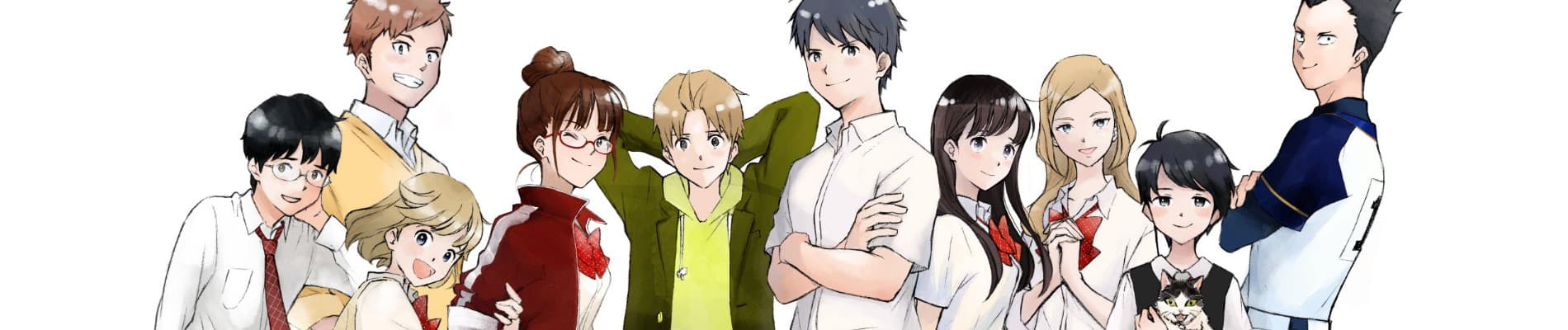

If you were to ask me what I think is the most arduous task is for a mangaka, I'd answer with character relationships and dynamics. For character-driven stories, it's imperative to smoothly convey some sort of internal change in the characters. Whether it be their personality, goals, motives, relationships, etc. One common criticism I see for many different series relates to relationships and dynamics. Maybe a romantic relationship stagnated after a while, or never happened in the end after flurries of fan-service, or a character acted in an unnatural manner that broke character. And I'm no exception, character writing is perhaps the strongest element that will make or break any series for me. Of course, my expectations widely differs from series to series, genre to genre. Among my least strict regards the school comedy sub-genre. I mean, I'm certainly not expecting phenomenally introspective character writing in Azumanga Daioh or Daily Lives of High School Boys, right?
Yugami-kun ni wa Tomodachi ga Inai endearingly shattered my expectational hurdles for its genre. The adorably dull art style and consistently lighthearted atmosphere kept me miles width away from expecting by far my favorite character, relationship and dynamic writing in any manga I've read up to this point. Even though I was always someone who parroted the phrase "Don't judge a book by its cover", I did the same expecting a light 6/10 gag comedy, only to come out proclaiming this to be my favorite manga of all time.
SPOILERS AHEAD
He was a boy, she was a girl
Yugami-kun ni wa Tomodachi ga Inai depicts a rather mundane premise: a transfer student named Watanuki Chihiro who interacts with an aloof loner named Yugami Yuuji. The first several chapters offers little more than this, mainly to establish the awkward start to their peculiar relationship. Chihiro has yet to adjust to her new school and acquaint herself with her classmates, and is stuck with the other loner, Yugami. Initially, I expected a gag story with a Manzai comedy style, consisting of Yugami saying and doing bewildering things, Chihiro reacting, rinse and repeat. It certainly seemed fitting considering Yugami's enigmatic nature and dogmatic philosophy & Chihiro's rather plain, neutral character. Though I was somewhat right about the comedy, the dynamics of both their characters came as pleasant surprises.
The story is largely carried by two things I believe to be among the most difficult to execute well; ambiguity and subtlety. The ambiguity derives mostly from Yugami's character and his relationship with Chihiro. Are they simply classmates? Friends? Fellow loners? Whatever it may be, the story takes its sweet time in developing and making Yugami and Chihiro's .... whatever-ship into the main highlight of the series. More on Yugami's ambiguity later. The subtlety coincides with the ambiguity well, with Yugami and Chihiro's relationship evolving with sneakingly small, yet satisfying nuanced steps. For quite a few other school comedy series I've read, character relationships often explode in development at the start to hook the audience in (Ex: Normal guy discovers the school idol's secret and builds an intimate relationship with her), then stagnate for the majority of the series due to recycling comedic gags, occasionally sprinkled with dull relationship progression. However, this series doesn't immediately reel us in with sporadic, huge development dumps, it steadily fosters the two's relationship and rarely shows any gap or break in its evolution.
Another refreshing aspect I found was the series' lack of cliches. Being a culmination of the school, comedy and sports genres, I was surprised that the typical cliches found in the respective genres were rarely played out. And if they were, they broke the superficial nature of the trope as simply redundant comedy and story writing, but as refreshing elevations of the characters.
Perhaps the series sounds like a melodramatic slice-of-life from what I've described so far, but Yugami-kun ni wa Tomodachi is additionally a phenomenal situational comedy. The comedy largely relies on the dialogue and interactions between various characters, but none more profound and amusing than Yugami's. Supplemented by the consistently lighthearted tone, the conflicts are almost always smirk-inducing. A strong driving force behind it is its trope subversion. I think subversive comedy can be dull after a while, once the audience has experienced the usual pattern of the expected build-up to be met with a jebait moment, but this series executes it without losing taste. There's no real build up to these subversive moments, making the jebait subversion much more "in your face".
The dramatic love confessionThe fireworks muffling the confessionHad the story featured only Yugami and Chihiro, the series would've been a stagnating cesspool. But because Sakura Jun wrote other characters with as much detailed writing as our main protagonists and others with roles extremely relevant to our protagonists' relationship and situations, it became an outstanding character-driven story. The other characters are often parallels to Yugami and Chihiro, in order to characterize the two further, but they're given their own distinct, enjoyable personalities in their dual interactions with the two.
All in all, I hope I conveyed my love for the story. Sakura Jun seamlessly strengthened an otherwise mundane premise with things I've always considered to be difficult to implement and execute in a consistently refreshing manner. Now I'll provide brief character analyses of both of our protagonists, then flesh them out further with important story arcs.
The Melancholy of Yuuji Yugami
Hmm, where do I begin with the SCP creature known as Yugami? The social martyr for the angsty, cynical teen? A living paradox? An undaunted contrarian? In the simplest terms, Yugami is, well ... Yugami.
It's extremely easy to wave off Yugami as an inconsiderate asshole. He makes blunt and harsh comments, has an aloof personality and the rancid rumors and reputation surrounding him characterize him as The Black Plague. However, there lies human consideration inside of him, too. Just unorthodox consideration. In simplest terms, imagine we all have social filters in our heads taking in inputs of someone's emotions, words and actions and outputs an appropriate response following social etiquette. Well, Yugami's social filter is just defective. He's often unable to empathize with socially-straining situations and conflicts, and coupled with his aloof and dogmatic personality, the solutions he offers are often views as inconsiderate.
But he does indeed take other people's feelings into account when his actions involve others. This is seen early on, when he excessively stresses over Rio's love letter to him. He spends days wracking his brain how to resolve this situation that'd appease both her and himself, but unfortunately arrives at humorously ridiculous solutions. In the end, however, he decides to uphold his honesty as the resolution.
As previously mentioned, the ambiguity in this series is top-notch. And for the nature of Yugami's character, it's easily the strongest driving force behind what makes him so enjoyable.
Yugami's character is established by others and even by himself to be a self-fulfilling being who sees everything through a black-and-white frame of "doing this will be good for me" and "doing this will be bad for me". As such, it certainly paints him as a selfish, self-centered person who dismisses the consequences of his actions on others.
His actions and words are often harsh, brief and brutal. Because he often can't empathize with dire social situations since he simply doesn't care about them, he may offer little-to-no help. This is best seen with his one-sided communication with Chihiro, particularly in chapter 20. Because of Yugami's extreme tendency to associate with things he cares about and ignore all else that he doesn't, he often doesn't care about other people's issues but forces his issues onto others if it comes down to it, such as in the previously mentioned chapter. Such scenes do paint Yugami in a selfish light.
However, as the story progresses, the situations and conflicts Yugami faces gradually paints a different narrative of Yugami. The intentions behind his actions seem to become less self-centered and more empathetic. His mild reactions, silent and brief dialogue tends to show that he's thinking about something other than benefitting himself from a situation. Still, Yugami's seemingly inconsiderate actions and the self-centered reasons he gives behind his actions balance out this surprisingly empathetic side, making him out to be a interestingly lopsided guy.
What exactly fleshed out this ambiguity in Yugami's character is Chihiro. For him, Chihiro was initially nothing more than an object to project and reinforce his beliefs and a little more than a frustratingly naive puppy. The very first chapter already presented how Chihiro would become a catalyst for Yugami's ambiguity and dynamic when he defends Chihiro from their upperclassmen's wrath. Though this and many of the early situations largely illustrate Yugami's intentions in a one-sided, self-fulfilling manner, they becomes ambiguously considerate and wholesome as the story progresses. Even when Yugami states repaying his debts is a principle of his, his consideration shows through.
How Yugami creates a rakugo club for the lonely ChihiroThanking Chihiro
Chihiro Watanuki
To offset the peculiar phenomenon known as Yugami, exists Chihiro Watanuki. The only person other than his family willing to freely associate with him, Chihiro becomes a catalyst and an irreplaceable presence in his life.
Chihiro is introduced as also a loner. A veteran transfer student who makes friends as quickly as she loses them. Thus, she disassociated herself, seeing that no long term friendships would ever to fruition. However, as the town Yugami lives in would become her permanent home, Chihiro switches gears and is determined to at last create unforgettable bonds with her new classmates.
However, the distance between her as a new student and her close-knit classmates combined with her fretful nature making her unwilling to initiate communication once again rendered Chihiro a loner. The only solace she had was both unfortunately and fortunately Yugami Yuuji. His influence had ironic effects on her. Merely associating with him swept Chihiro in the same black tarred category as Yugami, in the eyes of her peers, thus initially ostracizing her from everyone. However, in the various situations she found herself in thanks to Yugami, such as interacting with the baseball club, Chihiro started to interact with more and more people, eventually becoming friends. In a very strange way, Chihiro was helped out by Yugami early on, and their association became a heartwarming one.
A substantial, detrimental part of Chihiro's personality was her weakness to peer pressure. Early on, an important scene imperative to Chihiro's character was her clean-up duty. Perhaps something like taking over someone else's cleaning duties may be minuscule and mundane, but it expressed how Chihiro was desperate to have a good image of herself in the eyes of her new classmates, even if meant doing things she didn't want to. And the one who provided her some introspection was Yugami. While the depiction of Yugami lacking the skill to read the mood portrays him in an unflattering light, the depiction of Chihiro subservient to it portrays her as someone that'd let others step over her. And even though Chihiro continues to read the mood, she respects Yugami's rejection to follow this socially inherent rule.
Another substantial part of Chihiro's character was the tense dynamics of her circle. Thanks to Yugami, Chihiro became friends with Waka, manager of the baseball club, and entered her circle of friends, consisting of another person and Waka's childhood friend. However, the group dynamics turned into a cold war for quite a while in the story and depicts an interesting, even realistic, conflict.
Kaori, Waka's childhood friend, dislike and ostracizes Chihiro from their group for some reason unbeknownst to Chihiro. But with her fretful nature and unwillingness to confront and initiate, Chihiro ends up at an awkward, tense standstill with her. With both parties unwilling to properly communicate, misunderstandings and Chihiro's stress build up over the course of the story. Even when Chihiro tries to appease Kaori with niceties, she's ignored and still given the cold shoulder. And because she doesn't want to depend on Waka too much, something Kaori herself says she finds annoying about Chihiro, Chihiro only depends on herself to resolve this situation.
Though it's eventually resolved all fine and dandy, this conflict dually depicts how reading the mood isn't a one-fits-all solution, and proper, straight-forward communication is necessary.
And now to begin the lengthy examination of the saga of their relationship progression
Yugami-kun vs Wakanuki-san
The first dramatic turning point in Yugami and Chihiro’s relationship. Up until this point, their relationship was rather lopsided. Yugami helped out Chihiro for some odd reason, indulged her with his rakugo or miscellaneous rants and they irregularly interacted. In short, some twisted form of acquaintanceship with one-sided communication? But for once, Chihiro actually self-asserts herself in their relationship.
Chihiro overhears Kaori complaining that Chihiro stresses out Waka with her association with Yugami. Chihiro, insecure about her lack of objectivity, wants Yugami to hear her out and offer advice. He refuses, as it will involve him in a complicated mess. Simultaneously, Yugami is stressed out from Heitarou’s bad rakugo performance and wants to hear Chihiro's opinions about it to reaffirm his own. And in turn, she refuses, as she’s stressed out from her own situation. Agreeing to compromise by hearing each other out, Yugami continues to one-sidedly dominate the conversation for his own sake. Chihro, snapping from all the accumulated stress, finally self-asserts her position in their relationship and berates him for not being objective when he rants and defends Heitarou, and that he ignores others but wants to be listened to.
Up until this point, Yugami was criticized solely through the words and rumors of those who rarely interacted with him, but Chihiro, someone who regularly does, finally makes a valid criticism of his character; his hypocrisy. The objectivity that he's so proud of is shallow and narrow-minded, blinded by his own dogmatic nature, he's just as subjective as those who talk ill of him. And once hit with this criticism, Yugami for the first realizes he's flawed. And that he could learn something from others, instead of living in his own echo chamber. Though Yugami continues to one-sidedly dominate their conversations, it marked the first time that Yugami began to consider other people's words and principles. Not necessarily adapt them, but accept that his own thoughts aren't the only valid ones.

Yugami-kun Induces Tears and Stumbles Upon
Yugami and Chihiro’s ambiguous relationship is finally put to the test and examined clearly. Though we know what Yugami is to Chihiro, someone who she wants to befriend, what is Chihiro to Yugami?
After seeing that Yugami made Nogami cry, Chihiro exclaims that she’s “cutting” him off. To Yugami’s dismay, as he believes they weren’t even close enough to sever ties. As things go on, though, Chihiro becomes more distressed over this while Yugami is seemingly unaffected.
For Chihiro, this situation is extremely vexing and distressing. She’s always worried over the nuances and tensions in her relationships, and an ambiguous relationship with someone like Yugami causes her the most worry. For Yugami, he expectantly continues his life nonchalantly. However, it’s plausible that he’s indeed affected. He comments on broken ties being irreparable and his strange habits may be caused by the break off. In the end, he believes there was never any tension between them to begin with, suggesting that he thinks they already had good ties and that Chihiro is important to him. And in the end, Chihiro apologizes through a text, with Yugami simply replying with two words; "Got it."
The seemingly flat, anti-climactic resolution, being the text conversation, is perfectly fitting. There’s always been an ambiguous air to their relationship, and an indirect form of communication like texting compliments the implicit, growing nuances of their relationship. For Yugami and Chihiro, they don’t need a cliche, dramatic scene. This resolution perfectly complements the dual nature of their relationship, one of ambiguity and indirectness, and another of understanding and budding importance of each other.

Will Watanuki-san Change?
Compared to the usual nuanced, subtleness of their relationship, Chihiro explicitly expressed her feelings about Yugami in the most heartfelt, genuine and gorgeous confession scene I've read, that makes it transparent how far their relationship has progressed.
After hitting a no-hitter game, Yugami gains immense popularity. Though usually a person who ignores others, he starts to feel pressure from popularity, with everyone treating him differently. And Chihiro feels happy that everyone’s seeing Yugami in a positive light now, yet lonely that the distance between them may increase. Though, Yugami proclaims that he’ll never change to her right after. Kaori, who wants to date Yugami to leech his popularity, haughtily makes Chihiro write a “love letter” to Yugami. Unsure what to say, since she still isn't aware of what exactly their relationship, Chihiro reflects on all her experiences with Yugami.
The times he's helped her. How he isn't well-received in school. How his stubbornness shows how he never stops going forward. How he isn't nearly as terrible as everyone makes him out to be. How he brightens up her day. And how she'll always continue to root for him wherever he goes.Chihiro and Yugami's relationship can easily be misinterpreted as stagnant and turtle-paced. 14 volumes in, and Chihiro still isn't aware of what her connection with Yugami is. Their interactions are patterned, with Yugami's one-sided rants and Yugami unintentionally helping her out. Perhaps their interactions haven't evolved dramatically, but words speak louder than actions.
Whenever Chihiro is downtrodden, Yugami offers her his sarcastic, peculiar pearls of wisdom. But in a way, they encourage her. And in occasions when Yugami is unable to find a solution by himself, Chihiro's words may offer alternatives. Ultimately, their relationship revolves around indirectness and subtlety. Just like how their relationship was "restored" with mere phone texts, this letter that Chihiro doesn't even show Yugami further reveals the dynamic of their relationship; beautifully implicit and understanding even if words aren't spoken.

Watanuki Chihiro Ponders the Question
After 15 volumes, Chihiro finally establishes her relationship to Yugami; her friend.
Yugami leaves the cultural festival's after-party swiftly, satisfied with visiting all the attractions and booths in the festival and even complimented Chihiro's puppet show. However, their class again speaks ill of Yugami, more harshly than usual, for being unable to read the mood.
The start of the chapter references Chihiro's cleaning duty situation back in Chapter 18, where Yugami sarcastically asks her if she enjoys cleaning. Chihiro lacked the confidence to reject requests, submitting to the will of "reading the mood". And now, Chihiro has a dream about it, but now instead Yugami is the one cleaning up. And in this case, he doesn't read the mood, earning him criticism from his class mates for failing to do so. This serves as a premonition later on in the chapter, when everyone criticizes Yugami for not reading the mood once again.
But this time around, Chihiro actually speaks out. Even though she's the only one willing to stand her ground against the entire class, she defends her friend and opposes the hive-mind.
Going from a person who lacked initiative and confidence to someone berating the majority, signifies the positive extent that Yugami has had on her over the course of the story.


Watanuki Chihiro Has Friends
But what does Yugami think of their relationship? Well...
Unlike the times where Yugami rejects Chihiro's offer of friendship at the start of the story and Chihiro "cutting off" Yugami when their relationship was still up in the air, this strain in their relationship is much more tense. Chihiro asserted Yugami as her friend now, so she feels crushed that her feelings aren't mutual. And awkwardness and tension causes a rift between the two.
However, Chihiro and Yugami still find themselves thinking about each other. All the people she's met and memories she's gained were indirectly due to Yugami, and even if Yugami doesn't see her as a friend through out all of their experiences, what he's done for her is more than enough.
At the end, however, Yugami's surprisingly the one to end the stand still, once again restoring their relationship.

#
Yugami, elected student representative for the graduating year, reads his graduation speech, conveying his usual aloof philosophical rants, but goes on to encourage everyone’s he’s met. From Chihiro to Rio to Yaegeshi to Kaori to Kadota, etc, from all the observations he’s made of them and their conflicts over the past 2 years. Yugami simultaneously disregards companionship and encourages others to love themselves.
This chapter more than any other illustrates the beauty of Yugami's character. His principles were never compromised for the sake of plot or relationship progression, making up the core of his character. But, thanks to Chihiro's presence and all the people he's interacted with, Yugami's realized the values of other people's principles. And in this conclusion, he simultaneously encourages them and reaffirms his own principles. To the very end, Yugami doesn't need friends. But he learns that there's value in other people's pursuits of goals different to his.
Afterwards, Chihiro runs after Yugami, but doesn’t know what to say, except a simple "thank you". For all the unforgettable experiences and friends she's made thanks to the catalyst known as Yugami Yuuji. And Yugami, who never understood implicit meanings behind social conventions and would always furiously question people intentions, simply smiles back, signifying he understands everything Chihiro wanted to convey.

Conclusion
Character dynamic and relationships can often be a tricky task for many mangaka to undertake. And by miles, Yugami-kun ni wa Tomodachi ga Inai ranks among the top with its exceptional writing of Yugami and Chihiro's ambiguously wholesome relationship. Sakura Jun never cheapened the value of their relationship with repetitive tropes, stagnating drama or listless gags. This otherwise plain premise of two students interacting is deeply enriched with its phenomenal situational comedy, short but impactful story arcs, enjoyable side characters and the consistent pace. My dulled expectations coming into this story were blown out of the waters, earning the enthronement as my favorite manga. And any other school, slice-of-life comedy fan will surely be left mesmerized by the peculiar phenomenon known as Yugami Yuuji.
