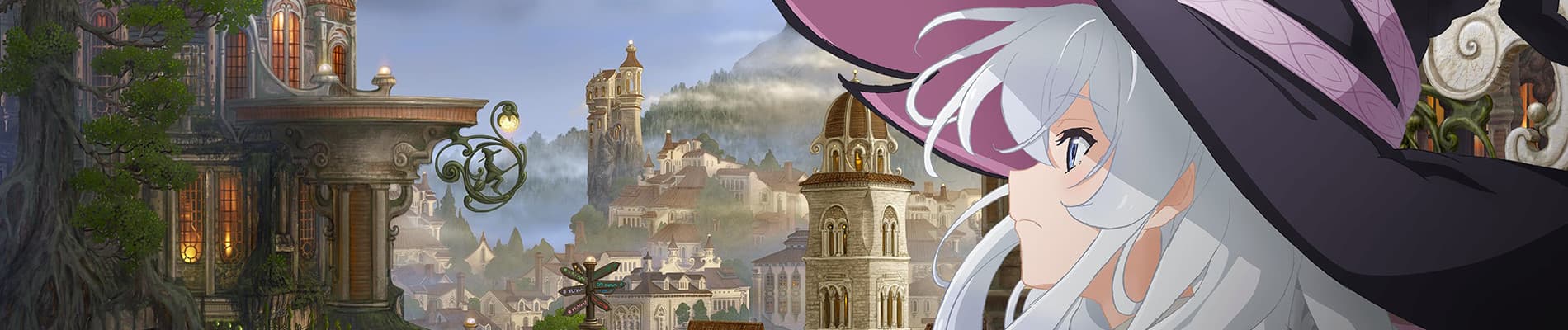
Whether you're cracking open a good book or turning on the telly, there's always something special to be found in consuming media, through sheer enjoyment and the impact they have on our respective worldviews. Growing up with stories is a universal experience. From various walks of life, both young and old alike are bound to come across any number of stories. Stories come in a limitless number of forms, ranging from whimsical flights of fantasy to the simplest of daily interactions. These tales have the potential to shape how we see the world, and thus influences how we interact with everything around us. Our personal experiences are stories in themselves, and the way they're told and interpreted gives way to an infinite number of stories internalized and shared. It's a beautiful cycle, one that Majo no Tabitabi revels in exploring. A collection of a wandering witch's adventures, Majo both celebrates and questions how we perceive media. And heck, even if you're not all that into meta-contextual analysis, the episodes themselves are loads of fun, capable of bringing out that childlike wonderment we associate with a great story. The following review is spoiler-free, but do jump ahead to my Tl;Dr if you'd like to go in blind. Without further ado, let's take a journey into the fascinating world of Majo!
You'll never know what kind of episode you're going to get in any given week, but they're all but guaranteed to surprise and deliver. The series follows Elaina, a young witch, and her travels to various locales. While rarely deviating from this simple formula, Majo more than makes up for it by regularly switching up its setting and themes. The show's stunning presentation goes a long way to draw us into its realm of magical mystery. One of the prettier shows you'll find this season, Majo is filled with distinct character designs, great lighting effects, a charming musical score, and most things in-between. An especially praiseworthy aspect are the strong directorial choices, bringing the best out of a tonally-colorful script. Anything from goofy comedic romps, high-stakes energy, and sinister dread is depicted well, through good shot composition and fun choreography. All in all, Majo's versatile presentation is beautiful to take in.
Integral to the show's "variety-hour" narrative structure is the inclusion of magic. While the in-world magic system isn't comprehensive or the most thoughtful, it's clear to follow within the context of each episode and allows for plenty of inventive plotlines. Personally, I find that the real "magic" of Majo lies in its ambition. The series takes every opportunity to explore fascinating concepts through various mysteries and obstacles Elaina faces in each of her tourist stopovers. From creative thought experiments made possible by magic to non-linear narratives, Majo is very much interested with keeping the journeys as unpredictable for us as they are for Elaina. The show is comfortable with competently playing to familiar story conventions in one week, before shockingly subverting them in the next. Where other programmes would prefer to maintain a status quo, Majo is not afraid to venture into the unknown with each new episode. Intriguing story concepts are often established and exhausted within the runtime, ensuring that each storyline doesn't overstay its welcome.
Her character is introduced as a bright-eyed child, enamored by the wonderful tales of her favorite book, 'The Adventures of Nike.' She aspires to follow in Nike's footsteps, in the hopes of too becoming a travelling witch and experiencing similar stories for herself. At first glance, the origin of our Ashen Witch signals a rather standard character, but what comes next reveals anything but. She's no audience surrogate or tropey righteous do-gooder. She has personality and wit, keeps a level head and at times indulges in refreshing sarcasm. She's vain as heck, she knows she's a queen and she owns it. Most importantly, as much as we'd like to believe otherwise, Elaina is pretty far from perfect. At several junctures she makes decisions, and not all of them are necessarily choices one would agree with. Which brings me to what I feel makes her so special: Elaina is a representation of the audience.
'The Adventures of Nike' plays a prominent role in the show, often mirroring or contrasting the reality Elaina encounters. In fulfilling her childhood dream, the travelling witch goes from locale to locale, not getting too attached to her scenery. The world is her oyster, she can seek out new places and people as and when she likes. However, that reality isn't always in line with the world of her folk tales. Things don't always go as planned, and she isn't your fairytale heroine. Oftentimes the show reminds us of Elaina's inexperience and immaturity, highlighting how much more she has to learn in life. Elaina's relationship with her childhood tales and her real-life decisions achieve three things. First, Majo challenges the idea of how audiences are conditioned to consume media. We're accustomed to expecting stories to play out in a specific way, with some sort of closure at the end. These happy endings aren't quite what Majo is shooting for, however. I've seen several discussions questioning Elaina's failings in a given episode, which the show doesn't portray in a positive light. We're not forced to accept that Elaina has handled these situations to the best of her ability, and the resultant lack of catharsis compels us to reflect on her decisions. This means that we, the audience, become more involved in the story, and I find that effect to be incredibly engaging. Just like how we're sometimes dissatisfied with Elaina's choices, Elaina herself is disappointed with the outcomes she faces. Which leads me to my second takeaway: Majo explores our relationship with escapism. How often do we find ourselves sifting through the various catalogs of our preferred anime streaming sites, picking what to watch? In a similar sense, Elaina is Netflix-surfing before Netflix was a thing, roaming without staying in one place too long. It's certainly not a poor habit in moderation. However, Elaina's mythologising of Nike and refusal to return home does depict a less-flattering extreme. An extreme not dissimilar to those attained by real individuals today, who may find themselves obsessed with escapism while neglecting loved ones and work^. With social media and shows becoming more accessible than ever, it's somewhat sad that this illustration hits home in a present-day context. If we enjoy a medium, we might give it an unhealthy amount of attention; if we don't find pleasure instantaneously, we are conditioned to change the channel. But as much as we'd like to enjoy the world of fiction, there are some things in life we can't escape from. And that leaves us with the third point: Majo demonstrates how we're tied to reality. The great big world can be a scary place, filled with things we can't hope to comprehend in our lifetimes - things that get us down, things that change our lives. Sometimes I feel greater comfort turning to the stories I enjoy, instead of facing the music. And it's in those times that I forget to appreciate how wonderful life can be, in all its unpredictable chaos. The stories we consume are often in our comfort zone, but stepping outside into reality could be more rewarding than we could ever imagine. Who knows if things are gonna go my way, or if I'm gonna make the right decision? Uncertainty and lows are what makes the highs so precious.
Isn't that exciting?
It's variety is engaging, and provides some compelling commentary about how we consume stories. But the problem is, the stories themselves can sometimes leave plenty to be desired. And it's not the script's fault or anything, these episodic plots are mostly strong, fascinating ideas. That being said, the show's commitment to reinventing the wheel each week can work to the detriment of each concept. The standard 20-minute runtime we're used to suddenly seems small and insufficient with Majo. Plenty of story material seems left on the cutting room floor, resulting in cheesy spurts of exposition and ideas not fully explored. Recurring characters and plot devices serve their purpose, but don't really stand out to me (sorry, Saya.) **The biggest issue with Majo is that there's not enough *Majo!*** It's certainly not a bad problem to have, but the stories do leave me wanting more when the credits roll. It really makes me wonder how much better the show would fare with double the runtime, as opposed to its typical single-cour structure. Another point worth noting is that there are certain episodes that approach some seriously messed-up territory (looking at you, Episode 9^^.) One of the common complaints about Majo as it aired was the sudden tonal whiplash some viewers experienced after the first two episodes. Do prepare yourself for the unexpected, and exercise caution if you can't handle dark subject matter.
Majo no Tabitabi is a layered and rewarding journey. Appealing visuals and a great score allow for the series' versatility to shine through; a variety of tones and themes are carried out brilliantly, ensuring that episodes are different but consistent. A vast realm of spells and splendor, the true magic of Majo's world lies in its fascinating concepts and meta-commentary. Majo has a thoughtful message for viewers, challenging the way in which we consume stories and perceive the world around us. However, there's also plenty of fun to be had for viewers tuning in to exciting adventures starring one of the best characters all year. Despite its many qualities, the show's short runtime does lead to untapped potential, which left me wanting more. That being said, Majo's adventurous offerings should not go unnoticed. 7/10~
Jokes, jokes. The V-Tuber rabbit hole is one I'm far too scared to fall into; I'm already shit enough with my time management as is!
-^^Ladies, Gents & Others: we have a controversy on our hands. Simultaneously the best and worst episode of Fall, your mileage will vary immensely with this adventure. Personally I'm mighty impressed at the craft going into this, so let's take a closer look. Being a wannabe pretentious douchebag film geek, I gotta gush over how much I enjoyed how the episode presented itself. Story structure does tickle my nerdy pickle, being as literal an interpretation of Campbell's Story Circle as you can get. Elaina's gets a "call to adventure" when she receives the flyer and returns to that same bench from the beginning, changed and shaken by that harrowing encounter. Oh, and let's not forget how Elaina & Estelle cross a "threshold" into the past - it's great geeky fun. Though I'm pretty sure none of this structure bullshit appeals to anyone reading this, so let's jump into the aspect that makes it all work: the visuals. Little expense was spared in making this work. Neat cues like Estelle's magic ring and the newspaper scene are purposeful and add a lot more than flashy tricks. Direction is also consistent throughout, and I was gripped from start to finish. The premise is where we run into some problems, holy hell that was messed up. Personally I don't have big problems with the arc itself, even if things didn't make sense and seemed out-of-nowhere. The dark twist hinges on an info-dump, and Selena (much like the Doll Town episode) has all but one normal scene before going full-psycho. Another problem is with the idea that Selena's parents are abusers, which isn't nearly as developed or convincing as the other setups introduced throughout the episode. Once again, Majo is simply too short for its own good IMO. The show had its work cut out establishing not just technical devices (Estelle's magic cauldron, alternate timelines,) but also setting up the steps Estelle took in saving her friend. Her countless sacrifices are what connects us to the story, which in turn makes Senena's betrayal hit so much harder. At a baseline the episode still functions, and Selena's tragic story works on paper. However, it's a lot weaker than if we got more than an hour to rewrite Selena's history. Or rather, more than the 20 or so minutes of runtime every episode is allotted.
And we're done! Thanks so much for making it this far, glad you stuck around with this "journey," heh. If you happen to like my verbose rants, feel free to check out my other reviews for seasons past and present, peace~
68.5 out of 81 users liked this review
