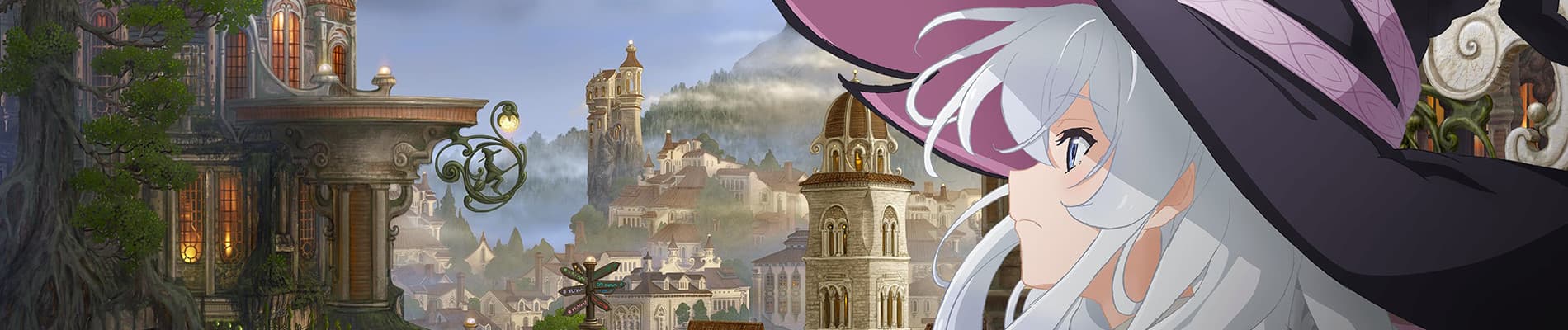
I really, really wanted to like Majo no Tabitabi. Anime, manga, and light novels have been short on more episodic series for quite a while, particularly those centering on a traveler's journey through varying settings. The best-known and best received light novel-turned-anime in this vein is Kino no Tabi, and Majo no Tabitabi takes obvious and direct inspiration; in both cases, a female protagonist travels alone, staying for short periods in small cities, acting primarily as an observer to events rather than as a catalyst (though generally being drawn in against her will). This isn't to accuse Majo no Tabitabi of being a ripoff--most works in this medium are derivative to some extent or another, and there are meaningful differences in both the protagonist's personality and in the settings themselves. Indeed, Majo no Tabitabi tries to tell its own story--it just doesn't do a very good job at it.
The protagonist, a newly-minted teenage witch named Elaina, having spent two arduous years as an apprentice to an older witch, decides to travel the world on her own, visiting various "countries" (as I mentioned above, none of these are larger than city-states), most of which have a unique theme that causes some sort of conflict over the course of the episode. For instance, in one of the episodes that I thought that squandered its potential, the country's prince had cast a spell banning all lies, causing the effect of the townspeople using underhanded ways to be dishonest without directly lying. Yet compared to say, Kino no Tabi, and oddly for a work focused on traveling between different locales with different cultures, nothing is really done with this outside the opening minutes of the episodes.
Elaina herself is, at best, a mixed bag of a protagonist. She's portrayed as slightly vain and self-centered--some people I've seen dislike her just because of this, but I'm generally more defensive of these sorts protagonists with personal flaws. The real problem is that her development over the course of the series is inconsistent, and cuts off right as it's seemingly about to go somewhere in the final episode. One of the later episodes, without getting into specific details, shows her failing to stop a gruesome murder, and ends with Elaina devastated and reconsidering her future as a traveler. The next episode proceeds to...not feature Elaina at all until the final few minutes, and then the episode after it doesn't seem to address anything that happened previously that seemingly would have caused her at least some trauma. While some of this can be ascribed to the decision to adapt chapters out of order to create more of a unified narrative and provide more spotlight to some secondary characters, the actual effect ends up being a clunky whiplash between very dark and fairly light-hearted episodes while failing to properly bridge the two, while emphasizing mostly uninteresting secondary characters over any sort of worldbuilding. An earlier episode features Elaina learning that a family has been staying with owns a slave who is repeatedly abused by the head of the household. While she at one point repairs a vase and stops the father from beating her, she chooses to not intervene any further and leave without attempting to free her from bondage, even after seeing the slave girl traumatized from learning about the outside world (it makes more sense in context). I don't necessarily think it would have been better for the story for Elaina to be a more active heroine, whether in this episode or in other episodes, but it reflects on a common problem in the series to introduce a moral dilemma without giving it any real weight or meaning.
There are definitely some highlights to the series. The overall production values are above average despite some awkward 3DCG usage (the worst offender being a breaking vase in the aforementioned slave episode), and there are a couple episodes that I genuinely liked, including both the first episode (Elaina's background story) and one about a vineyard. Ultimately, however, due to both misguided adaptation decisions and an author biting off more than he can chew, Majo no Tabitabi, like its protagonist, fails under its own hubris.
260.5 out of 339 users liked this review
