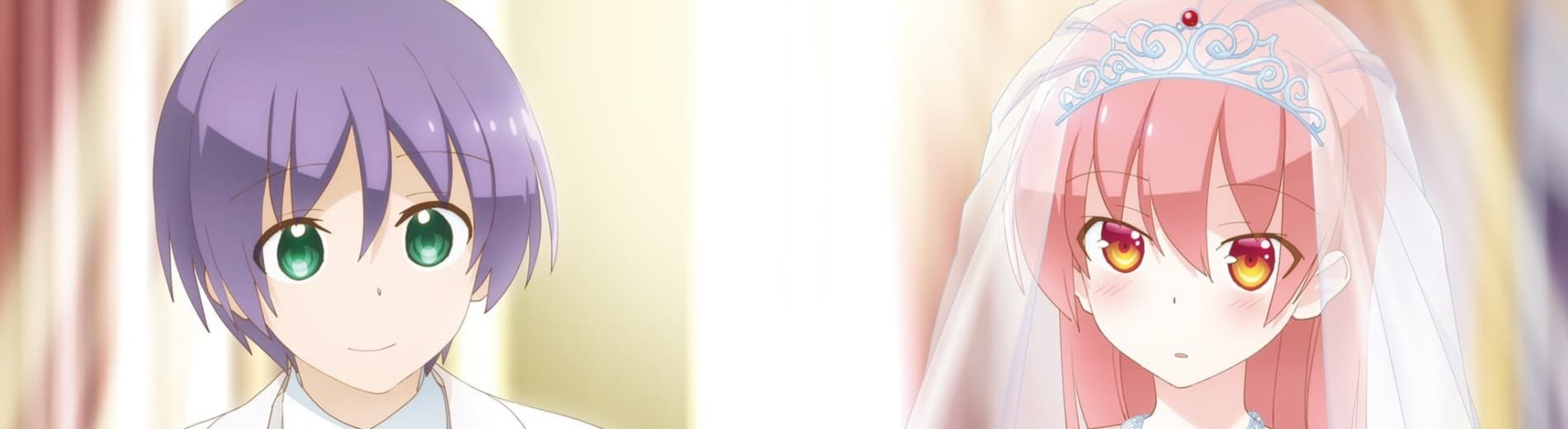
Tonikaku Kawaii is essentially a story about the lack of familiarity involving love at first sight, and ends up discussing what does it exactly mean to fall in love, as well as all the emotions that come with it. It's a story about the irrationality falling for someone can do to people, leaving them waiting endlessly for a happy ending that may or may not ever come. The opening episode is a perfect example of this, showing Nasa falling for Tsukasa's strength at saving him while also setting up the abnormality between both characters - one who due to his obsession with success has no idea what moderation is, and is willing to go so far as to confess to someone who caught his eye, and the other for striving desperately to find a place to belong after being lost for her whole life without finding one. The Tale of Princess Kaguya being used as a metaphor for the entire story, as such, is convincingly tied to the dynamic between Nasa and Tsukasa - one of two lovers that were seemingly destined to meet meeting one another, and finding solace and a place to call home in each other, with even a timeskip taking place in the first episode perfectly symbolizing the distance between the two.
Symbolism is only part of the picture of what makes this series what it is, but it's rather both characters and their attempts in understanding each other that also set this series apart from the overwhelming majority of the romance genre. Opportunities for drama arise left, right and center, but end peacefully due to the characters' relative level-headedness compared to most of their equivalents in the romance genre. One example that sticks out is how a side character had feelings for Nasa, and is clearly upset that she lost and desires to continue the good fight; instead of this leading down a path of overly melodramatic and extremely pointless drama, another character outright tells her that she lost because she was late to confess, and as such simply didn't deserve to win, a gigantic change of pace from series where hundreds of chapters are spent on this exact point, as if the audience couldn't have just understood that. Both leads don't magically get used to each other after marriage - after all, they're just two strangers who survived getting run over by a truck - but take time to hug, kiss and spend time to understand each other and their respective backgrounds, quirks and personalities.
This ties into one aspect that's underappreciated involving the show, and that is how we just see our main leads do something other than get into pointless drama or bicker with each other. Small pieces of characterization are laid out for both main leads, ranging from foods they like/dislike to tastes in fiction to their own social lives outside of each other and how they handle people around them as well as character flaws they both have - Nasa for example, has spent much of his life seeking to be the best at what he is, and as such is an overly perfectionist acting nerd who gets overly zealous of what he loves. By extension, this means he's just about the most awkward person involving interpersonal relationships imaginable and often overacts or steps out of bounds - something that is not uncommon in conservative cultures, Japan being one such example. Tsukasa by comparison, often expresses herself poorly and doesn't know how to communicate her feelings towards Nasa, making her dynamic with him one where he's the hotheaded man of action to her relative more insightful, quiet personality. Both characters bounce off of each other exceptionally well, with clear development and progression over the course of the series as Nasa slowly grows more accustomed to Tsukasa's presence in his life, and Tsukasa slowly but surely becoming more expressive and opening up to him in her life.
The comedy is an interesting beast to tackle involving this show, as while the rather standard production values compared to the likes of Kaguya-sama or Maou-sama de Oyasumi may fall flat for some viewers, the voice acting and sound design are worthy of a lot of praise. Voice acting is done exceptionally well, with Akari Kitou deserving particular praise over her performance as Tsukasa. Similar praise must be granted to Junya Enoki as Nasa, and Yuu Serizawa as Kaname, who similarly do an exceptional job balancing the comedy with the more serious moments in the series. A scene that is a particular standout is Kaname thanking Tsukasa for saving Nasa's life, which felt exceptionally well voiced even by the show's high standards. The music is also worthy of serious praise; the opening didn't do much on my end due to a rather poor drop when the title, well, drops, but the ending song is just a pleasant romantic song and essentially the de facto leitmotif of the series, with various tracks over the course of the show essentially being soft remixes of the ED. Character designs are basic yet lightly colored, fitting the overall lighthearted tone of the show, while also being capable of being more over the top in more comedic moments, though this would come as no surprise to anyone familiar with Kenjirou Hata's previous work in Hayate no Gotoku.
If there is a miss involving this first season, it's rather that for all intents and purposes the gags often get repetitive though strangely oddly specific insofar as humor goes. One example that sticks in my mind is of Tsukasa having no underwear and going commando under her clothes, with Nasa quietly losing it at what's going on - while no overly offensive sexual humor happens, thankfully, it felt strangely specific for a joke and I was left wondering why. Much of the series' jokes improve from this point onwards in the manga - though it's doubtful this'd do much for you if this wasn't already your brand of humor - and the dynamics progress considerably over the course of the series, leading to another issue wherein the last episode adapts a few chapters where the characters are much more close to one another later in the manga than they are in the rest of the anime. Of course, and ultimately one can argue that the occasional oddly specific gag could well be because of the author very directly stating in an interview that he's placing many of his own experiences after getting married in the manga, which isn't exactly uncommon for any fictional writer, but I digress.
Tonikaku Kawaii is a breath of fresh air for anyone who desires a romance series that incorporates popular elements and yet executes them exceptionally well. Some of its humor feels oddly specific, the production values while decent are nothing to write home about and some of the innocence involving the two main leads and their relative conservatism in approaching each other would fly over people's heads considering the cultural dissonance, but overall there's an excellent romance anime for those willing to look past otherwise minor nitpicks.
I cannot recommend this anime highly enough, and especially if you are a fan of romance series; this recommendation extends to the manga, which only improves in quality as it goes on.
Thank you very much for reading this review, any and all feedback would be appreciated.
31.5 out of 35 users liked this review