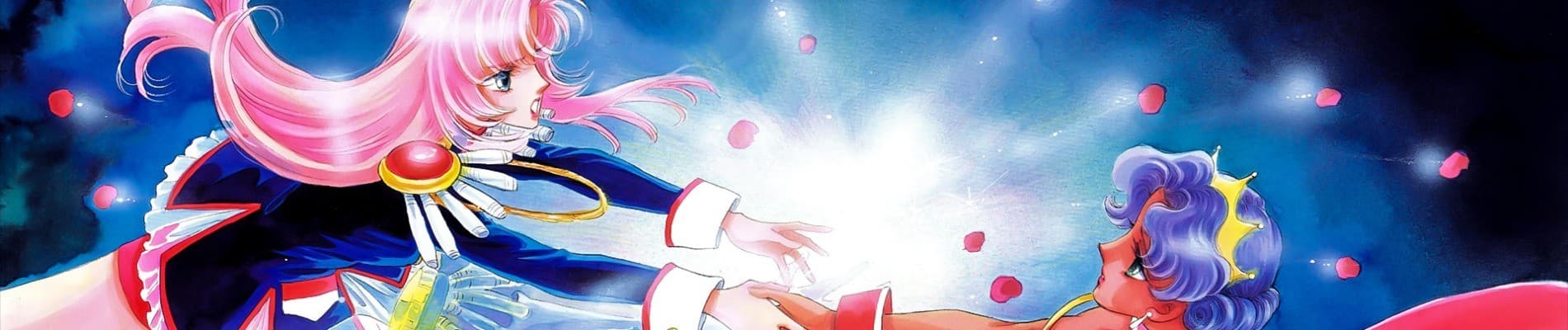
It is almost impossible for someone who is interested in anime classics to not have heard of Shoujo Kakumei Utena. The series has been on my to-watch list for a while, and when I finally decided to pick it up, the bits and pieces I had gathered from online discourse had made me expect to see a show similar to Rose of Versailles, but (even) gayer. Was my expectation met? Yes and no. Although the story of Utena is clearly inspired by the ‘female prince’ shoujo series like Rose of Versailles and Ribon no Kishi, it is so much more than that. I should’ve known, since it’s created by Kunihiko Ikuhara, the same person who’s behind Mawaru Penguindrum and Sarazanmai.
Shoujo Kakumei Utena is surreal, serious, yet at times weirdly comedic. It is riddled with symbolism and allegories, and tackles some heavy and complex topics such as abusive relationships and sex. But, although I am a sucker for symbolism in my stories, there were many times I felt it was overused. Sometimes I wondered if the series went out of its way to try and make me feel like I’m an idiot. I like to think of myself as a relatively savvy audience, but I often found that symbolism in Utena either obscured whatever point the show tried to make, or left me wondering whether there was a point in the first place. If the audience has a hard time understanding the symbolism, that’s on the author. At times, the show even felt it needed its characters to diegetically explain to the audience what the symbolism meant. You most likely will have to rewatch at least once to understand more easily what’s going on. Personally, I didn’t get invested enough to rewatch the series and catch all the symbolism the second time around.
It doesn’t help, either, that the series switches from standard formulaic magical-girl like fights, to absurdist comedy Nanami skits, to interesting plot-driven episodes. You never know what you’ll get when starting up the next Utena episode. While surprises are fun, in Utena’s case it’s so many surprises that it gets overwhelming. It just tries to tell too much! There’s an entire arc about a school building that went up in flames and the students that died there, but not much of what happens there ends up being relevant for the entire latter half of the show. I thought what was happening there was building up to the grand final mystery, but apparently not! Utena glosses over a lot of events that happen both in the foreground and background, but it seldomly lingered long enough for me to feel the catharsis from its conclusion; before I had the chance, the show had already moved on to the next idea or cool symbolism sequence. I did like the ending, though. For what the show is about, it sent a good, realistic message. It is conclusive and actually the only moment I thought was truly cathartic.
The show has a lot I like, especially its themes: coming of age is my favorite type of story. I want to love Utena, but it just never gave me the time to do so.
So we arrive at what I believe is the weakest point of Utena: its characters. Don’t misunderstand me: the characters have distinct personalities and seem interesting, but we quickly run into a problem I previously mentioned: I didn’t get the time to really know or bond with them. At times the drama also feels weird: the first five episodes, one of the main characters, Anthy, manages to get bitch-slapped in the most theatrical ways at least once per episode, and things like that made it impossible for me to take any character drama that happened in those episodes seriously.
My second gripe with the characters is that there were so many plot twists and shit going on that it was hard to keep track of and understand what each character stood for. There are times in Utena where characters just randomly ‘change their mind’ and ‘regress’ to making the same dumb mistakes you thought had they already learned from, and the only reason for that happening is because the plot demands it. I get that the writers tried to go for some sort of “pattern repeating itself” thing, but it didn’t feel natural. At such a point, the characters start to feel more like tools that represent a certain theme, rather than actual human beings.
As opposed to what many people apparently do, I won’t complain about the re-used scenes in Utena. Screw that. I managed to sit through several 70s anime, so I’ve gotten used to worse. Heck, I would even go as far as saying the communication of themes at times even benefits from the repeated use of the same scenes.
I love the surreal aesthetics in Utena. It’s probably my favorite thing about the show. The quirky shot-composition, the background details that randomly change, the weird random fax machine appearing in a log cabin... it doesn’t even matter that the symbolism will get lost on the audience, it just looks cool.
The only things I disliked are those pesky arrows that at some point show up to point out where the audience needs to pay attention. If you need arrows to tell your audience where to look so they will catch stuff appearing or disappearing from the screen, then you need to rethink how you’re directing the scene. It’s like the show is explaining its own in-jokes to me and expects me to still find them funny. It’s just another example of how Utena uses so much symbolism that meaning becomes obscure, so the show will have to infodump what it actually means with its symbolism. But, as far as visuals are concerned, this is just a small thing so it won’t affect my opinion too much.
Another thing I really like about Utena is its OST. It has a great, memorable OST, and the henshin-song got stuck in my head multiple times. I didn’t even mind it, because it’s a fun song! The opening theme is memorable too, as are both ending themes. I especially like the second ending theme a lot. I don’t have much to say about the voice acting (Japanese version). Sure, the delivery is hammy, but it kinda fits the tone of the series anyway. The voices all sound distinct and full of character, so that’s all great.
Shoujo Kakumei Utena has great historic value and is an interesting milestone in the line of heroic female protagonist shoujo. In certain ways, it improved upon Rose of Versailles, and it went on to directly inspire great series like Princess Tutu.
If you’re into anime history and anime classics -especially the development of shoujo/magical girl as a genre over time- Shoujo Kakumei Utena is a must-watch. The series tries to tackle a lot of complex themes and has much going on in the background, using a lot of inventive symbolism and metaphors. That being said, the sheer amount of stuff happening makes it hard to catch everything that’s going on on the first watch. I guess you could say that Utena is an ambitious anime, perhaps to a fault.
26.5 out of 34 users liked this review