If there’s one thing I've learned from watching anime throughout the years, it’s that it’s hard as shit to tell a story that takes place outside the literal world. The literal world has concrete rules that everyone’s familiar with, guideposts that anyone can understand and follow should you choose to write a story around them. Once you step into the realm of symbolism and metaphor, though, all bets are off. There’s no road map for you to follow, there’s no common script you can rely on, and there’s no safety net to catch you if you fall. You essentially have to write your own storytelling language from the ground up, figuring out a new set of nouns and verbs and adjectives and conjunctions to communicate the feelings behind your narrative. And then, you have to teach your audience that syntax as well so they can follow you without getting lost, all within the boundaries of the very work they need that syntax to understand. It’s like teaching someone introductory French by having them read a passage from the AP exam. And if that sounds insane to you, just imagine doing that for upwards of ten languages at the same time, all of which are necessary to understand each other, and you’ve got an idea of how fucking hard it is to write a story based on symbolism instead of the rules of reality. It’s no wonder why so few stories even attempt such a Herculean ask, or why so few of those that do succeed.
But on the rare occasion that someone does pull it off? Chances are you’re gonna end up with something as exhilarating, engrossing, and just plain magical as Flip Flappers.
It’s clear from the very first scene that this is going to be an experiment in contrasts. Quiet, reserved Cocona, with downcast eyes and murky blue hair, takes a standardized test in a grey, dimly lit room, a room of silence and stillness, with no motion but the scratching of lethargic pens and no sound but the haunting ticking of the clock and the dull patter of the rain outside. No one speaks. No background music plays. The atmosphere is utterly, completely stagnant. And then, there’s energetic, lively Papika, bursting into frame with a triumphant trill of symphonic music and kicking hyperdrive velocity as she rushes forward on a hoverboard, her vibrant, chaotic tangle of red hair billowing behind her like a windsail as she cheers at the top of her lungs. The colors explode with joy, the animation rockets forward to match her speed, and Cocona’s grey, listless world prepares to erupt with life. Cue heartbeat-accelerating OP that doubles down on every single one of these motifs, climaxing with the clouds of rain clearing as these two wayward souls find each other at last and run across a field of verdant grass rolling like a stormy sea, shoes off as they feel the rush of nature on their bare skin, dynamic, excited, happy, free. Ladies, gentlemen, and everyone in between, welcome to Flip Flappers. You’re gonna enjoy your stay.
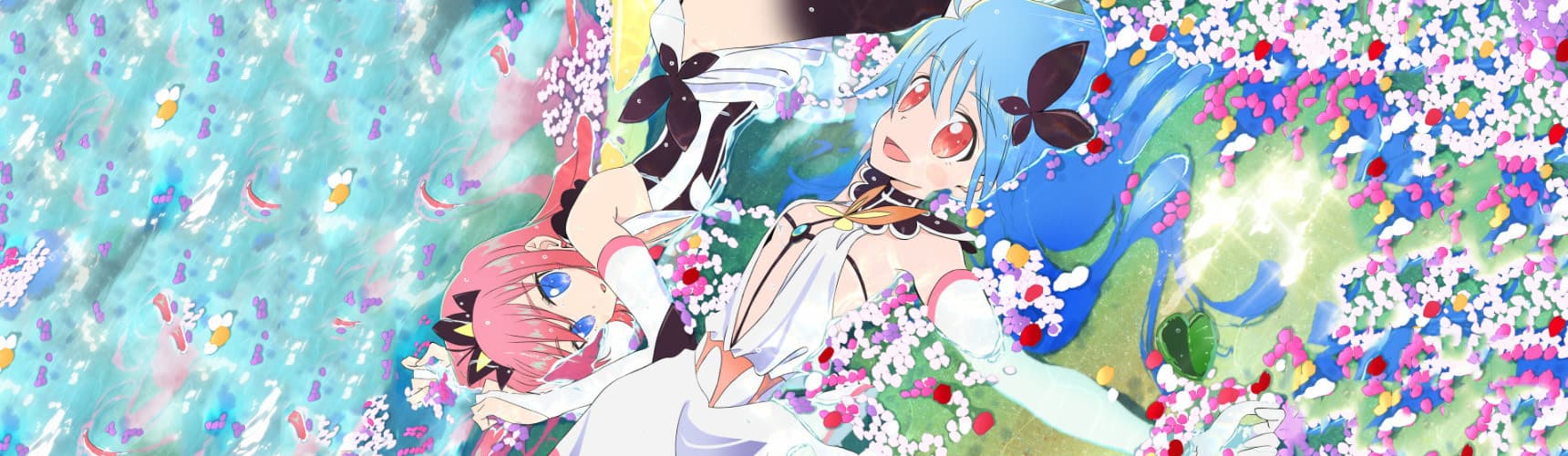
It’s honestly kind of remarkable how utterly this show commits to soaking you in that atmosphere of contrasts, all but marinating you in the stuff. Flip Flappers is already about so many things it’s hard to keep track of, but most of all, it’s about a girl who feels stuck in life, and another girl who shows up out of nowhere to set her life into motion. Cocona’s life is full of listlessness and indecision, her path blocked by a passing train that forces her to a standstill, but no sooner has the intertia started pulling her down than in comes Papika, leapfrogging over the seemingly insurmountable obstacle in her path and soaring into the rising sun. The colors of the natural world can be muted and somber at points, but once Papika drags them quite literally down the rabbit hole, the sky is a bluer blue than ever has been blue, the pastels drip like honey from the tree branches, and the quiet melancholy gives way to a vibrancy of truly epic proportions. It’s a dizzying, terrifying, liberating rush, made all the more stunning by some truly remarkable action sakuga that makes you feel every ounce of the kinetic chaos Papika brings into Cocona’s life. It’s the darkly-tinged whimsy Alice in Wonderland mixed with the propulsive energy of Gurren Lagann with a sizeable dollop of the surreal dreamscape of Madoka Magica thrown in for good measure, and the resulting LSD cocktail grabs your attention by the balls and refuses to let go.
And all that’s without even taking into account the true driving force behind this show: an unapologetically gay story of self-discovery and embracing life’s grand adventure. Papika’s interest in Cocona has so much concentrated lesbian energy right off the bat that there’s never any mistaking the point behind the crazy, crayola-nightmare metaphors being slung around all over the place. Cocona’s stifled by life’s expectations of her, but more explicitly, she’s stifled by the conservative, traditional life society seems to be funneling her down, pressured to get into a good school and grow up into a perfect model citizen. The repeated motif of her smoothing her skirt down now as she heads off to school emphasizes that even further; she’s expected to close off, remain dignified, remain “respectable”, and keep all her inner desires at bay, showing nothing off to the world around her. And then in comes Papika, who never met an inhibition she couldn’t trample, unapologetically imprinting herelf onto Cocona like an excited puppy and dragging her into a wondrous, fantastic world where they can be free of society’s watchful eyes, free to laugh and explore and be whoever they damn well want to be as they search for the pieces of a treasure that can supposedly grant them the one wish they’ve always wanted.
And despite Cocona’s desire to remain respectable, to push down the things Papika brings out of her and refuse to acknowledge this world at her fingertips, every instinct within her is screaming at her to let go and embrace it. She finds herself marveling at the world around her, catching herself laughing at the whimsy Papika inspires in her, stunned at the joy she finds just by being this new self she never thought she had within her. The adventures Papika takes her on are escapes from a world that demands her to be what she’s not, a chance to accept and explore everything she truly is. She can be wild, exuberant, a hero on a grand adventure that she gets to plot the course of. She can even be sexual in ways she never thought possible; episode 2 sees her desperately trying to hold back a growing desire to “eat” that makes her drool, while wearing cutesy cosplay of an animal commonly associated with fertility, only to finally give in and devour her heart out to escape certain death. And in case the lesbian subtext was somehow too subtle for you, in case Papika’s constant physical affection and intimacy and Cocona’s slowly burgeoning receptiveness to it didn’t cast out all doubts, Cocona’s first big moment of embracing this new her occurs when, to save Papika from danger, she goes full-on Super-Saiyan, her hair exploding in the color and joy she was denying herself, by summoning energy in her inner thigh.
GOD.
But because Flip Flappers is nothing if not a committed overachiever, it pushes the queer metaphors one step further and explores what it really means to start coming out of the closet. Papika’s an out-and-proud gay wunderkind who displays her sexuality prominently on her sleeve, and she wants to drag Cocona out of hiding right along with her. But Cocona’s reluctance to embracing her lesbian identity isn’t just based on stubborn ignorance; it’s based on a legitimate fear of the consequences of living out of the closet. The symbolically gay world Papika wants to “adventure” in is exciting and liberating, but it’s also dangerous, terrifying, and full of threats that could cause more damage than could ever be repaired. I was honestly shocked the first time Papika’s blood was shed on the back of a rampaging snow demon; in a world as colorful and vibrant as this one, the fact that our heroes can actually experience that kind of visceral harm jars you in a way you’re not ready for. Living out and proud means you’re a target for every homophobic force in society, in the crosshairs of every two-bit bigot and oppressive power system that could cause you serious harm, even kill you. And Cocona is understandably terrified of living in that world. Not just for her own sake, but because the thought of Papika dying is that fucking terrifying for her. Even back in the closeted “real” world, the forces of evil can still track them down just for spending time out and proud, pursuing the shard of symbolic joy they brought back with them. Wouldn’t it be better for her to, well, “conceal, don’t feel, don’t let them know”, if you’ll pardon the Disney reference, rather than risk the pain losing someone she’s only just realizing she cares so deeply about?
That’s a fascinating direction to go in, and the way this show explores that tension is nothing short of remarkable. Papika can’t understand why Cocona might want to live closeted, and she oversteps her boundaries trying to make her embrace the gay. She isn’t able to comprehend the larger forces that lead Cocona to the decisions she makes, even as she genuinely wants to embrace life together with her. And Cocona, for all her determination to stay where it’s safe, can’t keep herself from reaching into the dangerous world beyond and feeling out the parts of herself she’s been so desperate to keep hidden. She wants to be out and proud, even as it scares the living daylights out of her. But it’s not up to Papika how or when she makes that decision; only she can figure that out for herself. I can barely even quantify the level of complexity in their budding romance, how they learn from each other and grow from their mistakes, pushing and pulling and understanding each other a little better with each passing clasp of hands. Following their journey is like following a lucid dream: it’s giddy and unpredictable and never ceases to leave me with the biggest goddamn smile on my face, but it also helps me understand my own self-image a little better as I grow to love them that much deeper.
Flip Flappers isn’t just a fantastic example of non-literal storytelling, it may well be the best guide out there on how to write abstract stories, period. It lets you know right from the outset what kinds of symbols and motifs you can expect, and it does nothing but expand upon them more and more as time goes on. It runs on pure emotional logic, fitting for a story about exploring one’s inner world, and it sweeps you up in its majestic flow without shame or reservation. Were Flip Flappers any shyer about pounding in the meaning behind its metaphors, it would be easy for the audience to get lost in the weeds. But even if you can’t put a literal explanation of what anything is, you’re never at a loss for what anything means. You feel the push and pull of Cocona’s adventure into Pure Illusion as viscerally as if it was your own gut roiling with nervous anticipation. Packed with gobsmacking animation, stellar cinematography, gorgeous use of color and light, an unapologetically queer coming-of-age story at its core, and a director’s sure hand weaving it all together, Flip Flappers is a psychadelic kaleidoscope of awe and wonder, a spike of red-hot imagination that drives through your skull and refuses to leave. It sweeps you up on the wings of adventure that makes the crevices of the human psyche feel as broad and mythic as the plains of Middle Earth, setting out on a heartfelt journey that sees perception meet reality as it considers how the ways we see ourselves and each other can change our very lives if we let them.
Sure, it’s not a perfect ride. Once the plot kicks up in the second half and the story elements have to start getting a bit more literal, the show’s delicate balancing act becomes a lot less delicate and a lot messier. Plus, I don’t think I was ever entirely comfortable with the way it used fanservice. But against all it has to offer, those are both issues I can easily overlook. Flip Flappers may be an imperfect masterpiece, but it’s a masterpiece all the same, an endlessly delightful polemic for the importance of looking beneath the surface and understanding, if not fully comprehending, the perceptions that define our reality. And all that in just thirteen short episodes. What a remarkable achievement.
37 out of 44 users liked this review