Akudama Drive
a review by SunlitSonata
a review by SunlitSonata
When you’ve been in the anime community for long enough, you’ve likely noted the recurrent presence of “edgy anime.” Taking advantage of anime having less restrictions than western animation, there are a couple givens with these shows; a focus on dark lighting with the color red, loads of gratuitous sex/violence, characters constantly mugging the camera for their craziest face, trying desperately to suggest characters have depth by adding a surplus of angst and for bonus points, massive tonal swerves from gritty violent action to happy wacky comedy. All with a lack of tact and putting this shock value before the characters and the message. You’ve probably seen at least one show that’s fallen into some of these traps: Elfen Lied, Gantz, Deadman Wonderland, Another, Mirai Nikki, Akame ga Kill, most of Tokyo Ghoul’s anime, Akuma no Riddle, Ousama Game, Magical Girl Site, the list goes on. However, with every rule, there proves exceptions that can somehow make all of those elements work rather than have them sink the show’s integrity/intentional entertainment, and for the most part, Akudama Drive fits that exception.
In a dystopian future, Akudama Drive bases itself around some kind of “suicide squad”: outlaws pilfering from the dystopia. As the show goes on, you’ll get to see numerous exciting action cuts, plot twists up the wazoo, lip service to its filmic influences and moments of meaningful character interspersed between the crazy plot.
Now, if you were to look at the show from an overly critical lens who nitpicks every little detail (ex. ThatAnimeSnob, CinemaSins) you probably won’t enjoy it. There’s plenty of logical leaping and moments that put emotion before logic, but there’s still very contained pacing to its bombast. When watching Akudama Drive, I felt like it was designed specifically to be the length that it was as an original story. When need be, it’s brought forth by anarchic energy, via bikes defying the laws of physics or Doctor having instant healing capabilities that just aren’t there in real life. The show’s open mystery setups provide easy holes to enable more plot twists, whether from the conceit of the heists themselves, the Executioner’s purpose for hunting the Akudama in the first place or the puzzle of the show’s entire setting. The fact that these twists are presented with the gravitas they are is part of the appeal on a week by week basis. Understanding what the show is trying to be, rather than what ultimately inconsequential detail it missed in one scene, I think is the bigger picture. I mentioned before how it, for the most part, works to defy a lot of the pitfalls other “edgy” anime have fallen into, and it’s very much stunning the audience with the power it has in surfing those tidal waves. The amount of time to wallow in angst is limited and the post-punk style shines through all the way. Obviously, its dystopia isn’t developed to the extent of say, Psycho-Pass, but that just makes it more natural when things go hog wild.
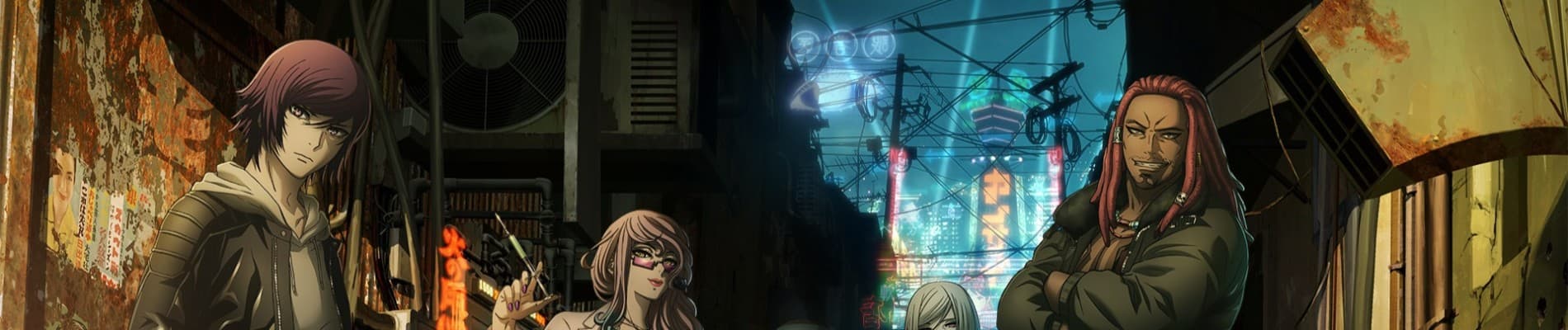
What really helps the show as it goes on is how incredibly self-conscious every character is. Kodaka’s work on Danganronpa proved he could be adept at creating characters with instantaneously recognizable designs and personality traits, and that carries through here as Rui Komatsuzaki’s designs translated to animation. Each one has a very distinctive look that gets their outlook with high expression values. From Doctor’s more slit eyes in conjunction with her lipstick and colored hair, to Brawler’s combo of dreads and vests, Cutthroat’s almost ghostly appearance clad in white, or the ever expressive big eyes of Swindler, there’s a lot to glean from an artistic standpoint to make each character stand out.
But that self-consciousness for the most part carries to individual writing in the same way. Courier’s on the job mentality remains consistent throughout the whole series as a reflection of how he views the world against the absurdity of his bike, and Hoodlum’s intention to constantly play himself up with the Joker color scheme follows through with his character from beginning to end. Every character is as they are, so it doesn’t feel like depth or comedic asides are obfuscated; they're inherent. The divide between characters that have these insane superpowers and those that lack them is also capitalized on, much to my surprise. Swindler, Hoodlum and Apprentice are barely pieces in a world that moves along without them, and the show realizes that when sprouting its arcs for them while it progresses. Now, this isn’t to say this always works. Cutthroat’s relatively simple masochistic killer schtick works out when he’s paired up with equally big-headed figures, but when he’s isolated in Episode 9, it’s the closest the show ever comes to wiping out on the edge wave in punctuating the shock factor. The last two episodes do stress it a bit with the metaphors it wants to get across in a way that might seem weirdly out of place for the rest of the show’s tone, but ultimately I think its writing works out to its reason. The ultimate fates of the earnestly portrayed characters, the insane pacing and keeping the ball rolling with its plot make it rarely boring moment to moment. I wouldn’t say the insane thinktrain ever hits Baccano’s levels of intricate thought, but it’s damn solid attempt to make a 4-and-a-half-hour blockbuster narrative. The ease of immersion, constant momentum, and the impressive spectacle would help make the experience, even (or perhaps especially) for someone who may be tired of other anime and their meandering pacing problems.
Although there is a noticeable dip as the show nears its conclusion, for the most part the show’s presentation is to its benefit, which enhances the hype factor. Rarely will scenes be content with flat lighting. Ambient lighting is constant, really making the look pop compared to other anime of its ilk; particular in episodes 1, 4, 6 and 12. Even with how the distinctive color choices enhance the designs of the characters, it’s able to make the environmental lighting give scenes that extra sense of pop-rock. This does mean though that episodes like 3 and 10 with their lighter environments tend to show the weaknesses of duller lighting and CGI pedestrians in different scenes, and the TV censoring can’t show all of the violence in full display. There might be some ruminations on the nature of violence, but you won’t see it stop for the “cursed” cycle of revenge; it’s in service of that “go, go GO” manic energy.
But on a more positive note, the animation also borrows some techniques from the Danganronpa games to strongly distinctive effect, like the puppet skits to break up the action, and the way its locations are constituted as play sets for scene transitions. It helps make the compositions more artfully crafted than they might have been otherwise and helps establish trademarks of the style, which were ironically mostly absent in Danganronpa’s anime themselves. That playful, toybox feel to the plotting and structure is constituted with these particular transitions, as enhancements of the overall vision.
“Vision” is what I see in Akudama Drive; a “drive” to perpetuate hype cycles through its wildly self-conscious characters and insane yarn of plot. Its brief 12-episode length helps to alleviate potential tiredness of the style, while its art design and characterization create a strongly distinct feel to spot it within a crowd. Akudama Drive isn’t a show that’ll blow you away with its characterization or satisfy the logical brain of putting everything together in insane theory charts. But it will present the type of exploitation and temptation-fueled balance of style and substance you won’t get outside the medium, and on that level, I can say, you done good.
23 out of 27 users liked this review
