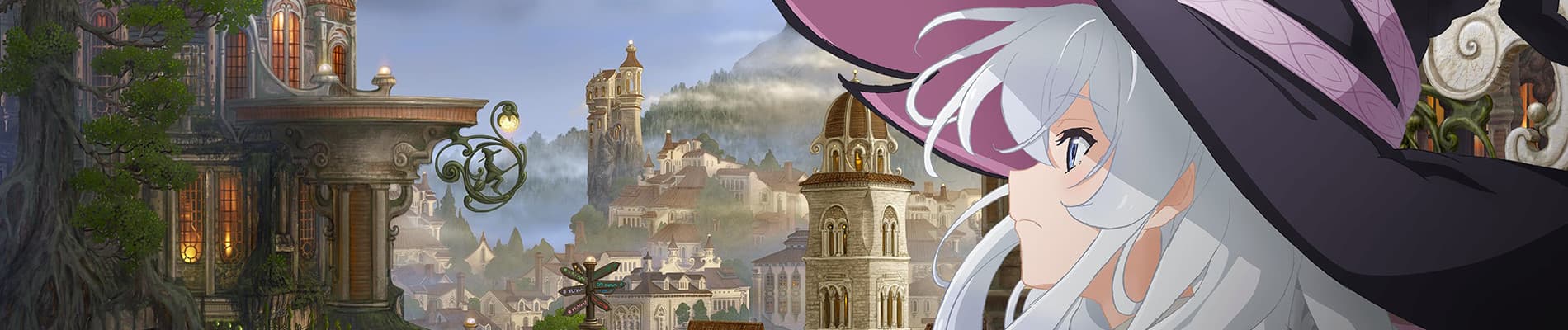
Apparently MajoTabi is not without controversy now that it’s ended. I got into it because of the SoL/cgdct angle at first, and then basically binged the whole show yesterday, so here’s my review, after a good night’s sleep, with everything still fresh in my mind.
Majo no Tabitabi (Wandering Witch: The Journey of Elaina) is mostly a traveling show in the sense of Kino no Tabi. “Countries” are usually depicted as wall-enclosed cities with some definitive trait going for them (like “Country of Truth Tellers”, “Country that is split in the middle by a huge wall”). For most of the show, Elaina takes her trusty broom and flies from one of these countries to the next, all the way writing about her travels. There are SoL elements in there, and the episodic construction definitely help that along, but it is not a feel-good show in the way e.g. Yuru Kyan is.
[from here on out: spoiler warning]
For the first episode though, we get treated with an origin story. Elaina’s, our protagonist’s, favorite books when she was a kid are “The Adventures of Niké”, stories written by her own mother when she was a wandering witch (this, of course, we only learn later). Her goal in life is clear: she wants to become a wandering witch just like Niké and she wants to do it now. Burying herself in her studies, she becomes a somewhat precocious child and manages to pass the Mage’s Exam at 14 (apocryphally something usually done by adults). After that, an apprenticeship with a witch is in order to become a full-fledged, card-(brooch)-carrying witch herself. After some struggles, she manages to find somebody who will help her in her goal: Fran, the Stardust Witch.
So far, so normal for an origin story. Here’s how the controversy, as I have understood it, starts. Fran’s approach to teaching seems very laid-back on the face of it, boiling down to using Elaina mainly as her maid around the house, until she breaks down frustrated that she isn’t learning anything. This, of course, is a trope in itself, whether the answer is “I wanted to see how long it took you until you broke” or “Actually, all the household chores were training”. In this case, it’s the former. Fran tries to break Elaina out of her general passivity, accepting all that is thrown at her. This is where I respectfully disagree with what most people don’t seem to like about this show: this is not a moment, afterwards entirely unrealized in the real world, in which Elaina learns not to be passive about the world around her.
This is, conversely, the moment where Elaina learns to take the reins of her own life, without regards to others. It is an individualistic message not too common in anime. She learns this lesson and then studies magic for a year under Fran, from the looks of it becoming one of the most powerful witches in the world. But during all that, she trains to become a wandering witch, not to become a wandering hero. From the get-go, her goal was never to set out and right the world of wrongs along the way, but to experience what the world has to offer regardless of what Elaina thinks might be the most moral.
And yes, she’s a bit conceited and arrogant. Big deal. Who isn’t conceited and arrogant during their teens? She’s got more going for her in this regard than most, given that her character is both beautiful and kinda OP, traits that she often expounds upon.
There’s another time-skip of a couple years, making her nearly 18 by the time she begins her journey. This is where it could’ve ended. The studio could’ve made up some countries with forgettable internals and just follow Elaina through her travels. And they certainly did that at times, with very lighthearted episodes. However, some of the episodes also contain quite dark elements. The difference in tone between episodes is often quite stark and, frankly, discombobulating, switching between yuri-bait with Saya (a mage's apprentice and later fully-fledged witch Elaina meets along the way) and blood-splattering killing sprees among monsters and humans.
Along the way, there’s always some kind of throwback to Niké, up to a full flashback episode about her two students, Fran and Sheila (who is Saya’s mentor). The whole show is extremely episodic in structure. Basically all plot points are resolved in a single episode, opening up the world to travel somewhere else without luggage from the past. The only overarching plot points concern characters.
The main critique I’ve made out from all this is that people see Elaina as inconsistent in her approach to problems in other countries. This is simply far from the truth. Elaina is almost too consistent in her approaches. She even spells it out more than once: “What’s in it for me?” Her priorities shift in accordance with what is most important to her at the moment. Sometimes it’s money. Sometimes it’s experience. Often enough it’s just not getting roped into things, and only the recurring characters, with which she has developed a bond beforehand, may have an influence on her internal decision process. Similarly to Main from Honzuki no Gekokokujou she’s a female character with libertarian traits and a not primarily nurturing or supportive, virtue moralistic role. It is 2020, folks.
The story is not perfect, of course. Especially the switching moods could have been addressed by a more consistent pacing, which is of course hard in a show as episodic as this. Some of the characters rely heavily on tropes to give them any semblance of personality, the shoutout to Harry Potter during the Magic Academy episode is overdone, and the parallelism between the relationships between the teachers and their students is similarly trite.
Both the OP and ED are beautiful, well-rounded and match with their songs, while the animation and backgrounds in general are clean and well executed, but nothing special. All these traits make MajoTabi a good anime. Not necessarily a great one, but an enjoyable ride nonetheless.
34 out of 40 users liked this review
