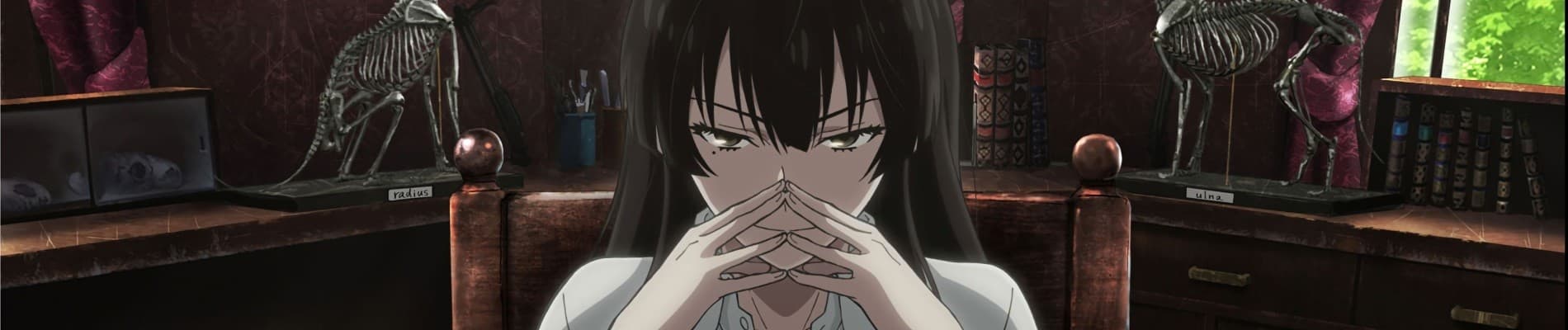
I can see a lot of potential buried in here, but I think it falls far short of the heights it could reach. This series follows a high-school student (Shoutarou) through a year of his life after meeting an aloof osteologist (Sakurako). Shoutarou accompanies Sakurako on a variety of field trips to search for bones for her collection, but they always wind up finding human remains. Sakurako immediately assumes a Sherlock Holmes role and Shoutarou acts as an audience surrogate requiring Sakurako explain her thought process. Once a body has been found and clues are being assembled, the circumstances of the deceased’s life come into focus. Some of the writing in these vignettes is powerful and moving. The characters the pair meets along the way have been written with true depth and empathy. Unfortunately, the show’s writing and pacing do not consistently develop and focus on these strengths.
Structurally, this show feels like it is oscillating between two narrative conventions which DO NOT mesh well. First is the obvious Sherlock Holmes detective story framework. Much of the series fits into this mold (and judging by the evergreen nature of this structure, it is quite effective for most readers/viewers). The show properly places and develops the aloof Sakurako as a Sherlock Holmes stand-in to great effect, including vaguely illustrating a traumatic catalyst for her generally shut-in lifestyle and extreme focus on work. From my reading, Shoutarou seems to be the Watson stand-in, an audience surrogate that mainly exists to force Sherlock to illustrate his logic. I think the writer’s choice to use Shoutarou as more than a framing device (as Watson is), is where the narrative power begins to suffer. Shoutarou’s ‘backstory’ is that he is a high school student and leads a self-proclaimed boring life. His transition from boredom to adventure could be worth exploring, but he seems to oscillate between abject terror and emotional mastery in difficult situations without a clear through-line of emotional growth. The writer also seems to attempt to overlay some standard high-school anime tropes onto this structure, which takes it off the rails for me. It is made abundantly clear that Shoutarou is very attracted to Sakurako. This is handled with occasional intrusive and unsettling male-gaze focus on Sakurako that heavily distracts any plot development or emotional table-setting being done. There is a ‘transformation’ sequence that plays out once the human remains are discovered in each episode. Most magical girl transformations seem to undercut the power being bestowed on the characters by exposing the (female) characters to male objectification as they are literally and metaphorically stripped and re-dressed. This sequence certainly does not objectify her in such an obvious way, but it is odd to me that the visual focus is on her rather than the skeletons in the background. My gut feeling is that there could be a more effective animation sequence that would let us see more into her internal thought process rather than just repeating what we already know: Sakurako is extremely knowledgeable about skeletons. Trying to cast Sakurako simultaneously as a Sherlock stand-in and occasional sex-object disrupts the high status of the character in a way that doesn’t quite sit right with me. Including these unnecessary male-gaze camera moves makes me think that the writer/director does not respect the character or the audience enough not to objectify her.
I believe if the writer/director was more confident in the audience’s appreciation for the emotional depth and intellect of the characters it writes, a structure similar to Mushi-Shi would serve it well. That series of proceeds as a series of vignettes which are only tied together by other people’s need for the protagonist’s expert knowledge. Shoutarou is a weak character that adds extraordinarily little to the story and only serves to smooth over otherwise-interesting character clashes with Sakurako. The writer also felt the need to add an overarching plot with a mysterious villain working from the shadows. Again, the Sherlock Holmes parallels are evident here. However, his reveal is horribly executed. He is given the least-menacing villain name I have ever heard, his motivations are transparent and nonsensical, and his machinations are too complex to allow for suspension of disbelief. Cutting both Shoutarou and the poorly paced overarching plot elements solves both major flaws in the series and opens some breathing room for organic character development for Sakurako and the people she meets in the course of her work. The last several episodes focus on a reforged bond between Shoutarou and Sakurako that don’t quite feel earned in my opinion. I think that arc could have been woven into a longer series of episodes more organically to truly work.
There are some truly electric moments throughout the series that show the writer has the skill to construct and pay off an emotionally resonant character drama in less than twenty minutes. What is most frustrating is that it feels like the same writer’s worst instincts (or a colleague’s) seems to have gotten his hand on the wheel and swerved it into oncoming traffic. If this show could sustain the power of those few episodes that really sing, I would probably give it a 9/10 (assuming they give up on objectifying Sakurako). As it stands, it’s a perfectly functional series with some minor and major flaws holding it back from being truly memorable.
27.5 out of 37 users liked this review
