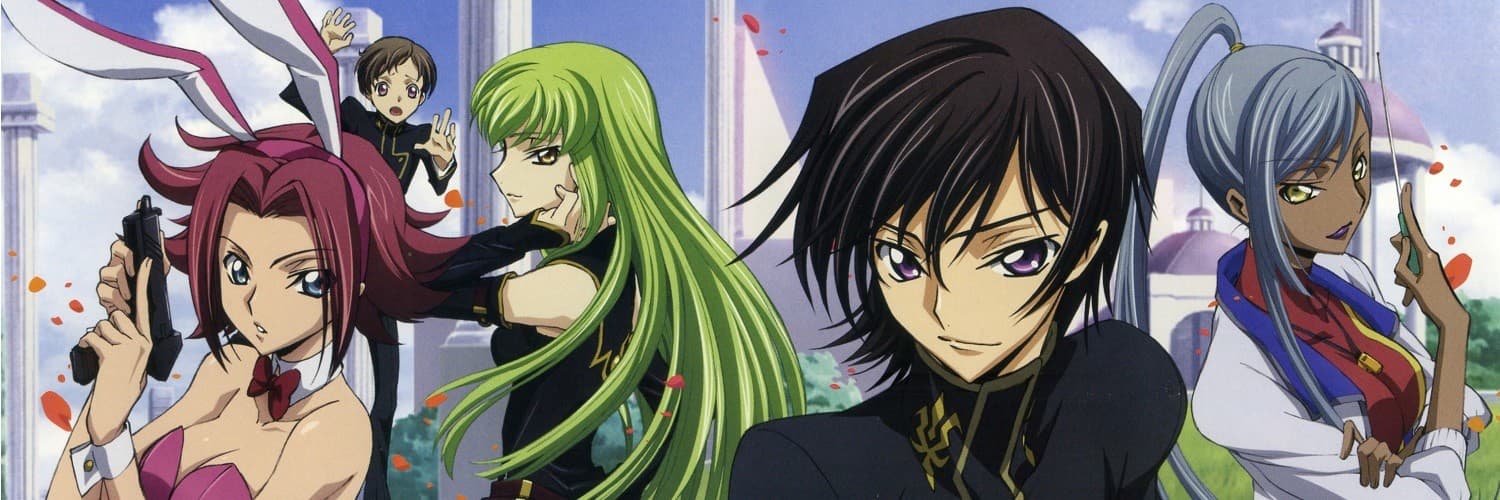
Code Geass is definitely a controversial series. The plot-holes, the slender character designs, the fan-service, the cheap ways it portrays characters as geniuses — all are aspects that are big turnoffs for some. I get why, but I think that despite all of that, Code Geass is an incredible anime with great characters, drama, themes, and even comedy. I really recommend giving Code Geass a chance, but if the criticized aspects that I listed are deal-breakers then please adjust expectations accordingly, because there are also Code Geass fans who make the series out to be perfect, which it sadly isn't.
BEWARE OF SPOILERS FROM HERE ON!
Well, I should clarify before starting that this review is loosely addressed to specific people with whom I've talked about the series and who don't like it at all. I'm not sure if I'm hoping to convert someone into believing that the series is well written, but I definitely want to condense my feelings on it into an essay. So, beginning from the facet of every story that I consider the most important...
The characters.
The highlight of the series for me is the cast and I honestly struggle to try and see it differently because the series is so focused on the psychology of Lelouch and how everyone else affects him. And that isn't to imply that other characters aren't explored apart from their connection to Lelouch.
What I think is often overlooked is the importance of the side of the story that takes place in the Ashford Academy. It's probably the most commonly criticized thing in the story, the argument being that the tone conflicts with the rest of the story and that it bogs down the pacing of the show.
I agree that the dark elements in the show aren't handled with tact, especially at the start, but they hold weight to the mental states of the characters, so I don't find it as outright disrespectful. And the character moments and developments which take place in the school are important to understanding how the characters feel and to see them interact and follow their relationships. It also doesn't exist in a vacuum, the plot developments outside are carried on in the school.
Personally I really like how the cast forms something like a family in the school while each of them has a different persona outside. It's charming, but also heartbreaking. We're constantly reminded of their old lives which they can't return to and it contrasts how they used to see each other and how that's changed.
The levity to the story which would otherwise be very dark and would risk being pretentious with the philosophical ideas that the characters give is also something I appreciate.
Anyways, I'll try to discuss the main characters individually.
First of all, Lelouch. Even for a main character, he is very much the soul of the series because it follows his mental state. We see how he gets power which allows him to act on his pent up ambitions. We see his ego growing from his successes and how he carelessly he uses his geass. He's surrounded by supportive people but he's alone in his quest. His drive becomes more and more clouded as he tramples over innocent people. Near the end of S1, Euphemia manages to make him give up on his lashing out and cooperate with the empire in a constructive manner, but tragically that future is lost and Lelouch gives up on some part of humanity in him. All that he has left to guide him is his desire to protect Nunnally and act vengeance for the murder of their mother. In S2, he realizes there are more people that he cares about, but he's put in opposition to everyone and he sacrifices himself to atone for everything and set the world on a right path.
I'm harping about this because of how many emotions and twists his tragic tale has. It's both heartbreaking and breathtaking. It's so effective because of how many people Lelouch is surrounded by and how he interacts with all of them: C.C., Suzaku, Nunnally, Kallen, Euphemia, Shirley, etc. Each of them impacts him in some way and plays an important role in the story and I'll get to them one by one too. Another reason is that Lelouch is a really multi-faceted character. I've described him in the past to someone who thinks he's bland and it went something like this: he's self-centered, passionate, ambitious, callous to those who have, in his mind, wronged him, self-righteous about his views, drawn to grandeur and spectacle, easily tunnel-visioned, stuck on his own perspective, and one aspect that culminates in the most interesting moments for his character is hiding and bottling emotions. And this definitely isn't everything you can say about his character.
Most of those traits are rather unlikable concepts and Lelouch is a very While many of those traits are rather unlikable concepts and Lelouch is a flawed individual, they're why he's so compelling and his struggle of remaining ethical in a fight for a good cause is muddied and made more complex by those traits. I mean Lelouch's motivation. He isn't fighting just for justice, his only driving force isn't a sense of right and wrong, but it's also a personal quest for revenge against his father as well as him trying to live life in a way he finds fulfilling. The multi-faceted nature is the reason for why it's so interesting.
I hinted at this before, but to elaborate on the last thing I mentioned, at the start of the show Lelouch had no outlet for his spite that he'd carried for almost all of his life. Since he lacked power, he was stuck, probably convincing himself that there's a path to achieving his desires while realizing that it was a hollow promise to himself and that he wasn't ready to throw his life away. He also couldn't abandon Nunnally. His life felt idle and purposeless to him and that's why he exploded when he finally acquired power to change everything.
The theme posed with his character is whether an individual has the right to hurt others if it's in the name of creating a better world. A revolution is almost bound to cause suffering to someone and people are caught up in it even if they're unrelated. It's not anyone's responsibility to fix the world but if someone tries to, then what's in their right to do? I can't really answer this question and although I have my own thoughts and beliefs, I won't go into them, because this is that sort of a question and the ending of the anime reflects the ambiguity.
There are two counterparts to Lelouch in this theme, Suzaku and Euphemia.
The first difference is that Suzaku is Japanese and hence is oppressed, so his actions have a very different foundation from Lelouch and even from Euphemia. This makes it all the more admirable that he's trying to change the system without violence, playing by its rules. The question with his character is whether it's right to prolong a discriminatory and oppressive world by prioritizing stability and safety. Euphemia is a special case because she's part of the people running the system, but she's just as good a counterpart to Lelouch and is actually the only character who defeats Lelouch's ideology as he resigns to cooperating with her. But first I want to talk about the criticism of Suzaku's character being inconsistent.
The point is that Suzaku's character doesn't make sense because at first he values the means over the results but later on he switches without a well established reason. Well, firstly, Suzaku wasn't always about the means. Before the events of the show, he was like Lelouch, killing his father to avoid the war escalating and destroying the country. That end was important enough to him to justify that, but he felt so much guilt and self-loathing that he stopped valuing his own life. He began looking for opportunities to redeem himself, putting himself in danger. His ideology also shaped up to be contrary to his past actions. So, with this context, why he changes in the show is because he fails to stop Lelouch from causing damage, so to put a stop to him, he lowers himself to Lelouch's level. Although he doesn't succeed in killing Lelouch even by firing a FLEIA, so yeah.
But to imagine an alternate outcome where Lelouch and Euphemia worked together and all of the tragedy could've been avoided... How wholesome the ending would've been... That's why what actually happens is so tragic, even if it's put together through a plot convenience. Euphemia was someone Lelouch could trust with his identity, the only person besides C.C., so the significance in accepting her death and using her to further the Black Knights was Lelouch's final step onto the path of destruction.
But the themes aren't everything there is to love about Code Geass. What I love the most is how Lelouch interacts with everyone and how the other characters perceive him. The dynamics his character has with everyone, even very minor characters like Ogi, are so compelling in my opinion, because they go through so many ups and downs due to Lelouch's mental state and how everyone is perceiving him.
And how this culminates at the end of S2 is so powerful because all of the characters are impacted by it. Lelouch who has lost everything. Suzaku who breaks from the trauma of firing a FLEIA. Kallen who doesn't know whether her feelings are real or the product of Lelouch's geass. C.C. who has lost her memories. Nunnally who is ready to fight against her brother. The Black Knights who feel betrayed. Everyone.
It's so frustrating as the audience because we know the intentions of the characters and that if things had gone just a bit differently then everyone would be a lot happier, but the web of lies and schemes that has lead into this point is so intricate and overwhelming. It's so hard to encapsulate this feeling due to how many parts it involves and that's why it's so mesmerizing.
This is also why Shirley's Geass being broken in S2 and seeing how everyone wears a mask through her is so powerful.
Well, there's a lot more to say, frankly, this is the tip of the iceberg, but it's already a huge wall of text, so I'll move onto addressing the flaws of the show in more detail.
In particular the Euphemia massacre. In of itself, in a vacuum, it's the most impactful scene in the series, at least in my opinion, and I think it's one of the most emotional scenes across the board. It's strengthened by how great Lelouch's and Euphemia's dynamic is too. Euphemia is the only person to truly defeat Lelouch's ideology as she managed to actually make Zero redundant and unnecessary. But what I wanna talk about is how the scene happens.
The infamous words of, "I could even make you kill all of the Japanese".
Well, it does kind of fit Lelouch's character as a concept. He likes to boast, and he didn't know his Geass had reached the stage where it's uncontrollable. But it's still shoddily put together and absolves Lelouch of blame in the eyes of the audience. It gets even worse if you consider that the Geass issue doesn't become a part of the show and is patch worked with simply putting on a contact lens.
It's the highlight of Code Geass's writing problem. The logic is abandoned for the sake of drama. And although I'd like to be able to confidently say it's always a necessary sacrifice, it really isn't, it's convenience. Whether you can accept this flaw is basically the question of whether you can truly appreciate Code Geass. It's fine if you can't, but there's still a lot to love in Code Geass.
Well, this review glosses over a lot, especially the issues in presentation and some of the minor characters switching sides on a whim, but well, I think I got some of it down. Hopefully.
44.5 out of 48 users liked this review
