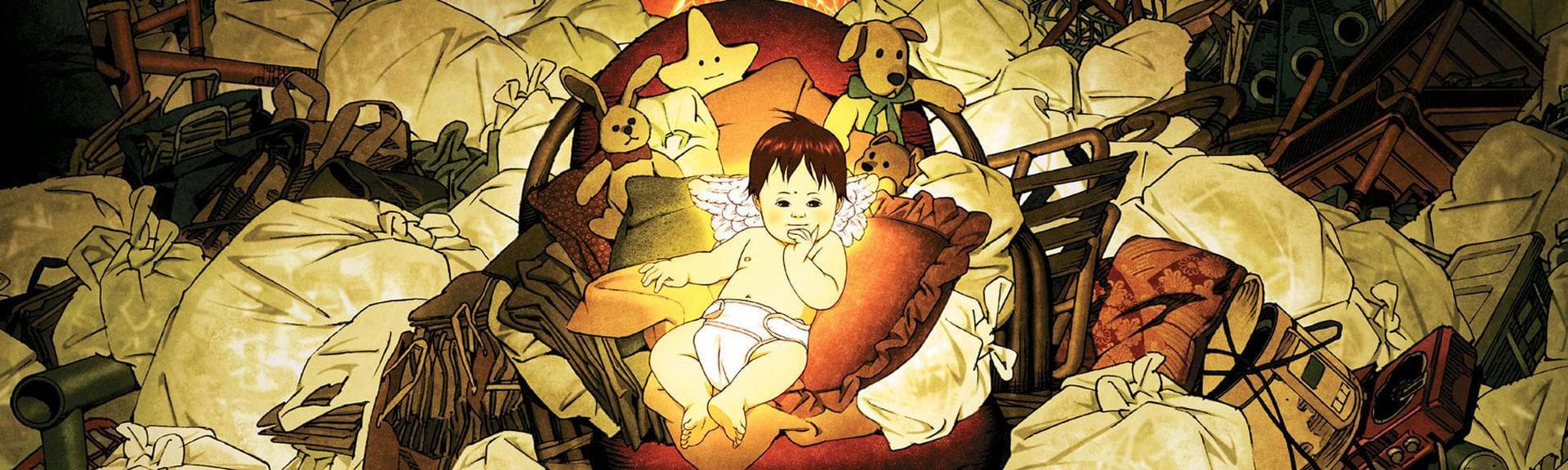
Tokyo Godfathers is a funny little paradox of a movie. On the one hand, it’s possibly the most unusual entry in Satoshi Kon’s body of work. On the other hand, it’s so unusual precisely because it’s not unusual at all. There are no reality-bending twists at play here, no dreamscapes that overtake the real world, no surreal Big Ideas that blur the lines between fantasy and reality until you can’t tell the difference between them anymore. This is Kon’s first work that takes place almost entirely in the real world, dealing with characters living fully in their reality and grappling with the struggles that arise from it. And yet, it somehow remains just as magical as his more outwardly surreal works. Why? Because this is a Christmas movie, and what good is a Christmas movie without some seasonally appropriate whimsy and a few minor miracles of love and family scattered in for good measure? Yes, not only is this the first time I could call Kon’s work grounded, it’s also the first time I could call his work genuinely uplifting, as opposed to cynically tense or poignantly tragic. The result is a big departure from what I’m used to with him, and it’s a welcome one: Tokyo Godfathers is charming as hell, a homely little fairy tale bursting with the spirit of the season.
The story centers around a trio of homeless people living in Tokyo. Gin is an middle-aged alcoholic with a bad temper. Hana is a trans woman with a vest for life and a desire to be a mother. Miyuki is a teenage runaway scared of facing her parents again. Together, they form a rough sort-of surrogate family, but the demons of their pasts keep them at arm’s length, sniping at each other and unable to let their guards down. That all starts to change one Christmas Eve when they stumble across a baby abandoned in the trash and decide to try and track down its parents. Thus begins a scavenger hunt through the Tokyo streets as they search for clues about the baby’s family, an odyssey that brings them into contact with all sorts of colorful characters, from mob bosses to Latin American immigrants to beleaguered cab drivers. And over the course of their adventure, they confront the choices and mistakes they’ve made, the regrets they left behind, and, of course, the true meaning of family. Hey, it’s a Christmas movie, you get what you pay for.
Okay, all joking aside, I actually want to highlight that point, because it’s in exploring the idea of family that Tokyo Godfathers ends up being as good as it is. Because this movie understands full well the complexities of real-life families beyond the happy, smiling ideal. Hana, Gin, and Miyuki all have complicated relationships with their real families, and while some of them desire to reconnect to what they lost, some of them don’t. And as they continue tracking down the baby’s parents, it becomes apparent that there were equally complicated reasons why it ended up in the trash in the first place. This isn’t just some treacly message that “family is everything,” this is an actual exploration of what it means to call yourself a family, what it takes to make a family worth fighting for, how communities of people can come together and give each other comfort across all walks of life. It acknowledges the ugliness and hard realities that a lot of people have to face. But it also acknowledges the incredible power of love to bring people together, to help us overcome our worst instincts and keep fighting to be better.
And it’s in that sympathetic writing that this film’s Christmas spirit truly shines through. Tokyo Godfathers isn’t afraid to go to some tough places, touching on issues of family abandonment, suicide, and especially the stigmatization of homeless people in “polite” society. A lot of the time, the conflict is driven by the characters merely existing in a public place where they “don’t belong,” and the internalized shame of that feeling hits them all differently. There are moments in this movie that really struck a chord with me; the raw emotions its characters go to are impossible to look away from. But just as it’s a film capable of exploring that grungy darkness, it never forgets to go back to the light, showing how this ramshackle family looks after each other and helps each other keep moving forward. The world may be a dark, scary, unfair place, but the bonds we forge can give us the strength to face that darkness down together. And yes, it is pretty freaking cool that one of the main characters in a movie from 2003 is openly trans, eminently lovable, is just as complex and flawed as her fellow protagonists, and gets a whole arc dedicated to exploring her trans identity. That’s not something you see a lot of in anime even today.
I also want to shout out just what a damn well-made film this is. I know it’s no revelation to call Satoshi Kon a great director; he proved his chops as a genuine master of his craft long before Tokyo Godfathers came out. But even without his usual surreal flair, this movie is a sight to behold for one reason: the character animation. This is, without a doubt, some of the best, more expressive character animation I’ve ever seen, striking a pitch-perfect blend between Kon’s usual hyper-real styled and more expressive cartoonishness. You’d never think designs this complicated and heavily textured could animate with this much life and energy but god dammit, Kon makes it work. Every single expression, every single body movement, whether for comedy or drama or anything in between, makes these characters pop off the screen like few others. It makes even the grungiest, ugliest gutters of Tokyo feel like a place you could call home, if only you had people you loved beside you picking you up when you fall down. As perfect a distillation of the spirit of Christmas as there ever was.
Truth be told, I can’t really think of any flaws this film has. Maybe a couple magical moments of deux ex machina too many, but again, it’s a Christmas movie. If I’m not here for sentimental sap, I’ve come to the wrong place. The only reason I’m not rating it higher is because it’s just a little outside the kinds of shows and movies I’d consider my favorites. It’s a very good film, it’s just not one I feel like I love. Rest assured though, Tokyo Godfathers is a fantastic movie and yet more proof of Kon’s immeasurable skill.
12 out of 12 users liked this review