__Spoilers ahead;
Feel free to agree or disagree.__
Have a good read!
Introduction
Devilman Crybaby is an anime directed by Masaaki Yuasa and produced by Aniplex and Dynamic Planning. It is the fourth adaptation of the classic 1972 manga Devilman, however Yuasa brings a new vision to the work. Released by Netflix in January 2018, Crybaby has not gone unnoticed, being heavily commented on anime and movie websites. The animation has only 10 episodes and adapts the entire manga.
Synopsis
Thousands of years ago the Earth was dominated by demons. These beings lived fighting among themselves and merging with other organisms in order to become stronger. God, angry with these creatures, destroys them, but the spirits of the demons remain on the planet.
In the present day, Akira Fudou is a member of the track team, along with Miki Makimura and Miki Kuroda, and is the least talented member of the team. However, Akira's ordinary everyday life changes drastically with the appearance of his childhood friend Ryou Asuka, who reveals a terrible secret involving his late teacher's research. Ryou tells Akira about the existence of demons, but these creatures are immaterial and need to possess other beings to have a physical form. According to Ryou, the demons are possessing human bodies and disguising themselves in society.
He intends to expose the identity of the demons to the world, but needs Akira's help, so the pair heads to a nightclub, but things get out of control, both are attacked by demons and Akira is possessed, but somehow Akira managed to keep his consciousness and gain the powers of a demon. This is the birth of Devilman, neither man nor demon. Now Akira must face the demons and protect humanity, while at the same time he must hide his identity and fight his demonic impulses.
CharactersAkira Fudou: Stereotype of the shy student who is not good at anything. He is extremely sensitive to people's sadness. He lives in the Makimura residence, since his parents are always traveling the world. He is possessed by the demon Amon and becomes Devilman, changing drastically in several aspects. With his new powers, he fights for the safety of humanity. He has feelings for Miki.
Ryou Asuka: Akira's long-time friend. He is a prodigious scientist and is very influential in this field. Ryou intends to reveal the existence of demons by applying unorthodox methods. He is responsible for Akira's transformation into Devilman and helps him fight against the demons.
Miki Makimura: Popular girl and star of the track team, Miki always sees the best side of people, which is sometimes a problem. She treats Akira like a brother and is often saved by him in difficult situations.
Miki "Miko" Kuroda: She is also a member of the track team. She sees herself as Makimura's "shadow" and feels overshadowed by her. Kurado seems to be based on Mikiko Kawamoto from the Devilman manga.
Crybaby features other classic characters from the 70's manga, such as Silene, Kaim, Jinmen, Taro Makimura among others, but also new ones, such as rappers replacing Dosu-Roku and his gang of bullies and the athlete Koda Moyuru.
Audio-visual
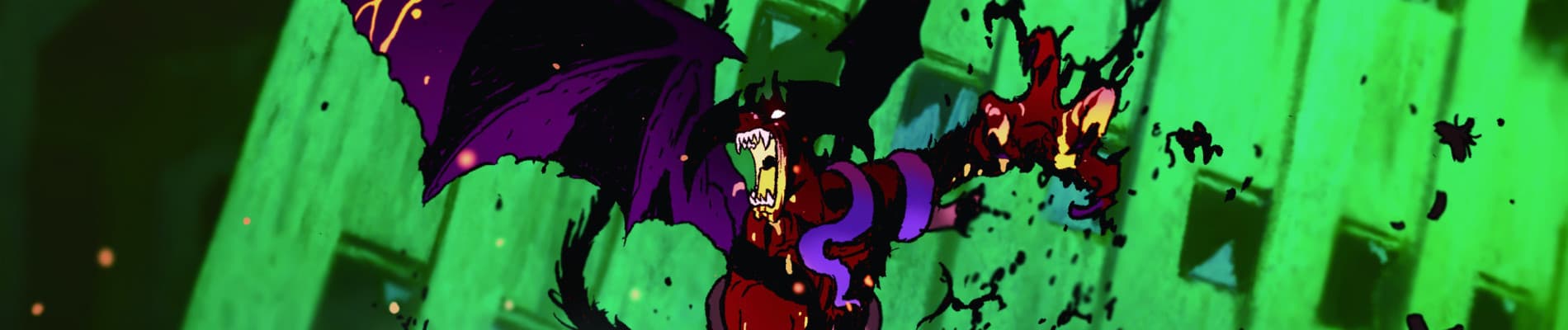
At first glance Crybaby draws attention by its animation style, being inconsistent, poorly detailed and disproportionate. Despite being non-standard, Yuasa adopts similar practice in several other animations such as Kaiba (2008) and Tatami Galaxy (2010). The use of color palette is a point that stands out, for example, the manipulation of the shades of red with black, managed to make the scene of Akira's first transformation into Devilman more emblematic.
Crybaby's soundtrack is another
highlight, making use of Electronic music, Techno, Synthwave and other types, making the sequences much more frenetic. Night Hawk and Strategist are some of the highlights, in addition to the classic Devilman no Uta song.
My Experience
It is clear that Masaaki Yuasa molds the plot of Devilman to the present times, as well as giving his personal touch to the narrative and characters. Nevertheless, Crybaby maintains the essence of the original material, i.e. they changed the packaging, but the product is the same. The differences in the anime even improve some aspects of the original. As for the characters, Miki Makimura has more presence and gets her moments in the plot, unlike her original version, which spends much of the manga flirting with Akira and serving as comic relief. These changes can create a more consistent bond between the character and the viewer. It also better establishes the friendship between Akira and Ryou, plus it significantly introduces Fudou's parents. The 2018 adaptation throws social criticism in several moments, especially prejudice, whether in the scene where the rappers are harassed by the police or when Miki, in her childhood, suffers bullying for being mixed-race.
The manga is remembered for its violence and sexual content. These elements are present in much of Devilman, and to take them out would be strange. However, Yuasa takes these points to another level, especially the sexual aspects, and gets the dose wrong. The confrontation between Akira and Silene is an example. But there is not an absolute focus on these scenes.
As for the demons, in the original version there is an established explanation for possession, since a demon can only possess a human body that has abandoned reason, an important fact in the origin of the devilmen. In the new adaptation this explanation has been dropped, the demons merge with humans left and right, and sometimes create dramatic moments. Some work, such as the end of the Makimura family, while others do not, such as the fight between Akira and Jinmen (Reijirou Fudou, Akira's father), and the weight of this event is quickly forgotten.
Devilman deals with many themes, and Crybaby is no different. The work shows how cruel and destructive human beings can be. Thomas Hobbes says that man is evil by nature, for he possesses unlimited power of violence, and uses it to preserve himself or his property. The philosopher was responsible for spreading the famous phrase "man is the wolf of man," summarizing that man is his own enemy, killing his fellow men, i.e. every man is potentially a threat to another man. The anime manages to display such reasoning, so much so that the key factor in the ruin of mankind is man himself. On the other side, the demons, seen as violent and emotionless beings, unite to achieve a common goal, while humanity is divided, obviously there are other variables at work, but the point is that demons can have feelings, as the relationship between Silene and Kaim, being considered by Akira as love. So we can think that there is not a big difference between humans and demons.
Another point of emphasis is the use of the media to spread intrigue and hatred. Sociologist Stanley Cohen theorizes that the media acts by distorting the context of those whom society considers to be outside the norm by creating the image of "demons," resulting in the construction of moral panic. Ryou uses such artifice to generate chaos and panic, claiming that individuals with divergent behavior are subject to becoming demons, making them a threat to humanity.
In addition to the aspects mentioned, Devilman Crybaby has strong religious themes, especially Christian ones. The painting of the Last Supper in the Makimura residence, the bible, and several others, appear expressively in the episodes. However, the highlight is Ryou Asuka, who embodies the role of Satan.The etymology of the word Satan means adversary or opponent. In Crybaby this being is Akira's adversary, and in the beginning, God's opponent. In the Bible he is considered an "angel of light" who became a rebel. In the anime these characteristics are maintained, being a creature of splendor and provokes a rebellion with the demons to challenge the Creator. In verse 09 of Revelation, it is evidenced that Satan is overcome and cast to the earth. A scene from the first few seconds in the first episode. In Revelation 12:12, it is said that there was joy in heaven, and sorrow for humans, influenced by him on Earth, where Satan acts intensely. In the adaptation Ryou Asuka (Satan) is a great manipulator, since the beginning of the anime he pulls the "strings" and influences the events of the story. Although Devilman has biblical references, these should not be taken literally. In the scriptures Satan is seen as a purely evil being, however his version in Crybaby feels love for Fudou Akira, even though he claims that love does not exist, nor does sadness, yet he finds love and knows sadness and possibly repentance. In the animation you notice that Satan has done the same as God, only this time he annihilates human beings. In the end, God and Satan are not so different, that is, there is no Manichaeism in Devilman.
Conclusion
Devilman Crybaby has its differences, however the end result remains the same as its original version, however it has its stumbles, and suffers from the reduced number of episodes, making it quite rushed. The animation may be strange, but with time you get used to it. The unglamorous fights, violence and sexual content may turn some individuals off, Masaaki Yuasa's exaggerations also bother. Devilman is quite divisive in opinion, however, like it or not, it is a source of inspiration for several works, either directly or indirectly.