
Imagine you are going out for a beer with your 27 year old buddy one day. As you guys exchange pleasantries and catch up on life, he mentions, "you know, man, I've recently been thinking about dating my 15 year old sister. I think I love her." Regardless of how open-minded you may be, the absurdity of this statement would take anyone aback, and assumptions would begin to pile in your head. Is he a pedophile? Why the hell does he want to be with his sister of all people? Is he coercing her into sex against her will? I believe that no matter how much you want to rationalize good will on behalf of your friend, the vast majority of people would struggle to sympathize with his desires. Hell, I would too. How would you go about judging him? Do you wait to hear his story and try to give him some benefit of the doubt, do you write him off as a self-absorbed predator/pervert and ignore him, or do you stand up to him that very moment? If the very idea of trying to listen to his story without completely assuming bad intentions and omitted details on the part of the 27 year old (different from skepticism) is beyond you to even consider doing, as in you would laugh at the idea of trying to give him any benefit of the doubt, then this show is not for you. As I had already mentioned, for what it's worth, I'd probably assume bad intentions as well and be thoroughly disgusted on my initial reaction, and most likely laugh because I would believe he was messing with me, but I would at least like to hear the details before I pass final judgment.
Koi Kaze is not an easy show to enjoy. Consistently sobering in tone, there is hardly any letup or comedic relief to brighten the mood. It deals with its taboo subject matter, incest and age gap romance, in a non-exploitative, realistic portrayal that takes some getting used to fully absorb without the kneejerk reaction of visceral disgust. The subject matter, if not dealt with tactfully, can easily fall victim to depraved and/or thoughtless nonsense, particularly wish-fulfillment fetishization that glamorizes controversial subjects while glossing over the downsides. Luckily, Koi Kaze is not a show that indulges in that. Not only that, Koi Kaze is not preachy in the least; it presents ideas with no expectation that the viewer is reprehensible for disagreeing with its insinuated themes, but instead, asks the viewers to keep an open mind and understand the psyche of our protagonists Koshiro and Nanoka. This slow-burning, tragic romance is one that takes an open-minded individual to appreciate, and is certainly not recommended for everyone. However, for those who are willing to push aside their preconceived notions, I believe this show can be a treat. Not a pleasant treat, but a treat nonetheless.
Koshiro is a man ten toes deep in depression. So accustomed to the doldrums of adult life, he faintly acknowledges at the beginning of the show, dazedly musing at his disheveled face in a train station bathroom, the fact that Spring has finally rolled around,

"It's been a while since I stopped caring about the change of the seasons... How important is the meaning that it's Spring now?"
Finishing this inner monologue of his, he almost forgets his work bag going out. This blurring of the passage of time speaks volumes of the life he has been living up until this point. It's as if every little memory he has created on in his daily life could be just as easily forgotten as that bag he almost left behind. Everything seems to have obscured into an insignificant cloud of existence without meaning. Estranged from everyone except a friendly coworker in Chidori, his father who he has naught but a cordial relationship with, and an ex-girlfriend who he never even loved, it is no surprise that he feels the way he feels. To the critical eye, he is a lifeless, unambitious, gloomy sad-sack who is feeling particularly sorry for himself. While Koshiro could probably stand to do more to better himself, this is not a story about self-improvement, discipline, and conventional character growth. It's far more personal, and in my view, powerful. The story of Koshiro is much more about the story of a person whose emotional needs were never, ever met in his life, and for the first time discovering what it means to authentically feel. In a flashback in episode 4, Koshiro recalls his ex-girlfriend asking him, "Koshiro, have you ever felt a longing for someone from the bottom of your heart?" In the present, he retroactively responds, simply, "No." It is not out of a lack of desire, however, as we learn in episode 8, despite his own love life being in shatters,
"I wanted to be close to people so I can see them smile and cry. I wanted to put myself in a place where people can meet and separate. Maybe I’ll be able to do as they do, someday. That’s what I thought."
But this could not be any further from the truth up till this point in his life. He has been indefinitely consumed, most likely for numerous years, by an apathy and loneliness that has left him dismissive of cultivating any meaningful form of intimacy. Additionally, I believe Koshiro suffers from Childhood Emotional Neglect. As we see, again, in episode 8, through Koshiro's past memories, ever since he was a child, he has had trouble expressing himself. Although never explicitly mentioned, I can assume his emotional needs were never met by his parents because they were caught up in their own divorce, while Koshiro essentially had to figure things out by himself. All this has lead to Koshiro being the awkward, loveless, and emotionally inept person he would eventually become as an adult. However, these jaded feelings soon change when he coincidentally meets again with a 15 year old girl he returned a train pass to after her dropping it, deciding to go to the nearby amusement park with her after receiving some free tickets from his work. After sharing a heart-to-heart about their past breakups in a ferris wheel, Koshiro begins to feel something he has never felt before in his life: love.

These feelings soon morph into self-hatred and dismay after learning that this girl, Nanoka, is in fact his sister. The apathy that had once robbed his heart of intimacy has now been pierced, opening him up to an unknown world. What should feel like salvation and relief has instead become complete and utter turmoil. In an attempt to salvage himself and protect her from his own feelings, Koshiro turns to berating her, ignoring her, and generally acting like a jackass to her for the first half of the series. Though he may have benevolent intentions, he still falls victim to his own desires, doing highly questionable things like sniffing her underwear and masturbating to her. These acts bring him towards a deep downward spiral of agony, paranoia, and self-hatred that are emotionally palpable.
Though they eventually learn to reciprocate each other’s love, it was never a pretty process. The trials to reach fleeting moments of love and joy are quite slow, yet uncompromisingly direct in revealing what each characters go through. Little is left up to imagination. This show blurs the line between fiction and reality by uncovering humanity at its weakest, most fragile, and most humiliating moments. Frankly, however, I found myself empathizing far more with the pain and suffering of Koshiro than any western romance movie. His character arc isn't some success story of revenge or overcoming insurmountable obstacles; it's dealing with shitty circumstances to the best of his abilities. Perhaps it may be my own sadomasochistic mind that indulges in this sort of material, but I digress. It is presented with this delicate balance that is simultaneously not intentionally made to garner meaningless, cheap sympathy, nor is it trying to make us hate the character. The show, more than anything else, encourages understanding rather than judgment, which sounds cliche, but it is incredibly difficult to slickly pull of. The main reason why is that it is presented realistically, with no cent of authenticity spared. The depths to which the Koshorio's emotions, ranging from longing to alienation to loneliness to denial to jealousy all coalesce into this very human tale that is only reached by a very select handful of dramas across any mediums. Stripped of this superfluous drama and instead focusing a more focused, personal experience, Koi Kaze matches Koshiro's experiences to be equal to that of an average existentially lost and lonely 20-something.
Now, finally, onto the most controversial part of the show: the ethics. In my view, the author wanted the viewer/reader to come to five conclusions at the end of the show:
Evidence: We see this when we learn about Koshiro’s true feelings towards his ex (and we can assume his previous ex’s): “I wasn’t having a relationship with her just for sex. But even if I was, I don’t think that’s so wrong. Is loving someone such a big issue? Is longing for someone something you can be so proud of? What kind of feeling is ‘longing for someone’ anyway?” (episode 4) We learn from this through insinuation that Koshiro was actually just sticking with her from the sex, despite what he says, and I believe this conclusion can be generalizable for his previous relationships as well. When talking about his feelings for Nanoka in episode 11, he mentions, “I felt this way for the first time in my life.” Though it may be subjective, I do not believe this is simply infatuation, which primarily consists of lust (though it may be of influence), I believe this is love.
Evidence: We see this around episode 6 as she comes to terms with her own feelings. Also, towards the end of the series, Chidori, arguably the most mature and well-grounded character of the series recognizes this when she is chewing out Koshiro for wanting to be with his sister, apologizing to him for placing all the blame on him because Chidori recognizes that Nanoka’s feelings are legitimate, but also chastising Koshiro for not being the “adult” and ending the relationship before they would run into real world problems.
Evidence: We see this at the end of the series with a metaphor when Nanoka and Koshiro write their names in the trees at the amusement park area, and the contractors decide to tear the trees down. One of the contractors mentions, “Developing big shopping malls in suburban areas is the recent trend... There are more people who want the mall built than people who object to it.” Essentially, majority rules, society won’t allow their relationship to exist.
Evidence: Time and time again, Koshiro knows in his heart-of-hearts that he has to separate from Nanoka and/or keep a firm distance from her to preserve a standard brother-sister type of relationship. There are a large pool of quotations from the show detailing how he wants to preserve that relationship and him hating himself for having the feelings he does, but despite all the self-restraint, he is overwhelmed by his own emotions when Nanoka reciprocates his love. Even at the end, Koshiro has an internal monologue when Nanoka tries to approach him to convince himself that he needs to stop this, but he can’t. Koshiro logically knows and wants to convince himself to just shoo Nanoka away to avoid the pain that is certain to come, but he can’t. He loves her too much. His feelings overwhelm him. “I don’t need anything. As long as I have you with me, I don’t need anything.” (episode 12) Though this may be indicative of somebody who is simply just lovesick, are these feelings necessarily wrong?
Outside of that, though the author may want you to ultimately come to the conclusion that incest is at the very least morally neutral between to consenting, genetically related adults (age of consent in most prefectures in Japan is 16 years old, not 13 like it is at the base national level, from what I understand) who are in love, that is much more in the hands of the viewer/reader than anything else. Nowhere in the show are the viewers given any indication that incest is inherently good. Is loving and feeling loved by your 15-year old sister an ethical situation to inject yourself into and pursue? Though I can genuinely understand the lovesick, depressed state Koshiro is going through, and resonate with the desire to connect with the one person who makes him feel something, anything for the first time in his life, I cannot with full confidence condone his actions. Though Nanoka is seemingly precocious and understands the situation, it is only after being lectured by Chidori that she reflects on the reality of her love. I have learned time and time again in my life that I would not engage in the same potentially life-changing decisions I had confidence in when I was younger compared to my present/future self. Though love will always be emotional, still balancing it with the wisdom that comes with learning the accountability of one's actions later on in life is crucial to making any life-altering decisions. Indeed, people need to learn to trust their gut sometimes, and even learning to overcome the failures of their intuition, giving a 15/16 year old the decision to permanently alter her life is negligence and immaturity on the part of the 27 year old, even if their feelings for each other are genuine. Nanoka can say she understands what will happen if they stay together and even be willing to commit suicide with him to avoid becoming socially outcasted in its most extreme forms (no jobs will hire, potential imprisonment, cutting ties with families and friends, earning the scorn of anyone who knows their situation, etc. etc.), but it's beyond me to grant that responsibility to her and approach it with fully-processed rationale.
In playing devil's advocate, I think a few conclusions can also potentially be drawn as to inethicality of their relationship:
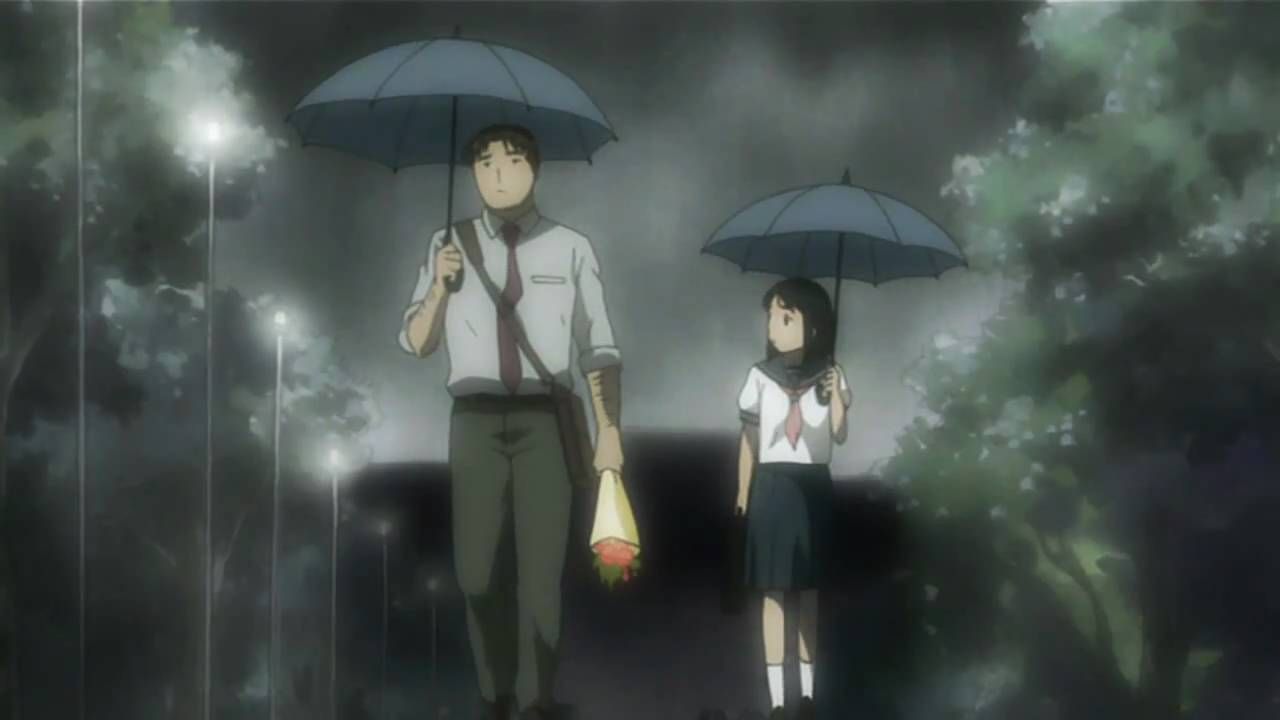
Luckily, I think one thing changes the nature of the relationship and gives me hope for a future in which Nanoka and Koshiro are at a level playing field: the promise to meet once each year at the end of the show. From my understanding, the ending of the show implies that the relationship will not be accepted in society, so they will meet up once per year in order to keep their distance while still maintaining some semblance of intimacy until they are ready to move on in their relationship. Perhaps with Nanoka maturing into her own, separate from Koshiro, can their relationship become one that isn't simply all temporary sparks of emotions and love, but instead manifests into one with the benefit of hindsight and earned wisdom learned from years of self-reflection and maturation on the part of each characters. So, with this in mind, my approach to this relationships is similar to that of Chidori in episode 13 in her final farewell to Koshiro,
"I won’t say good luck, but please take care."
Anyways, Koi Kaze is a fantastic show regardless of my ambivalent attitude on the ethics of the show. The bittersweet, melancholic tone and harshly accurate portrayal of depression and societal estrangement are unmatched across all artistic mediums. I find it difficult to not want Koshiro to find happiness despite his sometimes pathetic and immature shortcomings. Both him and Nanoka are not bad people. I know I run a slippery slope by saying this, at a subjective level, I think genuine human intimacy and close relationships are integral to the human experience and find it incredibly disheartening to see somebody not attain that. I'm partial to him because I deeply resonate with some of Koshiro's experiences (depression, loneliness, apathy). Therefore, I find it reassuring that the author had the artistic wherewithal to express my particular experience in an this show, because it's something that's very rarely captured well. Does it have to be his sister? No. But it has to be someone that he truly appreciates and makes him happy. Same principle applies to Nanoka.
Devoid of the irony, comedy, rushed pacing, sporadic tonal shifts, and sensory overstimulation the vast majority of shows demand of you, this show instead invites you to focus and look deep within. Much of the runtime consists of Koshiro and Nanoka in quiet pondering or observation. There's long periods of silence, with no music or dialogue to engage the viewer. It's really unsettling in that sense, because it does not pull any punches with the relevant, but difficult emotions and experiences that often go unexplored, bordering on second-hand embarrassment you get as the viewer in the awkward situations Koshiro finds himself in. Koshiro's blundering, boorish, and thoroughly uncharismatic nature certainly exacerbate that. It makes for a show that is admittedly one-note in nature (melancholic, awkward, somber), but unlike any other I've seen. Koi Kaze also subverts fictional orthodoxy, leaving problems in a constant state of being in flux. It's seemingly one complication after another that never fully fixes the underlying problems in Koshiro's and Nanoka's world, relaying oftentimes unfortunate truth that every good comes with a cost. Even in conveying all this, however, Koi Kaze never feels forceful, melodramatic, or like it has an agenda. Though they have their own merits in what they accomplish, that's why shows such as Evangelion that has a plot focused on mechs and cute anime girls (with it just being a vehicle to explore how broken the characters are) or a show like Welcome to the NHK (which is one of my favorites, but uses black comedy to get its point across), lack the same consistently straight-to-the-point dramatic fervor which really captures the human experience without any distractions. That's why Koi Kaze is the most realistic show I have ever watched, regardless of medium. Storybook lifestyles with ridiculous fictional circumstances have been milked to no end, and it is rare to find one so humble and seemingly unpretentious with this level of depth in comparison. So, with that being said, yes, Koi Kaze is a controversial tale, but a truly human one at its heart that has quickly become one of my favorite shows of all time.
(Edit: small grammatical and phrasing adjustments to the paragraphs. Added a few extra thoughts. Also raised score from 85 to 95)
56 out of 61 users liked this review
