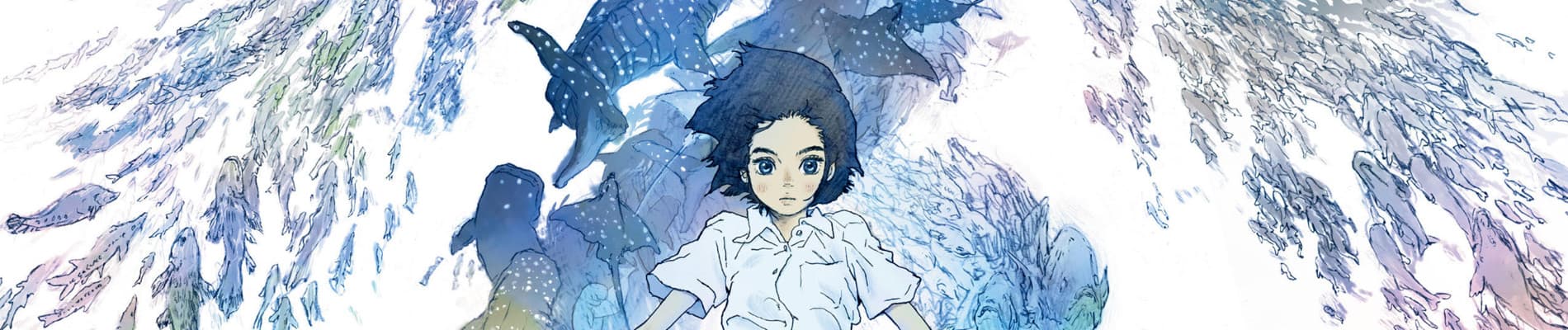
The best word I can think of to describe Children of the Sea is “overwhelming.” It’s not so much a movie as it is a whirlwind of sensory experiences, music and sound and color and light clashing and colliding like the tumultuous waves of a stormy sea. It’s a cascading tsumani of pure artistry painted on a stunning canvas that builds and builds and builds until whatever grip of reality you might have once had is shattered and you’re swept away by the sheer explosive wonder of it all. It’s perhaps a more purely “cinematic” experience than any film I’ve watched in a very long time. Certainly, it’s one of the single most gorgeous pieces of animation I’ve ever watched, period. And if you’re at all interested in checking it out- which I think you should- the best piece of advice I can give you is this: don’t bother trying to understand Children of the Sea. Just feel it. Experience it. Let it flow over you and around our and through you and fill every pocket of your mind and soul with its presence. I promise you, you’ll be better off for it.
The story, so much as it matters, centers around Ruka, a young girl who lives in a town by the sea. She’s listless and drifting through life, buckling under the pressure of bullying at school and her parents’ rapidly disintegrating marriage. But everything changes when she goes to visit her dad at the aquarium he works for and makes a shocking discovery: there’s a boy swimming with the fishes! His name is Umi, and he’s lived his entire life raised by sea creatures. He can walk and talk on land, but at this point his body has adapted more to living in the ocean. Soon enough, Ruka is drawn into his lively wake, and they start spending summer break together, along with another seafaring boy named Sora. But it quickly becomes clear that there are much bigger things afoot. There’s a group of researchers studying the boys for unknown reasons, all the animals in the sea seem to be gathering together, and the boys speak of some unknown ritual that the Earth itself is preparing for. And the more time Ruka spends with them, the deeper she finds herself pulled into the mystical power at the heart of it all.
On the surface, you might think that plot setup would lead to a youth adventure story as the kids set out to unravel the mysteries of what’s going on, possibly on the run from those evil researchers. But that’s not where Children of the Sea’s focus is. In fact, the longer the film goes on, the more the plot seems to become an afterthought. In the end, we get few answers to what was literally going on, and it’s pretty clear that we’re not meant to fully understand how or why any of this is happening. It’s all operating on a purely sensory level, speaking through imagery and music just as the highly symbolic whales that populate the film speak through oceanic songs to communicate far beyond humanity’s capacity to understand them. As a downside, that does mean there’s not much to be found in the way of real emotional connection here. The characters don’t grow or change much, most of the relationships and subplots- Ruka’s parents reconciling, a researcher named Jim rebelling against his superiors, Ruka’s antagonistic back-and-forth with Sora- are pretty underbaked, and the eventual climax operates on such heightened dream logic that it’s difficult to parse what, if anything, we were even supposed to take from it. Suffice to say, this is not a movie to watch for the plot. This is a movie to watch for all the stunning imagery the plot exists to facilitate.
But holy fucking shit, what imagery it is. Even from the start of the film, when we’re still grounded in the normal world, the production is gorgeous from top to bottom. Stunning background art, evocative and detailed character animation, a constant sense of sun-bleached, windswept wonder... it’s as beautiful as any Ghibli film, albeit with a slightly more grungy, tactile edge that acknowledges the sweat and dust and grime of the world as it exists. And that’s all before the surreal, increasingly phantasmagoric imagery starts filtering in. The deeper Ruka dives into the world of Umi and Sora, spending more and more time in the ocean, the wilder and wilder the imagery gets. The sea and the creatures within it take on increasingly abstract shapes and forms, colors and lines blur and shift, a heavy rainfall becomes an ocean of droplets racing through the sky, bioluminescent plankton becomes a sea of stars streaking across the sky, giant whales with archaic eyes on their skin leap through the waves, and all rendered in some of the most unspeakably beautiful animation I’ve seen in a long time. Imagine if Mob Psycho 100 had twice the budget and was an art-house mood piece instead of a shonen action series, and you might have an idea of how fucking good this movie looks. And then we reach the climax, at which point everything descends into a near-wordless acid-trip synthetic visual opera, weaving together infinite strands of visual thought in some kind of grand metaphor for the concept of creation and existence itself for twenty straight minutes of pure, unadulterated eyegasm. I had no earthly clue what was going on, but I was nothing short of captivated all the same.
And that’s Children of the Sea in a nutshell: an explosion of some of the most beautiful imagery you’ll ever see animated. Don’t go into it expecting a well-structured movie in a traditional sense, because you’re bound to be disappointed if you do. Go into it if you’re in the mood for something that will sweep you away on a purely sensory level, probably lasting a little too long in the process but never quite overstaying its welcome (seriously, though, I felt every second of this hour and fifty minutes). It’s far from perfect, but it doesn’t need to be: the magic it provides is more than enough.
101 out of 105 users liked this review