Mirai
a review by TheAnimeBingeWatcher
a review by TheAnimeBingeWatcher
Mirai is a baffling film to wrap your head around. It’s Mamoru Hosoda’s smallest-scale film so far, taking place entirely in a single location. Yet it’s also possibly his most ambitious in terms of the kind of story he’s trying to tell and how he goes about telling it. It’s his most technically accomplished film so far, with smoother character animation and more well-integrated background art than I’ve seen from him before. Yet it’s also his most amateurish film, making countless odd mistakes that an artist of his caliber should really know how to avoid. It’s a mess of contradictions, feeling at once polished and unfinished, big and small, too out-there and not out-there enough. And sadly, this confusion results in what’s probably his weakest film yet. I can see exactly how Mirai was intended to work and what message it’s trying to convey, but its overall messiness leaves it feeling crushingly mediocre. If I didn’t know Hosoda was behind it, I would swear this was a first-time director taking his first, uneven stab at feature filmmaking. But knowing that fact only makes the movie more frustrating: he should be better than this.
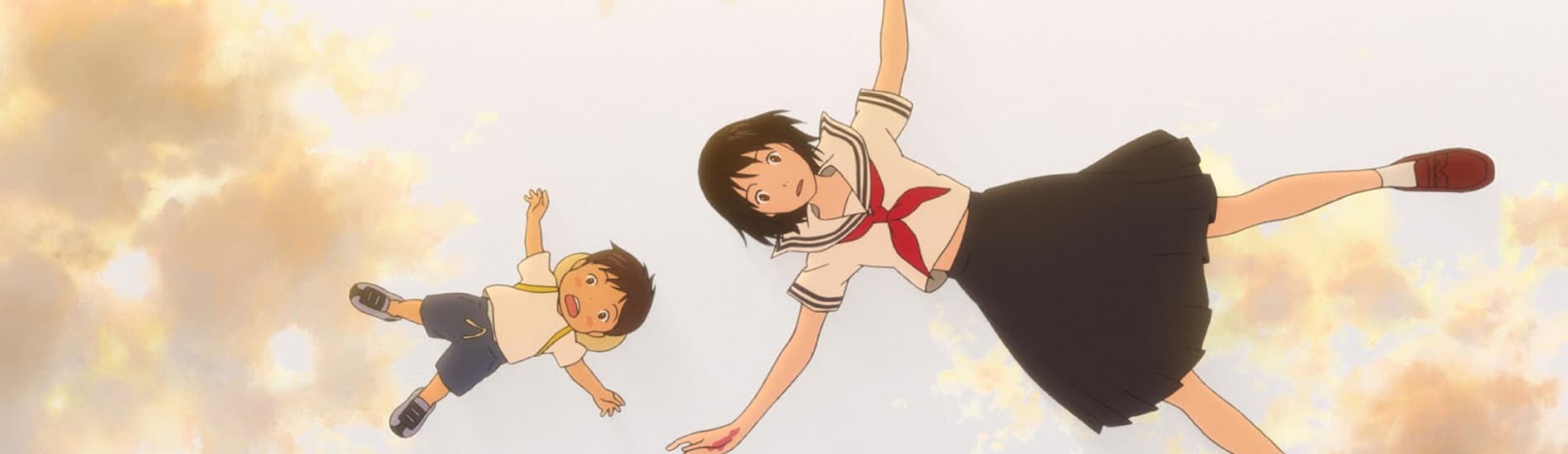
The story centers around an unnamed family living in the suburbs, and when I say unnamed, I literally mean unnamed. The mother, father, and grandma are only ever referred to as Mother, Father and Grandma. There’s even a big moment in the climax that hinges on the protagonist- their four-year-old son, named merely Kun (as in, Name-kun, but just the “kun”)- not knowing his own parents’ names. At least Yuuko the dog has a name. As does Mirai, Kun’s little sister who’s just been born. At first, Kun is excited to have a new member of the family, but as the stress of raising two children wears on his imperfect parents and they spend more time caring for Mirai than they do for him, he starts acting out and throwing temper tantrums. And then he discovers something unusual: the tree in his house’s yard is magical. It can transform the yard into entirely different places, transporting him through space and time to chat with his family members. He meets Yuuko the Dog in humanoid form, a teenage Mirai who scolds him for being so rough with her as an infant, his mom as a child, and his great-grandpa who hurt his leg in the war. Through each of these encounters, he learns something more about his family, growing to understand them more fully and his own place among them.
So we’ve got a classic example of Hosada-branded magical realism, with the real world influenced, though not really changed, by the intrusion of something inexplicable. But the movie’s biggest flaw is how weirdly surface-level its structure us. Mirai’s story follows a pattern to a fault: Kun gets mad at a member of his family, he says he hates them and goes into the garden to sulk, at which point the magic tree transforms the yard into someplace else and he has a little adventure with a past or future version of that family member, during which he comes to understand them better, and once he returns to the normal world, he no longer hates them and realizes how cool they really are. This exact series of events happens around five times, and that constitutes the entire damn plot of the movie. Kun doesn’t even really grow from the experiences until the end; he just gets past whatever was bugging him about that particular family member, there’s a fade to black, and he’s right back to being a brat about a different one the very next scene. It’s literally just five separate iterations on the exact same theme back to back, as if someone took a bunch of episodes from an formulaic, episodic TV show, stripped away the opening and ending credits, and put them together at random. This isn’t a movie, this is a compilation disk.
To some extent, I understand what Hosoda’s going for here. The cyclical nature is almost certainly intentional, with repeated lines of key dialogue and establishing shots emphasizing the similarities between the fantasy sequences. And each fantasy-version family member Kun meets has some direct parallel to his current spat with their corresponding current-version family member, so Kun can see how he’s just like them in some way. It’s meant to be a big statement on the interconnected nature of family, how our past and future are intertwined and we carry certain aspects with us through the generations. But the conflicts are so basic, the messages are so trite, and the overall structure is so uninspired that it feels less like a meaningful cycle and more like Mirai’s just repeating itself. It’s not satisfying to watch, and it just feels like it’s belaboring the the point until the inevitable conclusion. Even if there are some delightful moments along the way- Kun trying to sneak Teen-Mirai and Human-Yuuko past his distracted dad was a very fun little sequence- the overall package is lacking in direction.
On top of that, there’s a lot of stuff in this movie that’s just weirdly handled. Like, at first the tree just transforms the yard itself without moving it anywhere, but then it’s transporting Kun back to the past, and the climax has it construct an entire symbolic alternate dimension that would feel more at home in a Satoshi Kon film. I’m not usually one to gripe about inconsistent magical rules, but then we do learn what the rules are supposed to be for this tree, and it doesn’t fit what we’ve actually seen it do at all. It just does whatever the plot needs it to do with no rhyme or reason. In addition, I know this is a story about a struggling family working through hard times and re-learning to love each other, but the way they interact in the early scenes feels bizarrely mean-spirited and untrue to life. The way the mom talks to her kids is off in a way I can’t quite place; it doesn’t feel like how parents and kids communicate at all. Also, it feels like Teen-Mirai is supposed to be the biggest part of the fantasy stuff- the movie is named after her- but after her first appearance, she only shows up for a single other brief scene before coming in to play a big role in the climax. Her relationship with Kun feels like it should be the emotional core, but the movie’s so scatterbrained that she’s barely given more focus than any of the other fantasy characters.
These aren’t minor issues; these are huge structural and narrative flaws on aspects that are critical to Mirai’s entire operation. And I’m honestly baffled how poorly thought out the entire project feels. It’s like the second half of The Boy and the Beast if it were the whole movie instead, a bunch of clear thematic ideas floating in a muddy soup of unearned story beats and incomprehensible plot mechanics. It’s amateurish in a way that honestly kind of shocks me. Hosoda is a good filmmaker. He’s a good storyteller. He has no excuse for mistakes this blatant. The only part of this movie that feels fully thought out is the house itself. Which might seem like a weird backhanded compliment, but this house is genuinely really cool. It’s built like a giant staircase with each room serving as an entire step, tiered diagonally from each other. The playroom’s on the bottom, the yard is next up, then comes the dining room and so on. It’s such a striking location that I’ve never seen anything like, and the staging of scenes takes full advantage of the unique layout with how the characters move between rooms, up and down the tiers, what they can see from where. We never leave the house; even the fantasy sequences explicitly stem from the yard. This is a film set entirely inside a single closed location that somehow finds an entire world of possibility to explore within its confines. I can’t help but appreciate that for its sheer gumption.
Sadly, it feels like all the imagination and attention to detail for this film went into the house, and none of it was spared for the story. There are still good moments within Mirai, delightful little character interactions and imaginative visuals aplenty, but there’s nothing satisfying tying them all together. It’s a first-draft film from an artist who really should be better than that. Hopefully, Hosoda’s next movie, the upcoming Belle, will see him return to form with the same magic that graced us with Wolf Children almost a decade ago. For now, though, my journey through Hosoda’s work must sadly end on a note of limp disappointment.
14 out of 18 users liked this review
