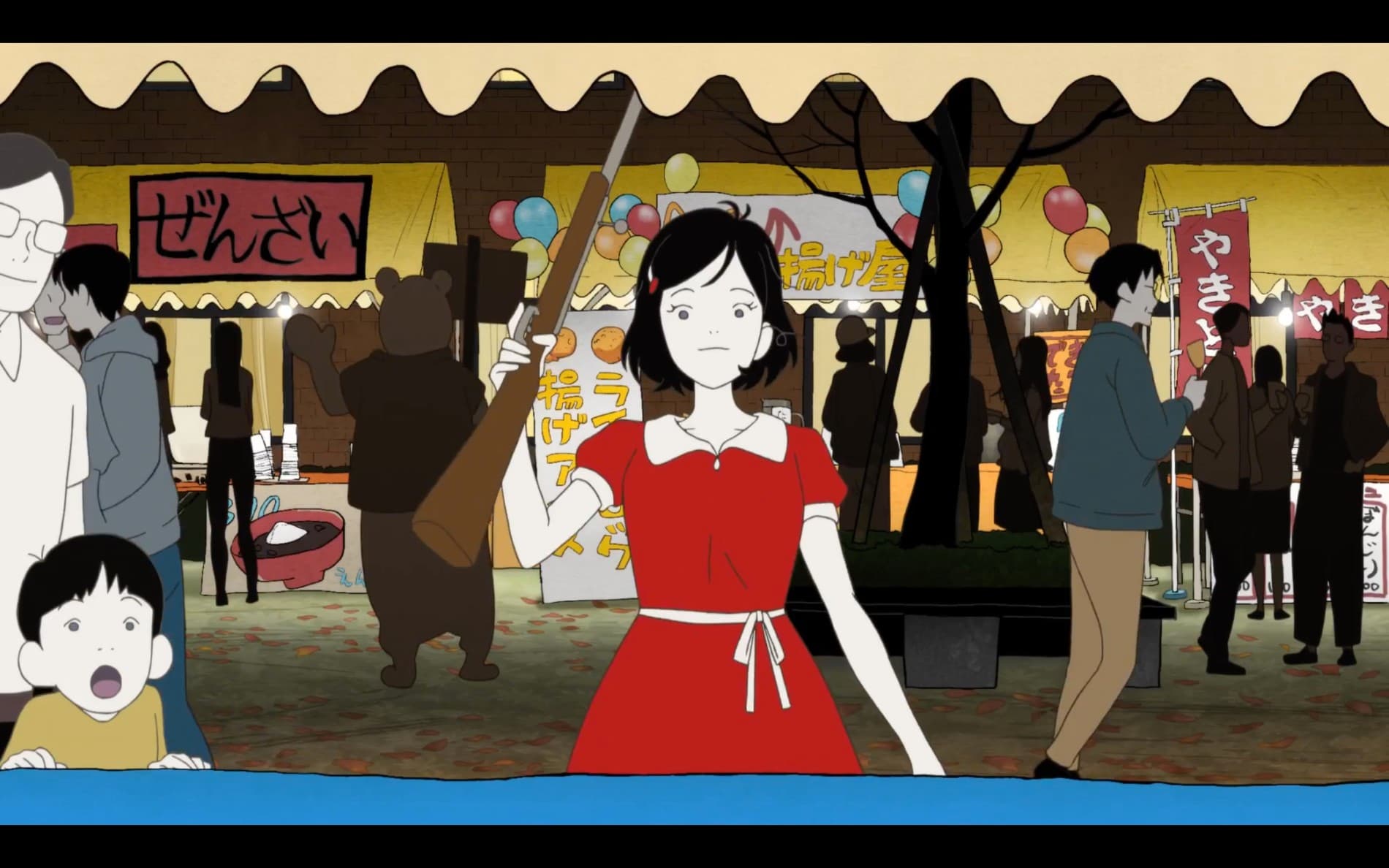
Going into The Night Is Short, Walk On Girl, I had every reason to expect I was going to love it. Both this movie and The Tatami Galaxy were based on novels written by the same person, and The Tatami Galaxy was an absolute delight of a headtrip. I’d even heard that the two stories took place in the same universe! So the prospect of Masaaki Yuasa once again telling a story from this author, in this world, with the exact same artistic style he used to make Tatami Galaxy soar? You better believe that had me jumping for joy. And yet, while I did overall enjoy The Night is Short, I was left frustrated that it wasn’t nearly as good as I wanted it to be. Perhaps that’s my fault for having unreasonable expectations; Tatami Galaxy was the kind of lighting in a bottle that usually doesn’t strike twice, and comparing the two was only ever going to end in disappointment. But I can’t help feeling I would’ve liked it more if it wasn’t constantly reminding me of its much more engaging sibling. It ends up feeling more like a bizarre Tatami Galaxy side story than a movie in its own right, and, well, I’d rather just watch Tatami Galaxy again since it does everything so much better.
Set at and around the same Kyoto university campus that Watashi and Akashi frequented in Tatami, the story this time centers once again on an odd-couple of a raven-haired manic pixie dream girl and her neurotic, fast-talking senpai who can’t work up the nerve to confess his crush on her. And once again, the characters are abstracted to the point we don’t even know their names; the senpai is only ever known as Senpai, and the raven-haired girl is only even known as Otome, or “maiden.” One rowdy night on campus, Otome decides she wants to throw caution to the winds and spend the entire night wandering around town, experiencing all the wild and fantastical occurrences that fate decides to bring her way. And she proceeds to do just that, wandering to and fro, drinking absurd quantities of alcohol without ever getting the slightest bit drunk, encountering all sorts of colorful characters, and getting lost in the absurdity of living life in the moment. Along the way, the night seems to stretch out longer and longer beyond its natural confines to keep the revelry going, and Senpai follows close behind looking for the perfect moment to confess. Oh, and Higuchi, Ryouko and Ozu from Tatami Galaxy show up as important supporting characters in Otome’s whirlwind adventure, offering all sorts of advice and lunatic experiences.
As you can probably guess, this movie feels a lot like Tatami Galaxy on the surface. Many of the same side characters, same central dynamic between the two leads, and, of course, the same warpy, surreal art style courtesy of Yuasa’s LSD-infused imagination. Not to mention a whole smattering of repeated visual motifs, from the wild cowboy representing Senpai’s sex drive to a mention of the rose-colored campus life. I’m pretty sure it even has the same composer- at least, it has a very similar score. Hell, Watashi himself is mentioned at some point, though he never shows up on screen. Frankly, I’m not sure how this movie plays to someone who hasn’t seen Tatami Galaxy and doesn’t get what all these things are referencing. Certainly, as a huge fan of Tatami Galaxy, it was a blast getting to see all my old friends again. Higuchi, Ryouko and Ozu are all as entertaining as always, the surreal visual style is still engaging, and the chaotic whirlwind of experiences the characters undergo feels exactly like a wild all-night bender should. There’s a particular extended bit with a guerilla acting troupe that puts on impromptu musical shows while being chased by the student council president as voiced by Hiroshi Kamiya, and it’s exactly as delightfully absurd as you’re picturing.
Unfortunately, the fact that The Night is Short feels so much like Tatami Galaxy isn’t really to its benefit. Because the more it tries to recapture Tatami’s particular energy, the more apparent it becomes how much weaker it is on every front. It flows as pure stream of consciousness, jumping from wild idea to wild idea with little to no continuity between them. It lacks the mind-bending intrigue of Tatami’s time-loop structure, but more critically, it lacks the meaningful payoff that structure eventually brought about. It’s not until the final act that we really start digging into Senpai’s hang-ups, whereas Watashi’s arc of learning to embrace the life he had instead of waiting for a dream to drop into his lap was baked into the fabric of every single story beat he experienced. Tatami was a wild ride, to be sure, but every bizarre direction it went in had purpose. It added to our understanding of the characters and themes, building a compete picture of what the show was trying to say from as many angles as possible. The randomness in The Night is Short, on the other hand, just feels, well, random. Yes, it’s enjoyable randomness for the most part, but I could never shake the feeling that we were going nowhere fast.
Worse still, all the similarities and shared elements between them really drive home how much less interesting the new characters are from the ones borrowed from Tatami. Senpai is basically just watered-down Watashi, Otome is Akashi if she took center stage in the narrative without adding much more in the way of depth, and the movie’s focus on their romance only makes it more apparent why the Watashi/Akashi romance was easily Tatami’s weakest aspect. These couples are just boring, and I don’t particularly care about whether or not they get together. Nor do any of the other side characters make much impact, save for the one who makes an impact in a bad way by constantly groping Otome’s boobs. But don’t worry, she happily forgives him because he “taught her about life” in an earlier scene, and I guess that makes it all okay. This is becoming an aggravating trend with Yuasa, where male characters act like pervs for like a couple scenes and then it’s never brought up again as if it’s not important. As if actively molesting women and girls is just another quirky eccentricity one may encounter among the beautiful chaotic mess that is humanity. And frankly, bullshit to that. Sexual harassment isn’t quirky, it’s invasive and cruel, and I’m just getting more and more tired of it the more anime lazily leans on it as a cheap punchline. Yuasa’s a creative enough guy to not rely on this shit, he has no excuse.
If I seem down on The Night is Short, Walk On Girl, it’s only because I wish it was better. I still overall like it, and it’s got imagination to spare, but I could never stop thinking about how much more fun I would be having if I just re-watched Tatami Galaxy instead. It’s not even appreciably better animated than Tatami, and you’d think nine years of technological development and a freaking movie budget would lead to some further pushing of the envelope. I suppose it was nice to check in on this world from a different angle, but I suspect I’ll forget most of what happens in this movie long before I stop turning the entirety of Tatami over in my mind. And it’s disappointing it couldn’t offer anything more than that.
52 out of 91 users liked this review
