There’s something to be said for judging a story by its spinoffs. True, a good story is good no matter the quality of its ancillary material; movies like Psycho-Pass and Robocop aren’t made any less fantastic by their awful sequels, and shows like A Place Further Than the Universe weave such a complete, satisfying experience that the lack of side stories doesn’t feel like a missed opportunity. Still, though, on the rare occasion when a franchise has spinoffs that equal the main story, if not surpassing it, you know you’ve found something really special. Neon Genesis Evangelion basically rewrote its own ending with End of Evangelion, and the result was probably the best anime film of all time. Gintama’s sole side-story filler movie ranks among the best of its arcs, and that is no small feat with a show like Gintama. Symphogear’s silly chibi shorts could have been nothing but disposable fluff, but they regularly pack in some of the franchise’s best character moments. To close out K-On, Naoko Yamada wrote a tie-in movie so damn good it actually elevated the show’s second season just by existing. And now, Yamada’s back to strike spinoff gold once again with Liz and the Blue Bird, a side story to Hibike Euphonium that transcends the show itself to become perfectly capable of standing on its own, accessible for newcomers and Hibike fans alike.
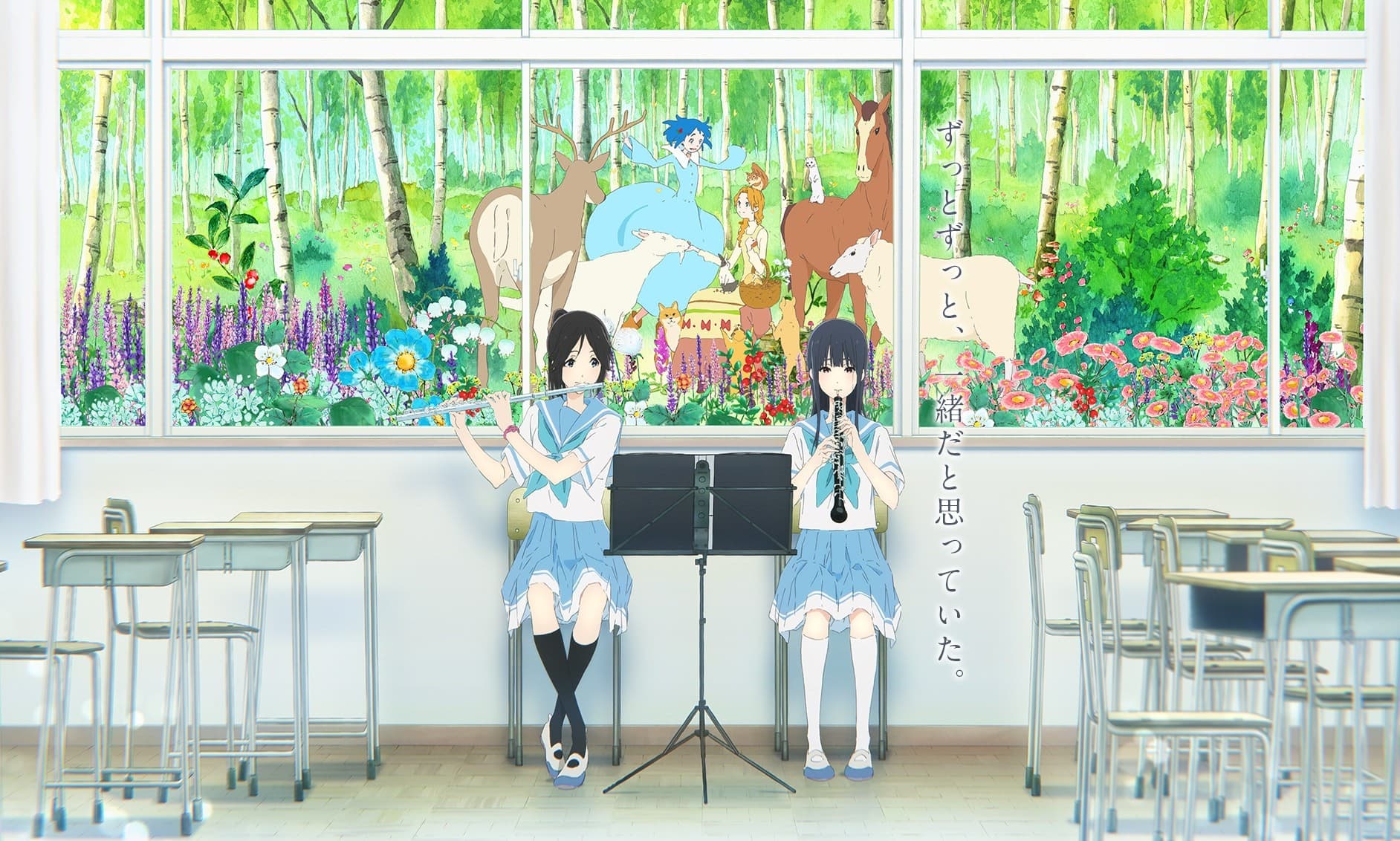
The story focuses on Nozomi and Mizore, two side characters from the show who take center stage here a year after the show’s events took place. They’re both concert band members in their final year at Kitauji High School; Mizore is quiet and withdrawn, Nozomi is cheery and outgoing. They’ve been friends for a very long time, but as the end of their high school experience approaches, their relationship begins to strain under the weight of unresolved tension they’re both still carrying with them. Exacerbating that tension is the fact that they’re going to be playing an important solo together for their band’s latest concert piece: Liz and the Blue Bird. It’s based on a children’s book that tells the story of Liz, a lonely girl who one day meets a bluebird in human form. The two fall in love, but in the end, Liz has to let the bluebird fly away. Both Nozomi and Mizore see far too much of their relationship in this story for comfort, and the thought of being separated like Liz and her bluebird after high school, as their lives tread different paths, makes it difficult for them to play the piece. And as the long summer rolls on, both of them must come to terms with what they want their relationship to be, and whether their story will have the same ending that Liz’ does.
The most striking thing about this film is its sense of minimalism. That plot description I gave you pretty much summarizes the entire damn film, deliberately paced across 90 minutes. The entire thing takes place inside the school with no cutaways to the outside world. There are only a few side characters; Yuko and Natsuki from the show proper, the briefest of appearances from Hibike’s central foursome (Kumiko, Reina, Midori and Hazuki), one of the new first-years in Mizore’s oboe section, and that’s pretty much it. At times, we cut away to the tale of Liz and the Blue Bird, animated like a picturesque storybook in motion, as the events in the tale parallel or contrast with Mizore and Nozomi’s understanding of themselves and each other. And that’s as broad as this movie’s focus gets. It’s about as paired down as it can be, focusing almost exclusively on its central twosome as they fumble their way through their vanishing days at Kitauji High. And then it’s paired down further with Naoko Yamada’s empathetic direction, which often favors the communication of subtle body language over spoken words, and Kensuko Ushio’s haunting score, which at times sounds like it’s literally constructed from the soft little noises you hear in silence. Footsteps, lockers opening and closing, shoes scuffing on the floor, the mechanical hum of piano strings... if you’ve seen A Silent Voice, you know exactly how Ushio’s soundtracks sink into your tenderest nerves and refuse to leave.
The end result of this minimalism is possibly the single most intimate movie-watching experience I’ve ever had. Watching Liz and the Blue Bird makes you feel like you’re right there next to these characters, breathing in the faint classroom dust and watching the sunlight dapple off the far wall. It’s tender, aching, even uncomfortable; at times, you feel so close to the events unfolding that you feel the urge to look away and respect their privacy. And the way Nozomi and Mizore’s story weaves through this minimalism is nothing short of breathtaking. Through the subtlest shifts of character acting and vocal performance, through the most deliberate choices of framing and editing, through the simplest reverberations from the soundtrack, you're taken on a journey with these two girls. You watch the ways the connect, the ways they miss each other, how Mizore doesn’t want to let Nozomi go and Nozomi doesn’t know how to follow her, how Nozomi doesn’t think she’s good enough for Mizore and Mizore struggles to live without her, how the ways they think they parallel Liz and the Blue Bird develop and invert over the passage of time. This is the kind of movie where just the opening credits, a near-wordless montage of Nozomi and Mizore walking through school in the morning, communicates almost the entirety of their relationship just from how they react to each other and how the camera chooses to focus on them. It’s insane how much is communicated with so little.
And it’s fucking powerful. The longer you watch Liz and the Blue Bird, the more vulnerable it leaves you as it peels back layer after layer of unspoken hurt and desire. There are moments in this movie that left me trembling with emotion, where it felt like I would shatter into glass if I so much as breathed wrong. Its portrayal of tenderness and intimacy is second to none, and the push and pull between Nozomi and Mizore as the fear of losing each other grows stronger is the kind of softness that hits like a speeding truck. It’s a movie about the liminal space between independence and interdependence, what it means to be with someone and what it means to be by yourself, what it means to love and what it means to let go, how to find your own strength while relying on someone and how to support someone while standing on your own. And when it all comes to a head and we hear the solo in its full glory, followed by Nozomi and Mizore finally letting all their walls come down around each other... yeah, suffice to say, my eyes are still damp. I can’t remember the last time a movie left me feeling this raw with emotion, like I was experiencing something so unmistakably and undeniably human it was overwhelming in its beauty.
But that’s the power of Hibike Euphonium, isn’t it? Out of all Kyoto Animation’s many masterpieces, nothing has captured the essence of humanity quite like Hibike. Nothing has so perfectly understood what it means to live and love as an ordinary person in an extraordinary world. And while I don’t think Liz and the Blue Bird quite surpasses the show’s best- it’s such a small, intimate story that it doesn’t have time to explore the sheer breadth of intertwined ideas that a TV show can- it is, nonetheless, a masterpiece through and through, and another high-water mark for a studio that’s already set so goddamn many. Whoever you are, however much anime you’ve watched, whether you’ve watched Hibike yet or not, you owe to yourself to watch this movie. Liz and the Blue Bird is truly, astoundingly beautiful, and it will linger in your heart long after the credits finally roll.
64 out of 67 users liked this review