Just a quick note: this review assumes that you're already familiar with Parts 1 and 2 of JoJo's Bizarre Adventure, Phantom Blood and Battle Tendency. Consequently, it may contain some light spoilers from those arcs.
Stardust Crusaders is by far the most iconic and well-known part of JoJo's Bizarre Adventure, perhaps because it's the one that truly began to set the tone for all the parts to follow. However, being iconic doesn't necessarily mean it's the best. In a lot of ways, Stardust Crusaders takes one step forward, one step back, and two steps sideways.
First, the biggest change from the previous two parts is the introduction of Stands. Stands are a unique variety of physical manifestations of fighting ability, usually taking the form of a humanoid. Basically, they're magic ghosts you use to punch people. These stands manifest in a variety of people (and animals) in a variety of ways. For example, while the protagonist Jotaro has a very straightforward Stand (i.e., it punches people), the Stands encountered in the series do a variety of things, from possessing people to attacking them through their dreams.
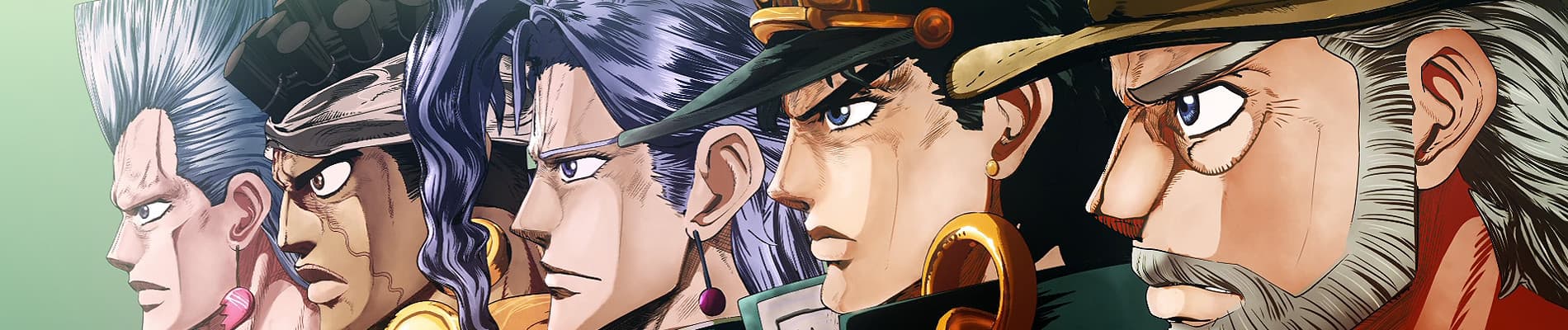
It's important to set this up now because Stands are vital to explaining the plot of Stardust Crusaders. The Stands only begin to manifest in the Joestar line due to Dio taking over Jonathan Joestar's body, and Jotaro's mother/Joseph's daughter begins to develop a Stand that is slowly killing her because she can't control it. As a result, Jotaro and Joseph are joined by three others (Avdol, Kakyoin, and Polnareff) as they journey to Egypt to defeat Dio. From this point on, the show becomes a series of battles as this group of five, known as the Stardust Crusaders, encounter Stand user after Stand user interrupting their progress on their way to Egypt. The first part sees them fighting their way through all the tarot-based Stands (minus Dio) and ultimately arriving in Egypt.
As with the last season, the anime is very well produced, with fantastic art, good music, solid directing, and beautifully hammy voice acting. The introduction of Stands, however, brings a drastic shift in things. For example, Hamon is completely irrelevant, making only one appearance in this first half and failing to be of any use. While it's a shame to lose the magic system we've had for the previous two parts, it's kind of a necessity since Hamon is really only useful for fighting the undead, and having to constantly fall back on that limits the places the series can go. The drawback is that Hamon incorporated the user's entire body and took a lot of training and skill to use, whereas Stands seem to be innate and, until you see a lot of them in action and really start to grasp how exactly the Stands and users are linked, it seems like the Stands do all the fighting and render the users themselves completely irrelevant.
The introduction of Stands also allows for much more absurd fights. Yes, Battle Tendency may have had a Nazi cyborg, but the enemies in the first half of Stardust Crusaders includes an orangutan pedophile dressed in an admiral's outfit, an enraged car, and a genius baby. As a result, the series itself takes on a much sillier tone. The voice acting is blatantly over-the-top, which fits the new tone perfectly. Joseph added a bit of levity to Battle Tendency, but in Stardust Crusaders, his exaggerated yells and Engrish phrases instantly steal the scene, in the best way possible. On the flip side, because this arc doesn't take itself near as seriously, it also incorporates a lot more toilet humor. If the idea of our heroes feeding a baby its own poo, peeing in a man's mouth, or being forced to lick a toilet turns you off, well, you're probably not going to be considering this arc one of your favorites.
It's also worth noting that this arc fixes a major problem from the previous arcs. While Phantom Blood and Battle Tendency only really had one hero and consequently had to sideline everyone else and have them shout out commentary like they're sportscasters, Stardust Crusaders uses a team of capable people who all get their chances to shine.
Finally, the pacing of this arc is absolutely terrible. It's a travel story, and while in some ways that makes it feel more epic, it also turns it into a very episodic show, with they fighting one stand per every episode or two episodes. Most of these fights end up being completely irrelevant. They don't cause character development and they don't advance the plot. All they do is provide another obstacle for the Stardust Crusaders to face. There's a reason why the two halves of this adaptation have a total of 48 episodes while the OVAs from 1993 and 2000 that cover the same arc are able to condense it to 13. While it's exciting when watched weekly, it becomes a pain to watch all in one go.
Due to the two halves of this arc being divided into two different seasons, I'm going to have to rate them individually, and the first half is by far the weaker one. It's a few episodes of setup, followed by what is essentially a lot of filler. The episodes may be fun, but they're not as compelling as what came before or what will come in the second half of Stardust Crusaders. On top of that, it's incomplete, so it loses a few points when judging it on its own. Despite that, this season is able to set up the new direction the series starts to take in a satisfactory way, and while it's not the same as Phantom Blood or Battle Tendency, I think it's just about on par with them. In the end, it's just good, pure fun with absolutely no substance to it. But really, isn't that what you're watching JoJo for anyway? Four stars.
142 out of 182 users liked this review
