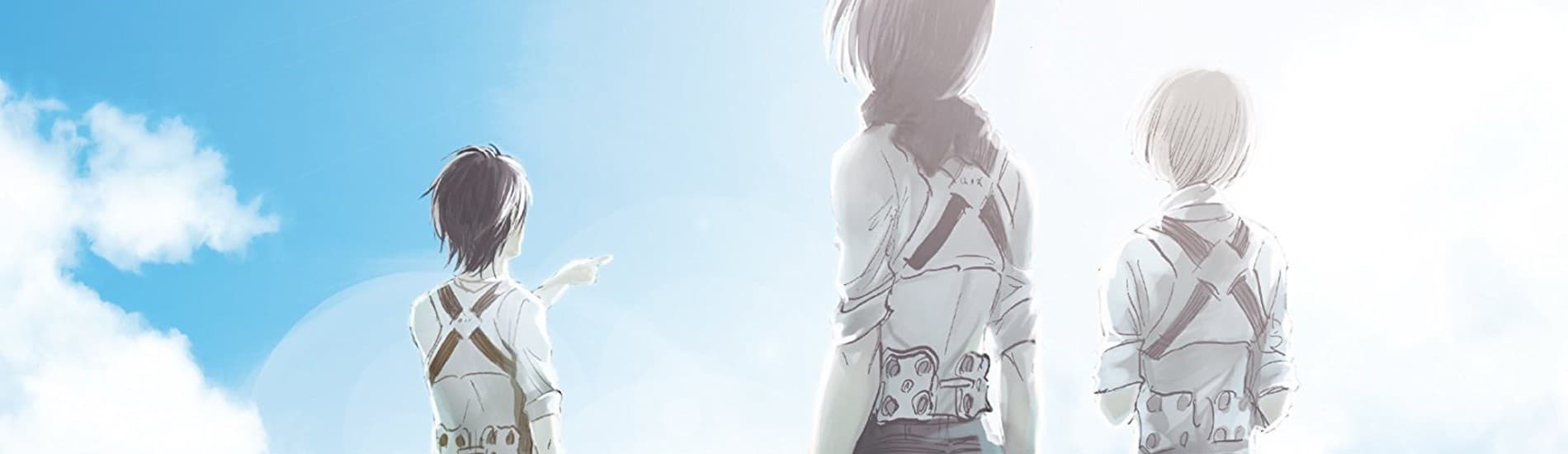
Attack on Titan
a review by Chizuo
a review by Chizuo
I went into Shingeki no Kyojin expecting a masterpiece, due to the show's popularity in the recent years (particularly now, with the long awaited final season.)
I couldn't help but feel that this series was just another example of popularity purely based on its premise and dark themes, uncommon to the Shonen demography or even of what should be expected of mainstream Shonen manga in terms of violence and explicit graphic content.
Although it surely did feel immature and too reliant on its shock value at the beginning, thanks to the countless deaths of non-important characters in gruesome ways, I can say that Shingeki no Kyojin matures along with its characters.
Well, what do I mean by this? I'll explain by taking the main character, Eren Jaeger, as an example. At the beginning, we see the character constantly acting in a rash, impulsive and overly naïve way. The enemy, was, in some way, just as rash, irrational and more concrete: a natural predator threatens humanity. It's a purely natural struggle for survival at first glance.
However, as the chapters and arcs go forward, we get constantly bombarbed with exceedingly complex moral dilemmas, social struggles, the nature of war and politics, and much more. As the enemies and their motivations become more abstract and idealistic, our main cast of characters (and especially Eren himself) also occupy a new space, since the past eminent survival issue has been taken care of. Now, the enemies are fellow humans, with ideologies of their own that fuel their actions in the complex and not-at-all hopeful and idealized world that the once-walled citizens thought existed.
It's kind of funny to think how this allegory is so neatly represented by Hajime Isayama in his manga. When the natural struggle for survival is a thing of the past, humans finally start to convey moral systems, ethics and all other social struggles, such as racial, identitary and class struggles derive from a growing complexity of human society itself. Why not call the walled world of Eldia the Wall of Plato of Shingeki no Kyojin, if you will?
Another thing that also sparked my curiosity with Shingeki no Kyojin was the constant blatter about the way it treated extremist ideologies. I think it was a good choice for the plot not to take a side on all the Eldian and Marleyan conflict, mostly serving as an exposure of their ideals, behaviors and policies, leaving it to reader to truly grasp the meaning behind any of that. It is beyond obvious that the series makes parallels with the real world, with loose ties to current and past ethnic struggles.
Isayama cleverly takes us on a trip not to make us choose what is right or wrong, but to acknowledge the root of all the circumstances of Shingeki no Kyojin. That is, the unending cycle of hatred, a byproduct of our intrinsic fear of the unknown. How hatred comes to be, its intricacies and consequences are masterfully explored through a variety of lenses in this manga.
Overall, Shingeki no Kyojin is a great portrait of the human condition. It is also a neat point that the author don't blatantly takes any side, but rather leaves it to the reader to figure out what was good, or bad - or even if there is such a thing. So, if I was to attribute a word to describe Shingeki no Kyojin is "human," above all else.
78 out of 86 users liked this review
