Your Name.
a review by Beam
a review by Beam
Compliments
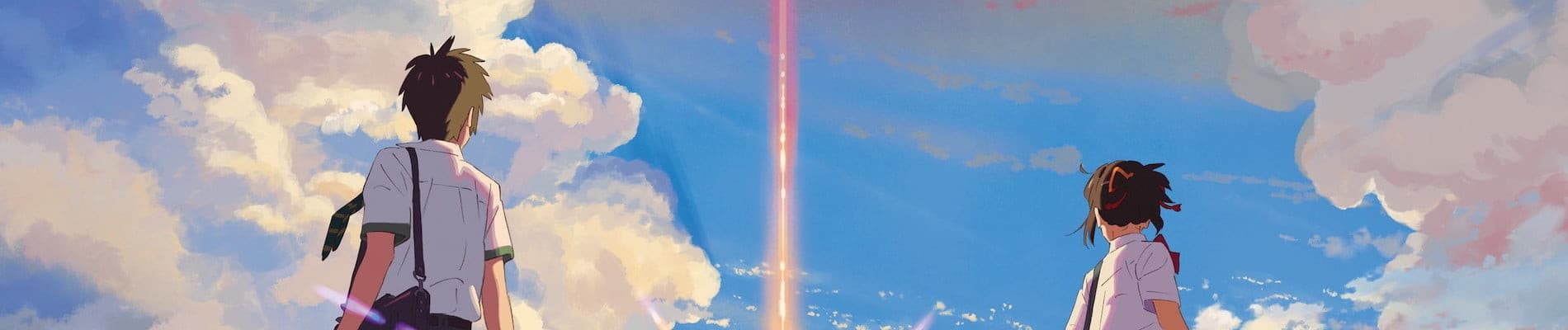
As Shinkai's biggest hit, it's pretty understandable why this film is as revered as it is. Visually, it is one of the strongest movies both in detail and proficiency in colour and lighting. The songs are splendid as well. Like most of Shinkai's films, however, the story and characters leave much to be desired.
The story itself is good because it presents less linearly than his other films but still maintains a cohesive view of its core theme, that being of the turmoils of separation. What makes this particular film more notable is this lack of clear linearity, as it allows a more creative and engaging way of telling its story. The asteroid crash is the most notable example. It takes the previous presentation of two different lives under dual-personalities, but it also intersects time travel and seemingly parallel worlds. In this sense, this film always kept me on my toes and remained engaging by introducing these new ideas that, whether I like them or not, retell an otherwise tired theme in a new and interesting light.
Problems
That being said, the film's abundance and biggest flaws become apparent well into its second act. The issues result from a combination of the film being too short and also a promise-freak. With being too short, the second act gives too much focus on Taki and not the interpersonal interactions with Mitsuha and her friends. While we are given ample time to see Taki sketch a non-existent town, get to it and then drink the saki to go back in time, Mitsuha is only shown a coincidental train ride and her friends doing everything shy of questioning or debating against Taki as Mitsuha. The film goes to great lengths to show our characters be confused by the dual persona she had, but there was no single intervention or debate about this? Whether from the film being too short or not, the same focus for Mitsuha's friends wasn't given, leading to a third act that more or less rushes to its conclusion.
With being a promise-freak, the film introduces interesting concepts that ultimately serve a singular or simple purpose. I already mentioned the potential conflict that dual personalities could have created, which did not happen, but a lack of greater attention towards the elements of time travel and parallel worlds also exists. For example, Taki and Mitsuha encounter both on the train and the canyon edge and attempt to exchange a ribbon and names during "the gloaming", respectively. Beyond this, however, the epilogue does not give this parallelism any attention again beyond constantly shouting "your name is" or "what's your name". Would it not be possible to meet on the canyon edge again during sunset to see if Mitsuha is still alive or dead? I suppose this prevents the iconic staircase shot, but a fleeting idea would also be fine if only to correct oneself afterwards (Mitsuha still alive and most likely elsewhere). The film succeeds in introducing engaging concepts, but it does not explore them as sufficiently as I would have liked.
Conclusion
Overall, is this Shinkai's best work? Sort of, but that wouldn't mean it's more deserving of its massive fame and box-office than his other works. I recommend this as a good introduction anime to people who are yet to experience a theme of separation, though do test the English Dub just in case it's something you want to share more broadly. It's a normal Shinkai story, and while his production values continue to improve, his direction remains the same. It's an unwavering tradition that continues to hold him back and moving beyond a theme he is not even masterful at nearly two decades since debuting.
42.5 out of 61 users liked this review
