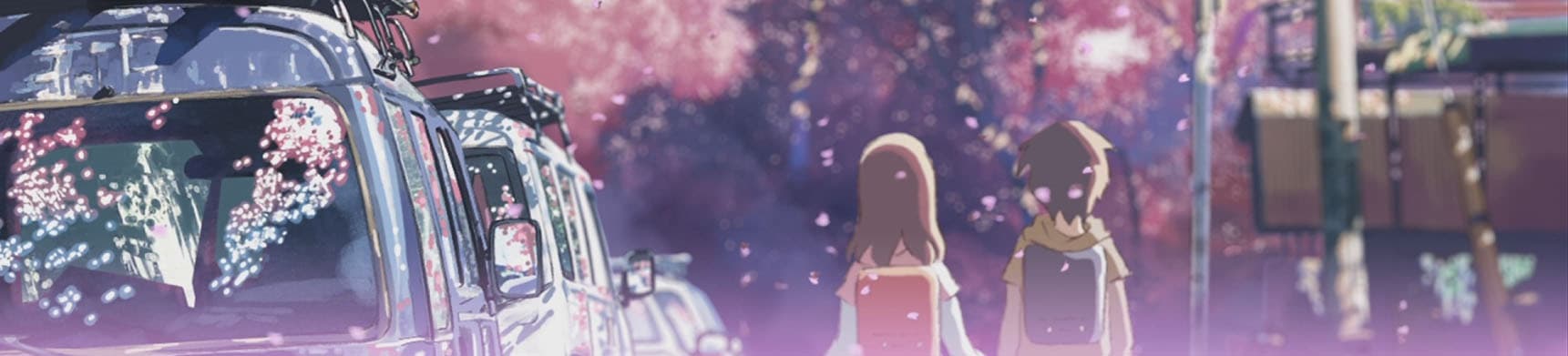

Even if you have seen it, go watch 5 Centimeters per Second again before reading to see if your perspective stayed the same or changed slightly :D
When talking about 5 Centimeters per Second in with not only modern standards but when compared with Makoto Shinkai newer works such as Kimi no Na wa (Your Name), Tenki no Ko (Weathering With You) & Kotonoha no Niwa (The Garden of Words), it can seem a bit bland as the former are more bombastic and in your face in terms of presentation. Common complaints being misunderstood as empty or boring. Hopefully, with this review, I can help describe themes and give you, the reader, a different perspective and another shot past the first initial viewing.
(Before I begin with story analysis I should note that it the movie is split into three episodes or acts that seem separate at first but connect thematically as a whole with Distance playing a role in that part. For this review I will review each.)
# Story 8/10
The movie begins where young Takaki and Akari sharing their future aspirations together, one being watching the cherry blossom together. This is significant important in the narrative because culturally in Japan Cherry blossom represent fleeting nature of life, fragility and distance of emotions and a sense of renewal or reset of time and life moving forward.
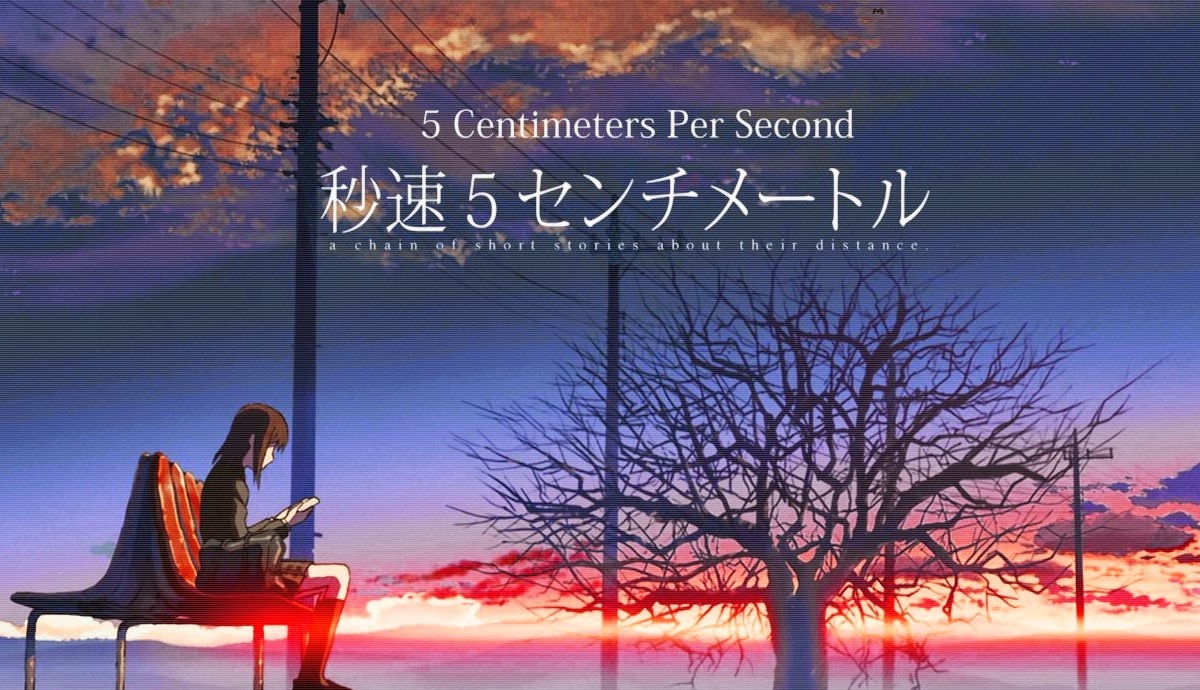
Cherry Blossom:
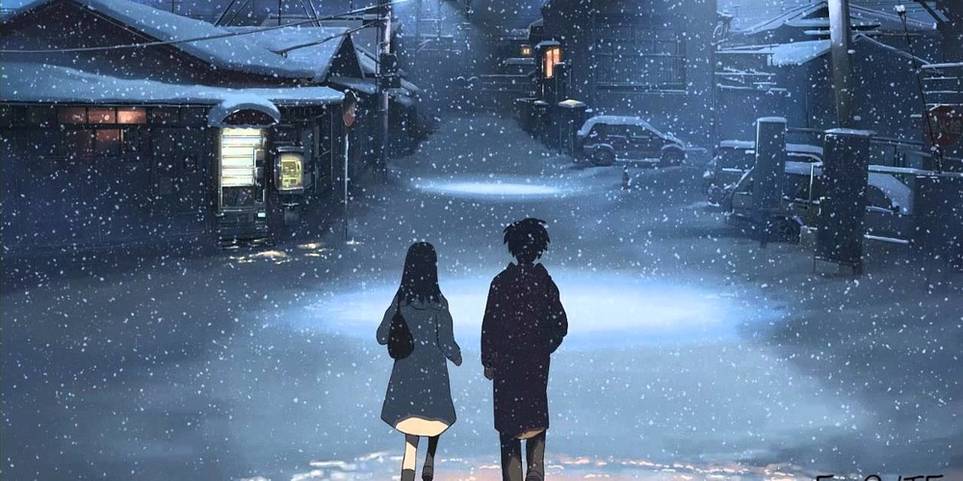
The first is spent with Takaki and Akari's youth. The small interactions, interest, and the innate connection they feel for one another. It is later discovered that Akari and Takaki would be forced to separate due to their parents careers. As Takaki's tries to make his way to meet Akari, there are road blocks that he fear will impend him from delivering his love letter to her. As he arrives late way beyond their meeting time, he see's her huddled up waiting for him. A snow storm covers the town and the train that they were logging in where Takaki decides that his moments with Akari and their time alone stuck in the storm was more valuable that giving the letter. This decision is also reciprocated near the end of this act when Akari decides also not not give her letter but decides to entourage him, saying that "...you'll be okay from now on...".
The constant imagery of trains represent not only the physical distance but the emotional distance in terms of accepting where their lives will go, leaving things half baked because of the saying the harsh truth and leaving feels kept deep inside.
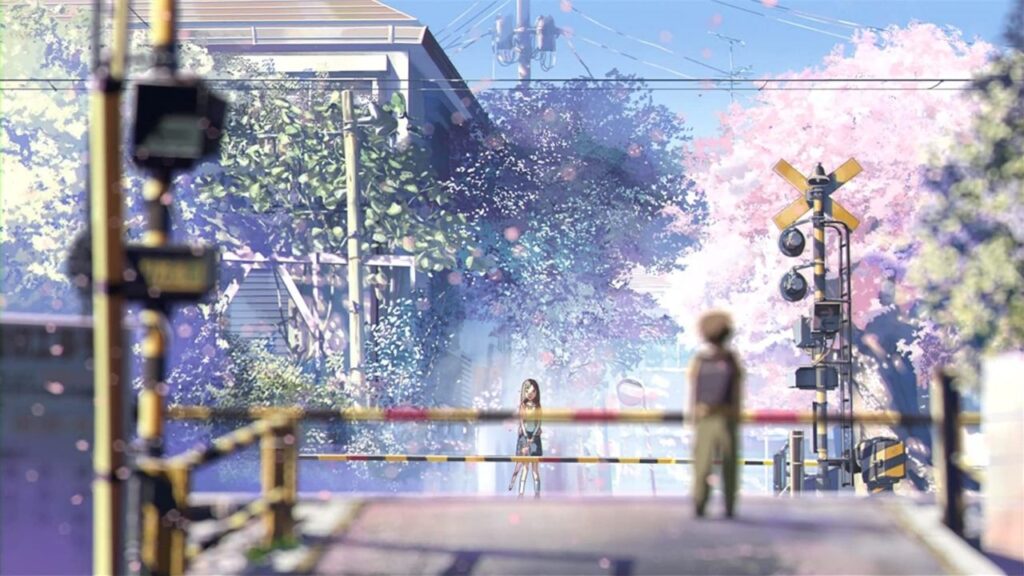
Cosmonaut:
The second and more saddening story of the bunch. A tale of unrequited love that Kanae longs for but due to Takaki's distant demeanor, fears her feelings shall not be realized. Kanae made it a goal to confess her true feeling after managing to successfully ride the waves with her board. Even after her successful attempts, Kanae, alongside the juxtaposition with the imagery with the rocket and themes of space, realizes that his true feeling, his goals are far from what she can connect and empathize with emotionally. As such, as they watch the rocket shoot up, Kanae resolves herself to keep her feelings bottled up, suppressed, and thus, cries herself to sleep as the second act ends with her realizing her love is more of a crux.
The imagery of the rocket ship details not only the distance between the two but the feelings never said as it is also represented with the tittle. Takaki is completely in this stage of his life in constant longing of the past and denial of other connection.

5 Centimeters per Second:
The final and shortest of the act is a 9 year time skip as Takaki has a job as a programmer and a girlfriend who he can't connect with. Themes of longing and minor signs of depression are present within Takaki and it is even more impactful as juxtaposed with Akari's situation as she completely moved on. A distant memory as she prepares to get married until she finds the letter that she meant to give to Takaki on that fated day when they separated.
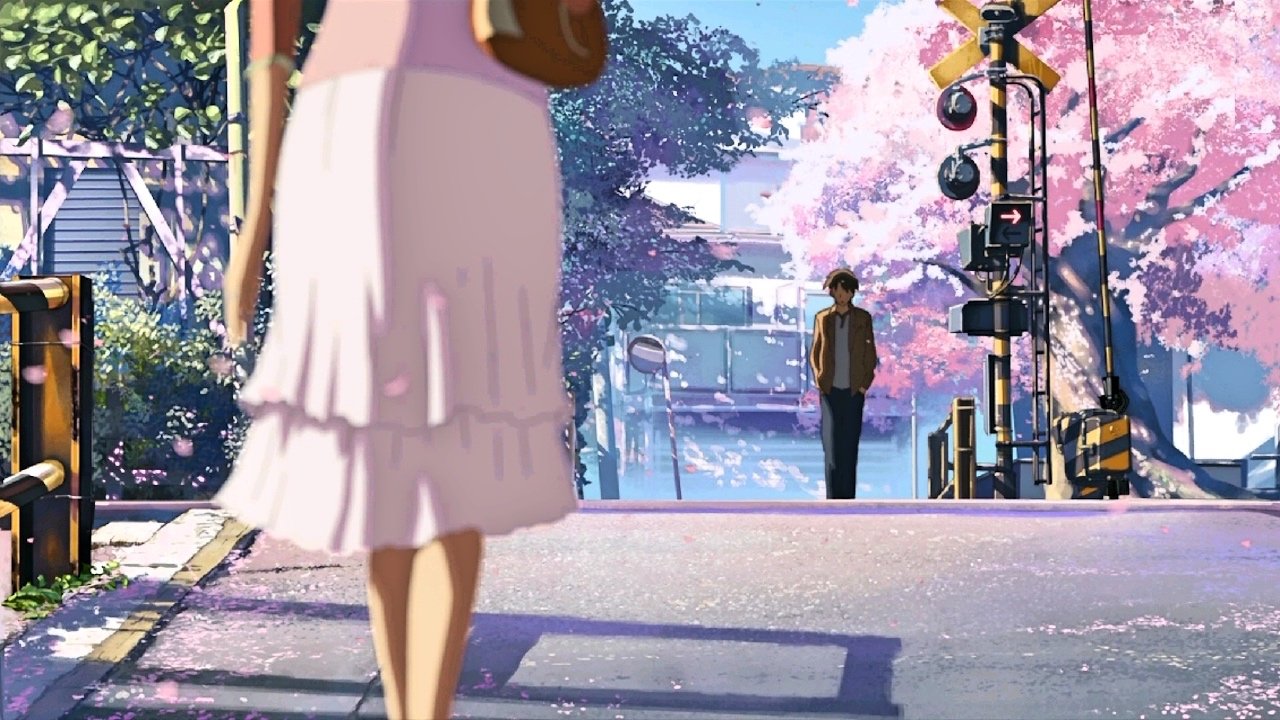
The movie, as dual narration plays out between Akari and Takaki recalling their first initial meeting in the railway, plays with expectation of them getting back together. A direct reflection to their snow filled farewell as it gives them each time to reflect on their lives up this point in the movie. And as the two of them reach the promised place, the final moments and prominent scene in the movie shows them reuniting. Akari and Takaki finally meet up from opposite sides of the railway filled with those cherry blossom falling 5 centimeters per second. The place, as children, they promised to meet. And as Akari was turning to meet his gaze a sudden train intersected their gaze. And as the train passes Akari has gone and left Takaki. Takaki responds with a simple smile, walking forward without looking back.
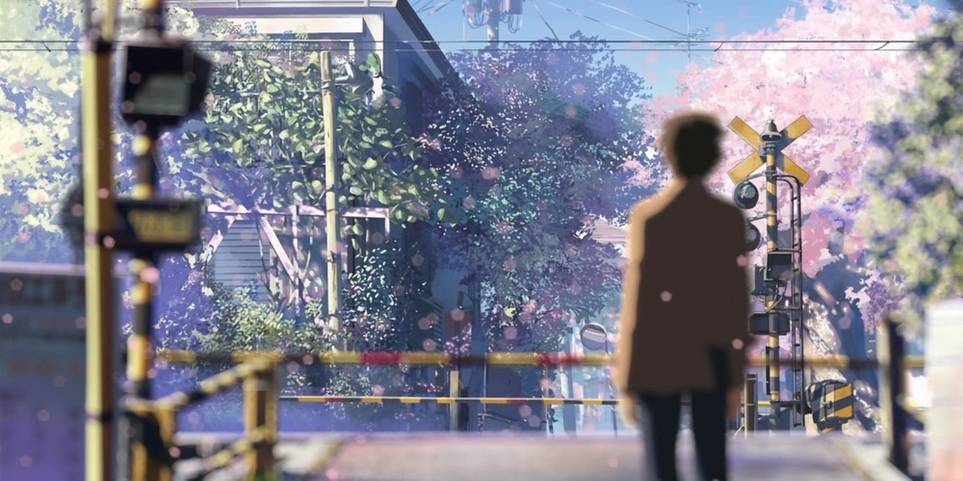
The Ending:
I will admit on my first viewing, this completely not only confused me, but ruined it for me. "Why would Akari not wait for him? Why was there so much build up for nothing? How was this worth the wait after a boring first half?" In fact, I was that distraught that I was about to write a review at the time that not favorable until my "in the moment analysis ended" and I had time for it to simmer in the critical pot of one's mind. And oh boy, Makoto Shinkai not only took it full circle but address these threads in a subtle and beautiful way with the use of the environment, character expression, and letting the audience think for themselves.
Full credit to the story boarding into connecting 3 seemingly separate stories and connecting them into one. This is true because of the promise they made in the past was fulfilled in full with them finally meeting again to see and experience the cherry blossom's again. But the thing with cherry blossoms is the they are fragile and ever floating. Changing where the wind goes showing nothing is constant and thus is the same with life. Where as Takaki became reclusive with his feelings affecting others like Kanae, Akari took a contrasting approach. And as such, the build up showcased not only the amount of time passed but showed how Takaki struggled with moving on a being stagnant in the past, not being to see the present. Takaki's smile the the last scene was one with positive acceptance as it showed that Akari, not only has moved on but connecting with their last meeting and her parting words "...you'll be okay from now on...". Finally being free from the shackles of the past, Takaki realize that nothing will move if he longs for the past. And as such he move forward.

Story Extended Thoughts - Themes & Messaging 8/10
The theme of connection is present in the first act as it shows both Akari and Takaki both grow close to one another but is suddenly taken away due to external factor. It is show visually true the environment and body language that both are cherishing every moment with one another. Sadly, this does not last as their farewell is not only bittersweet, but also leaves things unsaid which greatly affects Takaki's mental state moving forward in the next act.
Longing is primarily present in both the second and third act but for this example, Act 2 is where is is most evident. The reason why Act 2 shines in this regard is with Takaki and Kanae. Even after Kanae succeeds in her own personal goal and is ready confess. The episodes tittle alone 'Cosmonaut' describes Takaki emotional state. Far away from Kanae which not only put more distance upon them but also a parallel to how difficult it is to confront one's feelings. This is shown with how detach he is from life that isn't the past.

Acceptance is one of the final themes and is show with the passing of time and the Cherry Blossoms from Takaki and Akari's first and final meeting. Which all shows how distance affects individuals differently. Distance represents growth, represents experiences to one's emotion and represents reflection upon one's life. But most importantly distant changes individuals to find and realize new perspectives with the passage of time. Just like with how Cherry Blossoms ignites a sense of renewal or reset of time and life moving forward.
Characters 7/10

It is rather impressive given the run time what Makoto Shinkai accomplishes in this movie. Especially with the style and presentation with how it heavily relies with environmental and character movements to convey feeling and themes.
Takaki and Akari, at least in my eyes, are both two sides of the same coin. Although we actually don't see Akari that much and the story is focused on Takaki's experience, it is symbolic in the sense of how one's deal with not only a long distance relationship, but one that is flawed for failure that neither knows how to handle well. And that is okay because it not only grounds it in reality in terms of individuals not knowing exactly what to do but showing how complex emotions can be. In some cases infuriatingly beautiful. And that's what Takaki's side entails. A complex and emotional strain of the fear of letting go.
Kanae on the other hand is the direct contrasts to Akari. Kanae is flawed, awkward and she is constantly in her head about her feeling for Takaki and trying to get to know him. Even after the beautiful scene of her finding her resolve in her own way through the board, it quickly becomes bitter sweet. The Rocket scene and the revelations she acquire there she realizes that Takaki is constantly distancing himself from her. And as she discovers more about his character that he has been suppressing, combined with the fear of rejection that becomes a reality, she, although sadden deeply at a love that will be never be accepted, finds out that life constantly moves forward and decides that she should find her own way.

Although some folks might view this as a negative and I can totally see that in terms of the characters not being honest with themselves. It involves active deduction between reading the enthronement and character quirks of each of the three characters. Comparing it to Makoto Shinkai's more recent works that have really enjoyable characters, interactions, and motivations but are more in your face with who they are as character. Not saying one is better than the other but these are styles that are unique to story telling. And in terms of this story, this style of active engagement work really effectively for this film. This means the answer is not always directly stated and it comes down to what the view gets from the characters and themes. Which on one camp makes it open to interpretation and more importantly, flawed. Which in this context is good because it acts as a good conduit it terms of how vague emotions and mental states are. Of course, personal investment is important and if you as an individual do not care or simple did not get attach to said themes then that is also okay because again, it is about the journey and what the individual takes from it.
Art, Animation & Sound 10/10
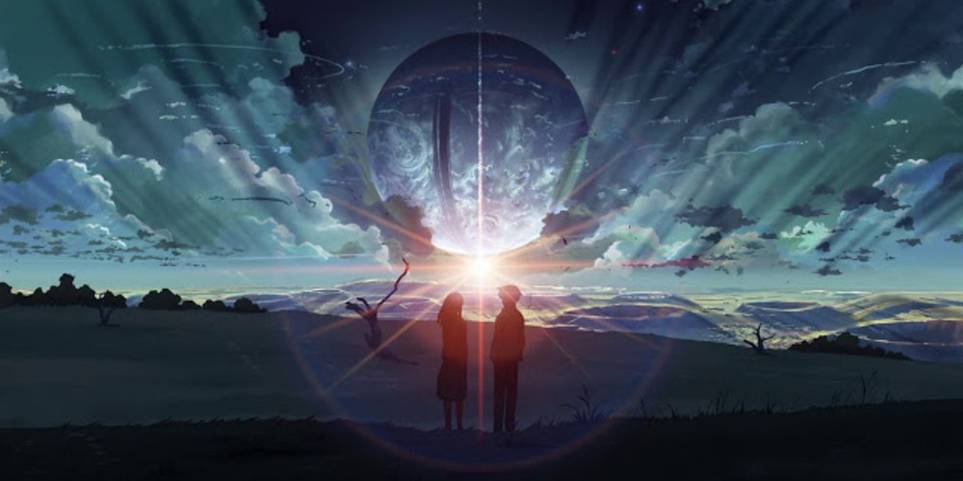
Do I need to even say it. And for 2007 this is simply a marvel to look at. Even though even for its time and comparing it with the industry at the time it was making insane strives, it works for what it was going for. Especially when you compare and put context in, it is even more stupidly impressive not just visually and audio wise but how it connect thematically with the characters. From the atmosphere of the lighting and shading of each scene to the emotional connection showed the dedication the team had.
And for music, the soundtrack written and produced by Tenmon fits the film in a lovely way. Themes and Tunes that were more on the softer side that made the film feel more personal. In a sense of longing or wishing for days lost which is neatly accurate to the movie.
And of course, the main theme song. One more time, One more chance written by Masayoshi Yamazaki is a song that was practically made for the film. In fact, it is as if the song weaves the main themes in your face about distance, longing, emotional connection, apathetic dispositions and of course, acceptance all wrapped in a neat bow. Plus it is just a really good emotional song if you want to cry deeply about a past that can not only be replicated but also will never come back.
Again was just in awe for a majority of these categories in terms of how impressive it all is. Again, not perfect and again, not the pinnacle even just in the context of that time period, but what hits it out of the park for me is how it connects in the narrative and thematically as well.
Enjoyment 8/10

Final Thoughts & Conclusion
Also side note, if you did not enjoy the movie, that is not only completely fine and normal, but completely respectable disposition to have. Plainly, I was confused my first viewing and underwhelmed at the start. Not everything that people enjoy will connect with everyone simply because well, we are people. People with different exposures to opinions, perspectives and general quirks that we like or dislike.
But in reading this lengthy review can give you a second look on the film that has so much more. More in terms of subtle messaging that is not only easy to miss but can be generally confusion given how this film heavily relies of active viewer participation and analysis throughout the film. And similar to the Cherry Blossom flowing in the wind, it is through our small experiences that give us the steps to move forward. No matter how long, difficult or complicated the journey is, that distance, as daunting as it maybe, shows in the film that it is worth a wealth of experience no matter the outcome.
Hope you have a damn good day, night, evening, morning, and whatever in between and hope you have a good one~!