When I was a kid, there was little I loved more than a good YA magic school story. What’s not to love about the fantasy of being whisked away to a place where learning is actually fun, and exciting, and unique, and tailored to the things that actually interest you instead of forcing you through a rigid, inflexible curriculum designed to turn you into a mindless drone with no actual practical real-world knowledge? And with the primary setting serving double duty as a central hub for the entire cast to interact within and a unique location that could be explored and fleshed out in its own right, there are no shortage of interesting and mind-blowing avenues to explore without even having to step outside the walls. Magic school stories are kind of the perfect YA setting in that regard: they allow for countless unique storytelling opportunities all in the same proximity. And the stories that took full advantage of those opportunities- Harry Potter, Percy Jackson- regularly ranked among my favorite fictional properties thanks to the sheer bevy of imagination on display. I have a deep and abiding love for this genre… which only makes it more disappointing how few good examples of the kind I’ve been able to find in recent years. Sure, Blue Exorcist was a breath of fresh air, but one show can only tide me over so long. Even RWBY didn’t really get good until it finally left the school behind. With so much potential baked into every facet of this genre, I’ll always be chomping at the bit to get at any story that promises to do it right.
Thank god, then, for Little Witch Academia.
Watching this show for the first time was like getting hit with a nostalgia bomb so intense it time-warped me back to 2010. How long has it been since I got this excited about the clumsy protagonist getting into trouble on their very first day of school and immediately ending up in a life-or-death scenario? Or watching our heroes stumble through a Forbidden Forest full of killer plants and all manner of dangerous critters? Or watching the central power trio share a dorm room where they can shoot the shit together? Or the mysterious vanished paragon figure whom our hero seeks to emulate with all her heart, carrying on her teachings in a world that seems to have forgotten them? And magic classes, and rivalries, and overcoming bullies and lack of natural talents to soar higher than everyone else? And as if that wasn’t enough, they even have their own freaking Lee Jordan to narrate the broomstick sporting events. Yeah, I have missed this. I have missed this kind of magic, if you’ll pardon the pun. I have missed falling in love with this kind of story, reveling in the joy of a world of wonder just outside my fingertips. This is the kind of story that reminds you why you fell in love with these kinds of stories in the first place, re-using and remixing all the tried-and-true cliches to recapture the spark that made them so entrancing back when you first discovered them.
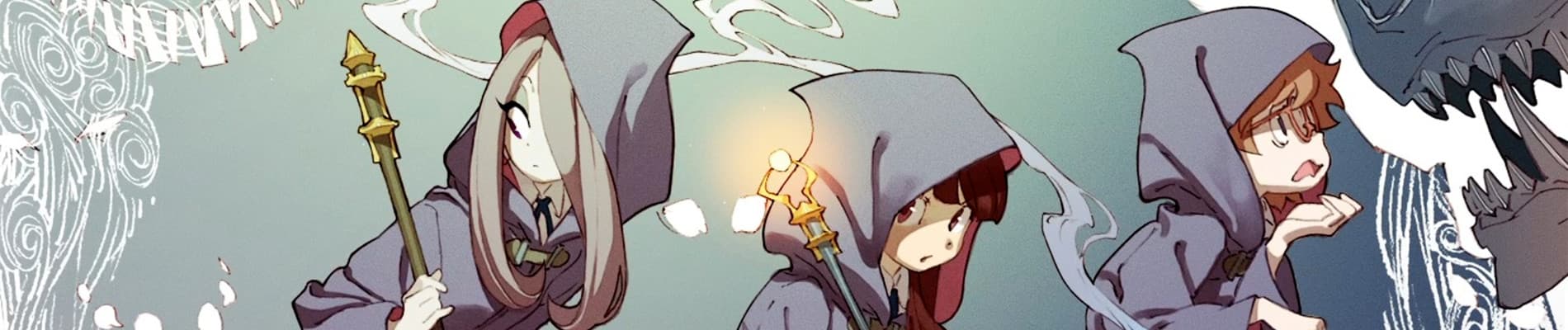
The show centers on Atsuko Kagari, Akko for short, a young witch who enrolls in the prestigious Luna Nova academy to follow her dream of following in her idol's footsteps. As a child, she was inspired by the witch Shiny Chariot, who dazzled countless people with her showy performances and magic tricks. Chariot has since vanished, and we soon discover that few people in the world of magic take her seriously. Much like Akko herself, she was a screw-up, a slob, someone who got in trouble and made mistakes and played outside the rules to often disastrous effect. But no matter how many times she messed up, she kept trying until she found her own way to glory. Because as she always said, "A believing heart is your magic," and there's nothing that can hold you down as long as you hold fast to that truth. Inspired by these words, Akko does her best to be a great witch despite her seeming lack of magic talent, and as one might expect, all sorts of shenanigans ensue.
So no, this is not the most complex story in the world. Its themes are mostly broad, its characters mostly simple and approachable, its conflicts mostly predictable. You can always count on Akko’s lack of talent screwing her over, getting her in trouble in a way that conflicts with the things she and her friends actually want to do, leading to a scenario where she bucks against the school’s authority and tries to sort things out on her own, with incredibly mixed results. She gets in petty squabbles with her more antagonistic classmates that drive home how immature these teens still are, rising to the bait time and time again. Her fiery temper and scattershot passion leads to a lot of chaos and consequences, and a good chunk of the episodic plots follow her attempts to escape those consequences or make up for them. It's a mostly straightforward story tackling mostly straightforward tropes without much in the way of innovation. But it tells this straightforward story so goddamn well that its relative lack of depth doesn’t matter at all. It’s slavishly devoted to the traditions of its genre, but not out of cowardice or laziness; it seeks these charms so intensely because it clearly loves them just as much as I do. I live for the contrast of fantastical learning environments and the inescapable drudgery of heavy schoolwork no matter what subject that work is about. I adore the forbidden forests, the hidden chambers, the secret magical artifacts with wild and wondrous abilities. I’m a slut for the friendships and rivalries, the sporting events and dark invasions, the trials and tribulations, the wonder of discovering things that dazzle the imagination. I love these stories because they fundamentally understand why diving into fiction can be so, well, magical.
And Little Witch Academia is magical from the tips of its toes to the top of its pointed hat. It’s bursting with whimsy and imagination, aided by possibly Trigger’s best-looking production yet. Their usual manic energy and sharp edge is toned down just enough to bring this fantasy to life without sacrificing the eclectic, stylized passion that makes their aesthetic so instantly striking. The character designs, in particular, are bloody fucking fantastic, with enough range and personality in motion to put even Gurren Lagann to shame. The animation is rough and stretchy enough for the characters to flail in disarray like Loony Tunes when the slapstick kicks up, but still solid and specific enough to allow for more subtle motions. Akko can whiplash between caffeinated joy to morose pouting in the space of a second, and it all feels completely natural. And sweet buttery muffins, the expressions are legendary. I can’t tell you how many times I was reduced to cackling by nothing more than a perfectly timed flex of a character’s facial muscles. Akko’s droopy eyes of confusion, Sucy gleefully sucking up poisonous gas through her nostrils, Diana’s primly poised gestures and posture… so much of everyone’s personalities comes through perfectly in how they’re animated. And that’s all before the action kicks up, when the camerawork and kinetic motion place you right up there on the rushing brooms, watching rapid-fire displays of enchanted wonder soar right above your heads. I could freeze-frame any moment of this show and find countless giddily exciting details to talk about, then unpause it and find even more to gush over while it’s in motion. It’s frenetic without being exhausting, restrained without being subdued, spirited without being obnoxious. It's a cavalcade of imaginative, heartfelt setpieces that seek to inspire and delight in equal measure. And thanks to the story’s overwhelming sincerity, it achieves them all with aplomb.
And yet, LWA is even better than that. Because despite its purposeful childlike simplicity, it does actually have a surprisingly nuanced subtext that becomes more and more blatant as it goes: the confluence of past and future.
See, unlike most Magical School stories that cordon off magic from the ordinary world because it's easier to write worldbuilding that way, magic in LWA is part of the ordinary world. It takes place in a society where magic and technology regularly overlap and intertwine, and it stakes its unique thematic identity in exploring the conflicts raised by that overlap. Magic has often been cast as a fairly traditional, old-school art in whatever fiction it shows up in, but so few stories have actually examined the mechanics of how society’s advances would naturally evolve this art. How would magic affect fan culture and the development of stories in the public eye? Would stories written this way take on a life of their own thanks to the freedom magic allows, with each generation of fans adding to an ever-expanding mythos just as they do today on the internet? Would some people (and dragons) try to adapt with the times and invest in science and logic over the whimsy and enchantment of this stuffy old art? And like all vintage arts, what would the future of magic look like in a world that seems to be rapidly outgrowing it? It's common knowledge by now that Trigger intended magic to be a stand-in for the art of animation in this show, but really, it's a metaphor broad enough to apply to any kind of artistry that's struggling to understand its identity in a changing world.
And as bizarre as it might be to see mechanized tools and stand-ins for Skype and Twitter (sorry, Owler) be of regular use alongside broomstick flying and pixie dust, that clash gives this show a brain just as brilliant as its heart. Luna Nova’s stuffy traditionalism is emblematic of being too wedded to the past. They’re like an underfunded college trying to do whatever they can to scrape by while refusing to address the heart of the issue: that they’re working an outdated model that few people actually want to follow. Their view of magic as this rigid, inflexible antique is bleeding them dry and waning the public’s interest in keeping the art around at all, to the point where the poor students have to subside on nothing but potatoes all day. To the world at large, magic has lived past its expiration date and is no longer needed. It’s as useless a novelty now as vinyl and corded telephones, something to be evolved beyond and left behind for the few obsessives to remain obsessed over. And considering how deeply in the shitter Luna Nova is, you can’t blame them for thinking that way. This school is probably the worst cheerleader magic could have, seeking to keep it exclusive and unwelcoming out of some misguided concept of tradition for tradition’s sake. They can’t evolve with the times, so the times are evolving without them. Meanwhile, the show's eventual main villain- who shows up in the second half, so no spoilers- serves as a case study on the opposite front, showing how being too reliant on modernity can be just as destructive as being too reliant on traditionalism. I don’t think I’ve ever seen a magic school story tackle the realities of its magic’s existence in modern times to this extent.
It's this underlying tension, and the way it explores that tension, that makes Little Witch Academia such an incredible piece of fiction. As devoted as it is to the past, it’s equally devoted to the future. Its story is all about the balance between the old and the new, finding a way to keep the spirit of the things we love alive when pulled in two directions. It understands how both the limitations of the past and the uncertainty of the future can be equally destructive, and it pushes its story to synthesize those two extremes into something far more powerful than either of them could be on their own. And in doing so, it allows itself to break from the limitations of its genre in the second half, even as it still embraces them, and become something far more daring, far more inspiring, far more shocking, and far more beautiful. It’s a story of moving forward while keeping an eye behind you that melds the warm nostalgia of the past with the blistering excitement of the future, supercharging the traditions of the magic school genre with the dynamic, eccentric determination of Trigger’s forward-thinking philosophy. And the result finds the perfect sweet spot between comfort and chaos, between recapturing the love of the past and finding new, brighter love right around the corner. For as much as I’ve struggled with Trigger’s sensibilities in the past, never before have they felt so earnest and worthwhile as they have here.
And at the heart of it all is Akko herself, stubborn, hot-headed, reckless, determined, and beautiful. If this is a tale about the tension between magic's past and its future, then Akko represents the spirit of everything that magic should be. Through the inspiration Shiny Chariot instilled in her, she’s more prescient than anyone else about the power magic still holds in this day and age. Her personal journey to self-actualization is simultaneously the journey of the world to recognize and accept magic's place in a changing world, and her triumphs are the triumphs that prove the worth of magic to touch people hearts, inspire them to greatness, and dazzle them with ideas never seen before. As she grows throughout this show, she faces hardship and failure time and time again, shocking secrets that change her perspective on the path she's following, moments of weakness that reveal to her how far she still has to go. But no matter how many times she gets knocked down, either by the outside world or her own flaws, she always finds the believing heart to stand right back up and keep searching for her own magic. There are moments in this show that make me bawl my eyes out, moments so heartwarming and heartbreaking you'd scarcely believe this is the same show that devoted an entire episode to a wacky Gurren Lagann homage, complete with fantastic 2D mecha animation the likes of which you barely ever see nowadays. But that's just how LWA rolls; for all its surface-level charm, its true, inner beauty is what sticks with you long after the credits roll.
I also want to give a special shout-out to Diana Cavendish, who may well be my favorite rival character in all of fiction. And that was not a guarantee. I normally have huge problems with the snobby rival archetype; it’s too easy to turn them into a cheap, meaningless roadblock en route to our protagonist’s goal, with no other purpose than to annoy and distract. Weiss from Volume 1 of RWBY is the perfect example of how insufferable these kinds of characters can get. And the version of Diana we get in the initial OVAs this show is based on was that character to a T, serving the Draco Malfoy roll of antagonizing Akko at every turn and lording her superiority over her less talented rival. But Show Diana avoids all those pitfalls due to one incredibly welcome reason: she’s allowed to be right. Sure, she might be a little full of herself and have some absolutely insufferable cronies, but Diana herself is rarely unjustified in her frustration with Akko. She’s able to accurately call out Akko’s character flaws, pointing out how easily she crumbles before pressure. And her frustration comes from a very real place of not wanting to see this art she’s dedicated herself to be treated so brazenly by someone who seems to take it for granted. Thus, Diana is able to challenge the hero in ways that actually make sense. She’s able to push Akko in directions we want her to be pushed in, serving as a genuine source of growth for her, even if inspiring change in Akko isn’t her primary goal. She’s the rare rival character who we can fully get behind whenever they stand up to the protagonist, and I cannot begin to describe how refreshing that is to me.
But what makes Diana especially great is that because her antagonism of Akko is based on understandable, even sympathetic reasons, she’s still able to be a genuinely positive force in Akko’s life. Sure, Diana doesn’t let Akko ignore her own failings, but when she’s being unfairly picked on by classmates for a duty she didn’t choose herself? She’s the first person to call them to settle down and take their attention off her. Because her rivalry is based on justifiable reasons, it only makes sense for her to still be able to approach Akko as a fellow classmate on the occasions where she isn’t making a mess of things. They squabble and but heads, but when all is said and done, they’re still able to come to mutual understandings when the circumstances demand it. And as a result, not only can Diana call Akko out on her flaws, they can still work together as equals. They’re not mutually opposed forces, they’re two halves of the same coin, both with hang-ups to get over but also not inherently unable to connect on the same level. It’s this level of human nuance that makes Diana such a powerful force for good in this show; she’s able to provide a meaningful obstacle for our own hero while still have us rooting for her to succeed. And when Akko starts to push Diana our of her own comfort zone in turn, that well-established camaraderie proves the perfect jumping-off point for the two of them to finally start seeing eye to eye as friends (and perhaps even more; Yoh Yoshinari himself once drew a piece of NSFW Diakko fanart, so take that however you will). This is damn good writing, folks. This is what separates a good show from a great one. And LWA is pretty damn great.
If I had any criticism to make, it’s that being so beholden to the tropes of the Magical School genre means it inevitably runs into a handful of said tropes- the make-or-break test, the love potion, the villain who somehow nobody can figure out is the villain despite obviously being a villain- that it could’ve tinkered with more. This show walks such a precarious balance of past and future, and perhaps it could’ve done more to compensate for the sins of the past upon occasion. But that complaint is dust in the wind against everything else this show has to offer. Little Witch Academia is a triumph. From the dazzling action scenes to the stunning character animation, from Akko’s powerful maturation to Diana’s fantastic position as the rare sensible rival, through a powerful narrative that managed to genuinely shock me out of my comfort zone on more than one occasion, this show is truly special, a never-ending spectacle of delights old and new that reminds me of the deepest loves of my past while pointing me towards the loves of my future. This is everything I want anime to be and more, and I know I’ll be thinking fondly back upon this show well into the future, just as I now look back upon the likes of Harry Potter. A forward-thinking love letter to nostalgia, a comfortably familiar beacon of progress, and perhaps the first time Trigger has actually saved anime, Little Witch Academia is entrancing, soul-enriching, and nothing more or less than magical. So give it a watch, and see what it inspires in your believing heart.
20.5 out of 23 users liked this review