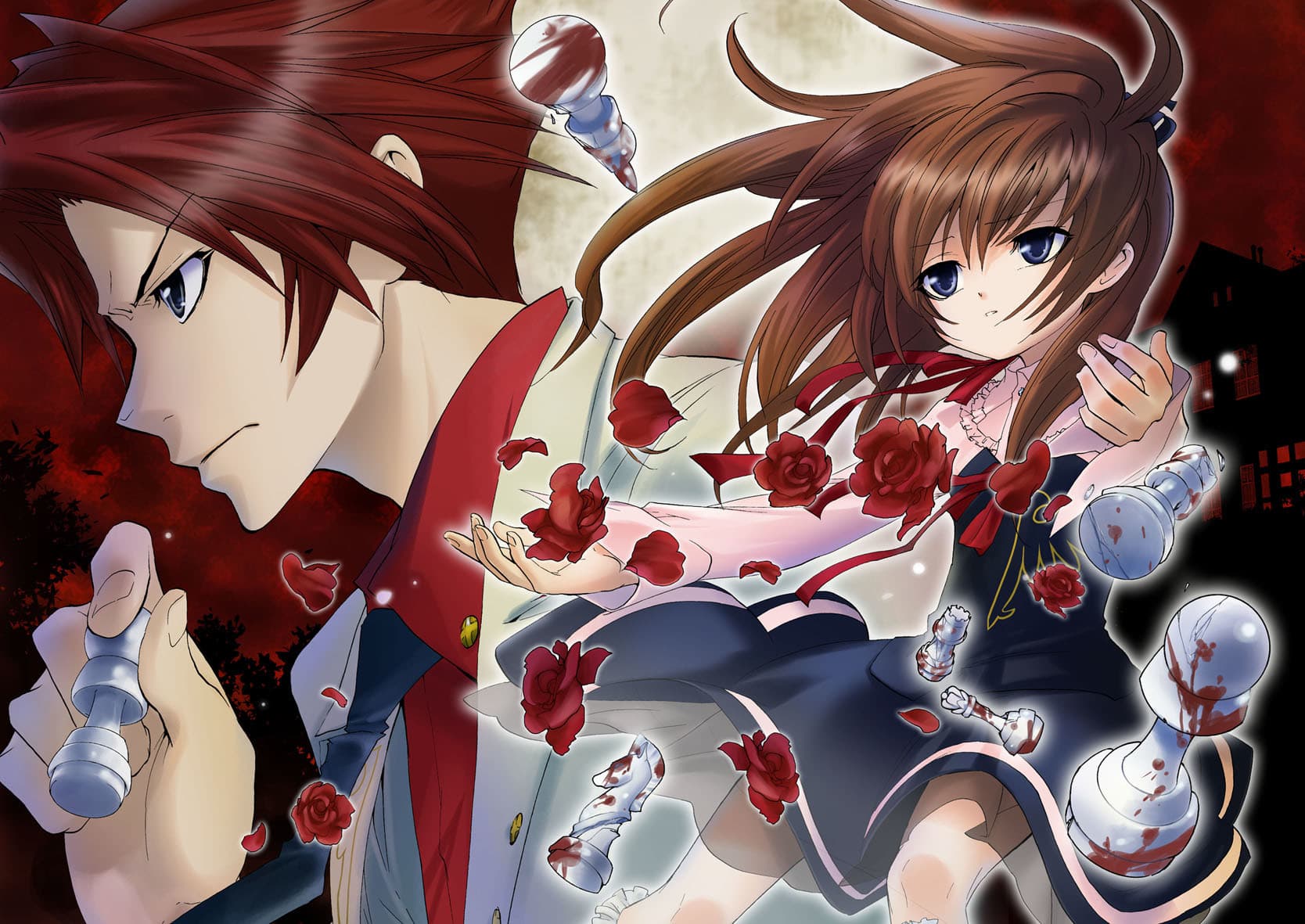

This review will not only be a review of the Umineko manga episode 1, but also its visual novel counterpart. I will review both, mention a few interesting things about each, and in the end, give scores for both separately.
The score in the bottom quadrant reflects my VN score, as it is a more accurate representation of my thoughts on the series and all individual episodes.
This review will also contain spoilers on episode 1, so if you haven’t read it, kindly do so before reading this review.
Umineko’s plot follows the affluent family of Ushiromiyas during the two-day period of the annual family conference which occurs on their privately owned island named Rokkenjima. I will not give any greater story summary than that as this review is written with you, the reader, already knowing the story in mind.
So this episode, being the introductory one to Umineko’s world, is extremely slow in getting to the serial murder mystery game, in fact, if you read it knowing nothing about it, I honestly couldn’t blame you if you were surprised when, halfway through, murders start occurring. So the way Umineko positions itself is as a game between the author and the reader, this isn’t something that is immediately made clear, but anyone moderately quick on the uptake will likely realize it by the end of this episode. There are 18 people on Rokkenjima by the time the serial murders start happening, and it is cut off from the rest of the world by a large typhoon. Thus, with no police, no forensics or any semblance of modern technology, you are meant to ascertain which of the 18 individuals on the island is the serial killer. It should be made clear that you are not meant to solve the riddle by the end of this episode, as there are 7 more to go, while solvable at this point, it is extremely difficult.
However, Umineko is not merely a mystery, it is also a story. You may find this observation redundant, “of course Umineko is a story, what else could it be?” , so let me justify this claim. Now, I am by no means a connoisseur of the mystery genre. However, in my experience, slight as it may be, mysteries generally tend to scrape all manner of characterization and emotional writing in pursuit of this one truth which lies at the end. They are better looked at as riddles than actual stories with characters who inhabit them. Umineko, much to my delight, dispenses with this notion and fleshes out its extremely lovable, although highly flawed and extremely jaded cast of characters. There is heartfelt writing, interesting character dynamics and many sorrowful and joyous peaks interspersed amidst the mystery and the profound meta commentary on the nature of the genre. What I mean to say here is that Umineko is far more than your run o’ the mill mystery, and so long as you enter with that mindset, I think you’re bound to appreciate it much more.
Now, I’ve talked at moderate length about what Umineko is and how you should approach it. Now before I take a crack at the characters and talk about them individually, let me mention some of Umineko’s flaws which may dull the experience.
So firstly, the pacing, as you can expect from a 100+ hours story (significantly less if you read the manga instead) this is not a story that will be kind on your time. Some parts, especially the ones more focused on slice of life scenes, tend to slow down the story to a crawl. And yet, it isn’t only limited to them, sometimes, mystery-related info-dumps overstay their welcome.
There is an instance, somewhere 3/4ths through the story where a corpse is discovered in a furnace, the corpse happens to have polydactyly, a medical condition of having six toes essentially, and while this, at face value, needs little more than a couple lines of prose to be explained, Umineko breaks down into a full-blown study of polydactyly, its implications, and all manner of mumbo-jumbo that is not associated with anything of relevance. While this condition should have been used merely as a means of identifying the owner of the corpse, it forays into one of the most mind-numbingly boring discussions I’ve been privy too.
There are many more cases like this, and manga handles it better than the VN, as it naturally has better pacing by the virtue of visualizing the things that have to be explained in the VN, not to mention that the author is not particularly good at condensing his prose down to a more digestible level, and what you have is an overtly bloated style of writing for a piece of fiction that is already extremely bloated on its own. Now, I am a great admirer of density in fiction, all my favorite fiction is somewhere between ten to thirty hours long, so I will concede that in this regard, I am innately biased against Umineko, and you may find its pacing way more agreeable than I did.
Another thing I didn’t like is how the tropey Japanese dialogue and the fact that the main character initially comes off as a pervert mislead you into thinking Umineko is just an average VN with a mediocre protagonist. It markets itself very poorly in the first few hours. Now hear me out here, I am unfortunately not 5 years old and do not find the gropey humor of Umineko’s first episode particularly entertaining. In fact, it led to frequent facepalms during my Seven Deadly Sins readthrough and its safe to say that I derive no enjoyment from it. However, let me also say that the main character of Umineko isn’t actually like this, and merely likes the interaction of getting slapped as he ‘goes in for the kill’ metaphorically speaking. This is still a bit too… anime for my liking, but far more digestible than what Meliodas does. The dialogue gets miles better in the following episodes, but for this one specifically, it feels like it could have been tackled more elegantly. My complaint here isn’t that Umineko is too anime (vague as this criticism is) but rather that it initially markets itself as such, which I do not like.
Now, what I failed to mention previously is that there is one more great mystery besides whodunit/whydunit/howdunit, and that is the Golden Epitaph of the witch Beatrice. Solving this epitaph is supposed to grant the solver 4 great treasures, an entrance into the golden land, and all the family wealth of Ushiromiya family, which was bestowed unto Kinzo Ushiromiya (The head of the family) by The Golden Witch, Beatrice. The epitaph also casts allusion to the murder game with its third section, and it is under this pretense that murders are, according to epitaph, split into ‘twilights’. Epitaph states that you should kill 6 people during the first twilight, tear apart 2 who are close during the second, and going further, kill in certain ways (gouging head, chest and so forth) for the following twilights, totaling up to 13 victims.
The text below is in reference to the solution of the epitaph, kindly do not open unless you already don't know it/are way too curious to contain yourself.
I think the pacing between twilights is quite solid in this episode and the first twilight marks the start of Umineko proper, I will not talk about the deaths nor circumstances here, but let me say that the author posits some quite interesting scenarios and will give you mental tools to solve them on your own later on. The end contains a 4th wall-breaking section known as the Tea Party and the ???? section, also called the Hidden Tea Party, or Tea Party of inhumans. Now, the ???? section is where Umineko truly engaged me, it comes at the very end of episode one and features a discussion between 3 great witches, and just seeing how these infinite beings bounce off of each other as they discuss various metaphysical principles on which the Umineko world is founded was fascinating to me.
The Tea Party which occurs just before that lays out the actual premise of the story, which is Beatrice challenging Ushiromiya Battler (The main character) to a battle of wits wherein he tries to prove that the murders were done by a human hand, and she tries to prove that it’s all witch’s doing. This is why every murder scenario is seemingly impossible at first, makes working out the howdunit extremely fun.
Ushiromiya Kinzo
The head of the family, I like this character a lot. He gives me the same vibe of an extremely imposing character like Charles zi Britannia from Code Geass. There is an air of madman’s genius about him, also, characters who contend with fate are one of my favorite archetypes so I took a liking to him rather quickly.
Kinzo’s Children
Kraus isn’t particularly interesting, his role in the story barely ever lives up to what you’d expect of the heir to Ushiromiya family. Eva is extremely complex, although this episode will not lay her character out particularly deeply. Rudolf is mediocre, and Rosa has yet to come into the amazing character she will become by the end of episode 4.
The spouses of Kinzo’s children
Natsuhi, contrarily to some of the other characters on here, is almost immediately engaging. She has an inferiority complex spurred on by Eva as she is repeatedly told that she isn’t a ‘true Ushiromiya’ and merely a ‘borrowed womb’.
Kyrie acts as Battler’s step-mom although they have a much friendlier relationship than that. She also acts as his mentor before the twilights unfold and teaches him basic problem solving. She likens mysteries with chess, stating that ‘flipping the chessboard’ (which is a fancy way of saying that you think from your opponent’s perspective) is a good way of solving mysteries. This chessboard flip will become Battler’s signature move in his oncoming bouts with Beatrice, and it’s really cool how she is always a part of him, regardless of whether she is there or not. In case you couldn’t tell, I really like this character.
Hideyoshi, being Eva’s husband has an interesting role. Initially, he is very unassuming and performs the role of the cool uncle for the other children of Ushiromiya household. Where he shines however, is when he is alone with Eva and unravels the parts of her personality which go beyond her being an asshole to everyone and her tongue-in-cheek demeanor. I consider him more of a complementary character to Eva than a full-on one in his own right.
The Servants
Genji, Gohda and Kumasawa do not play big parts in this episode, I will discuss them at a later point.
Kanon and Shanon I find to be extremely boring even as their character arcs are peaking, I am not particularly fond of them. Their arcs seem to be about becoming human, as they are constantly referred to as “furniture” in the Ushiromiya household, but Kanon is far too edgy for my liking and Shanon is far too plain to be likeable. I find them both thoroughly mediocre.
There is also a family doctor called Nanjo, he is an uninteresting side character, although there are some decent moments between him and Kinzo, and as a foil to Kinzo, you could say he adds value to Umineko as a whole.
Kinzo’s Grandchildren
Battler is the main character and an absolute GOAT, he plays the part of Beatrice’s rival throughout Umineko’s story and their dynamic is one of the most interesting parts about it. He is carefree and energetic but also quite smart.
Maria is also an excellent character, although you won’t see that this episode, in which she comes off rather creepy. She has in-depth knowledge on the occult and waves it as a flag of pride, and frequently encourages everyone to believe in the Legend of the Golden Witch, stating that Beatrice is a close friend.
Jessica and George have unfolding relationships with Kanon and Shanon respectively, and much like those two, I do not particularly like these two either. I find all 4 to be a quartet of abject mediocrity and their inner dynamics are of little interest to me. That being said, they do have their emotional moments here and there.
The witches have far too little screen time this episode to be properly discussed, but we will discuss them and their role whenever I review episode 2!
We can break down Umineko’s sound in 3 parts, voice acting, SFX, and OST.
Voice acting is stellar, nothing short of a masterpiece. All characters sound distinct and the way that voice actors change their cadence and manner of speech depending on what is going on is nothing short of commendable. For example, you will have scenes with Maria where she is an innocent sweet girl, and certainly sounds the part, and you will also have scenes where she is this occultist mastermind who brings unease and disarray by voice alone. The sheer range most of these characters bring tells you that every VA brought their A game for this. Another stellar example is Kinzo who usually has a commanding voice and an imposing tone, yet breaks into tears at so much as a mention of Beatrice, the VA really sells fickleness of Kinzo’s nature to the absolute best of his ability, and what we have is a standout performance. Other amazing performances include but are not limited to: Battler, Rosa, Natsuhi and Kyrie.
The SFX work of the visual novel is nothing short of a marvel. Almost every effect relating to the super-natural is instantly recognizable as something that belongs to Umineko. The SFX of golden butterflies passing by, for one instance, is very easy to recognize. There are others which are relegated to future episodes like the sharp cut of the red truth, but we will talk about those when we get there.
The OST is the single most marvelous thing in existence, but this episode, in my opinion, does not yet sell the full range of the OST well, that comes mostly by episode 2 and keeps expanding later on. Two of my favorite OSTs this episode were Worldend, played when George proposes to Shanon, and Prison Strip, played when Battler accepts Beatrice’s challenge, resulting in one of the most badass scenes in all of fiction. I will talk more about the OST in the following episode, as that’s when the real heavy hitters start coming in, but this episode is an excellent demo reel of what will become one of my favorites OSTs of all time.


16 out of 20 users liked this review
