It’s always a weird feeling where I feel like I have to play defense for the most popular, widely beloved franchises on the market. But that’s the paradox of ubiquity: when an anime, movie franchise, TV show, book series, or whatever become so popular that pretty much everyone’s at least heard about it, it can be easy to take it for granted. They become so omnipresent that we forget what made them good in the first place, and we forget how to love them in the same way we used to. Small wonder the cry of “overrated” has become so prominent in today’s criticism; it can be so hard sometimes to divorce the most popular stories from that popularity and approach them as if seeing them for the first time. But it behooves us to remember: things get popular for a reason. Sure, there’s plenty of garbage that amasses a following by appealing to the lowest common denominator (Twilight, the Transformers movies). But when something becomes beloved enough to rule the conversation- the MCU, Miyazaki movies, there’s a good chance it’s because it’s good enough to actually goddamn deserve it.
Which is why I now find myself here once again, feeling the need to remind today’s anime fandom that My Hero Academia is still really damn good.
Yes, it feels like 2019 was the year the anime community finally got tired of Deku and company. With stuff like Promised Neverland, Demon Slayer and Doctor Stone taking up the mantle of hype shonen series for everyone to rally around, the first truly mainstream anime success story since Attack on Titan and One Punch Man felt like it was falling by the wayside. I’ve seen so many people lately who just seem exhausted with the whole thing, with heroes and villains, with UA Academy, with All-Might and One-For-All and All-For-One. And if no other semi-serious anime analyst is gonna step up in its defense, then it might as well be me. My Hero Academia isn’t perfect, and it never was, but at its core, this is still the best vanguard modern anime could possibly ask for. It’s inspirational and emotional, genuinely hilarious with great characters, packed to the gills with stellar animation courtesy of Studio Bones, and constantly striving to be a hot-blooded shonen with something to say about the nature of heroism and its place in society. There’s a reason why this show’s first season is second only to Naruto in MAL popularity for long-running shonen action titles, why this franchise is one of the rare few to break out of the otaku dungeon and achieve mainstream success in the United States and beyond. And I will be damned if franchise fatigue makes us forget why we fell in love with it in the first place.
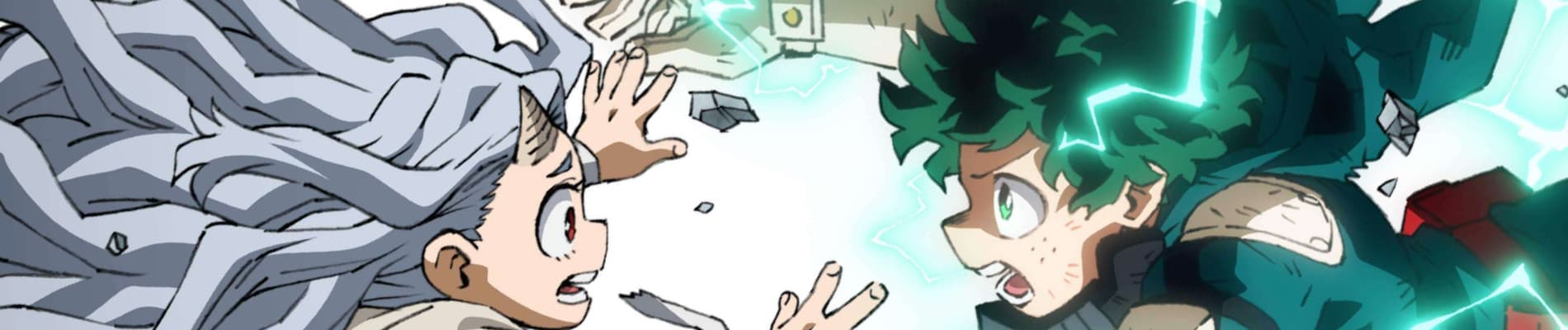
All that being said, I do understand the lukewarm reception this latest season has received. Especially after the crowning achievement of awesome that was season 3, season 4 feels like a step down in pretty much every way. Like all of MHA’s two-cours seasons, it’s pretty evenly split between two separate arcs, and the first one is by far the stronger of the two. The Overhaul arc sees our plucky heroes confront villains in official capacity for the first time, using their fancy new provisional licenses to team up with established hero teams and go after the dangerous, mysterious Overhaul, the League of Villains’ latest uneasy ally. It’s the darkest the show has ever gotten, bringing Deku and company up to the big leagues with a truly chilling undercurrent of menace and brutality. Overhaul’s gang are all dangerous beyond belief, and the emotional and physical trials the heroes undergo to bring them down make for some truly nail-biting moments of dread. Not to mention how the arc’s emotional core is centered around Overhaul’s daughter Eri, a victim of the madman’s abuse who Deku and Togata have an opportunity to save before the battle even starts brewing… but fail. It’s a stark look at the realities of this show’s world that are bubbling to the surface now that the light of the Symbol of Peace is no longer around to blind us to them, and it kills.
The second arc, meanwhile, has a far more laid-back goal in mind: a school festival! I honestly kind of love this idea, just for the sheer balls it takes to follow up the series’ darkest arc yet with a tried-and-true staple of anime time-wasting. Why shouldn’t My Hero Academia be able to embrace the medium’s more slice-of-life elements? Certainly its characters are strong enough to carry it. Unfortunately, this arc definitely suffers from a lack of real meat on its bones; none of the conflicts that brew throughout it have any real legs to stand on. It feels like we should’ve been spending more time on watching Jirou come out of her shell and embrace being a punk rocker, or the flamboyant pair of villains Deku encounters trying to bust the festival up, or even the follow-up to the Provisional Exam arc that sees some fascinating developments for Bakugo and Todoroki. And it can’t help feel like a lot of this arc is just killing time in between the big moments.
Actually, that’s kinda this whole season’s biggest issue: there’s too much space between the really good stuff. At its best, My Hero Academia is a series of compelling, well-produced story beats that all build on each other until climaxing in moments so utterly jaw-dropping that they become the new standard bearers of what “that kind of thing” should look like in shonen. The big moments are still there in season 4, but the space between them is wider and less interesting. The Overhaul arc is plagued by countless flashbacks that drag down the pace of what should be a tense, propulsive lair invasion. The School Festival arc is full of dead air and underbaked time-filling. And the animation across the board is far less consistent than it’s ever been, with stiffer character models, flatter direction, and an overall lack of polish. One highly emotional battle’s climax is played out entirely in still shots, for crying out loud. In previous seasons, even a lot of the chill character moments were still given flair and style; I still remember how enjoyable it was watching class 1-A just hang out in training camp last season thanks to how snappy the direction on their interactions was. That spark is missing from season 4, and even if you can’t pinpoint all the little ways things feel off, the difference is noticeable all the same.
And yet. Whenever this season actually does get to those big moments, the moments where all the frustrations and limitations fall away and the production team pushes their effort to Plus Ultra and beyond… yeah, it’s still really fucking good. Kirishima pushing his hardening to the limit to protect the heroes he looks up to, Deku’s final showdown with Overhaul, the freaky wall-twisting powers of Overhaul’s right-hand man, a final-episode Endeavor-focused smackdown that somehow manages to rival All Might vs All For One in sheer hype factor, even the freaking music-video-esque concert that caps off the festival… when this show hits its peaks, it blows everything else out of the water. The best battles of this show are some of the best battles not just of the year, but of all damn time. The best animation isn’t just above-average, it’s the new standard against which animation deserves to be judged (well, not counting Bones’ other 2019 masterpiece Mob season 2). And man, everything related to Eri’s painful escape and recovery from her abuse is just goddamn spectacular. Forget Nezuko, give me this smile to protect any day of the week.
That’s why this franchise has become the new face of modern anime for so many: at its best, few things even come close. The truly great moments might be fewer and further between this season, and the overall quality might be more uneven than ever, and Mineta still seriously needs to just die already, but it’s still far from running out of steam. You can keep the cringy lameness of Doctor Stone, the confused intentions of Demon Slayer, and the insufferable stupidity of Fire Force: when all is said and done, there is still no better vanguard for the face of modern anime than My Hero Academia. And I will continue to love it as long as that star keeps shining bright.
109 out of 148 users liked this review