
I want to get a few things out of the way first:
1) Just as with many Japanese animated films, I found Umibe no Étranger on TikTok, but the video I came across was an edit using clips of the explicit scene. There's nothing inherently wrong with enjoying sex scenes from any anime, movie, etc. that aren't problematic. However, it's important to bring light to the fact that there is (or should be) more to BL anime than the explicit scenes, especially in a movie like Umibe no Étranger. This movie is so much more than that. Not to mention the sex scene in this movie was not put in as any kind of fan service, nor there for the sake of being explicit. It serves a purpose and meaning to the story as a whole. Umibe no Étranger is a beautiful story—which is why I'm writing this review.
2) There is an age gap in Umibe no Étranger, and some would consider it to be large. It is a bit frustrating to see manga/anime that pushes the limit so far when their ages could have been so much closer with no hindrance to the story, and it would be completely understandable for someone to be uncomfortable with their age gap of 7 years (the movie mostly takes place when Shun is 27 and Mio is 20). That being said, nothing about Umibe no Étranger is pedophilic, and nothing about their relationship can be considered grooming. As much as I wish their ages could have been closer, the characters' relationship does not begin until Mio is well of age. Mio and Shun are both adults. 3) I have not read the manga. This is only my review of the movie. let's begin!

visuals

Unfortunately, I was unable to find this movie anywhere that let me watch it in HD, although I was so anxious to watch that I didn't look very hard. This took me out of the experience a bit, but the visuals, to me, were still very pleasing and comforting.

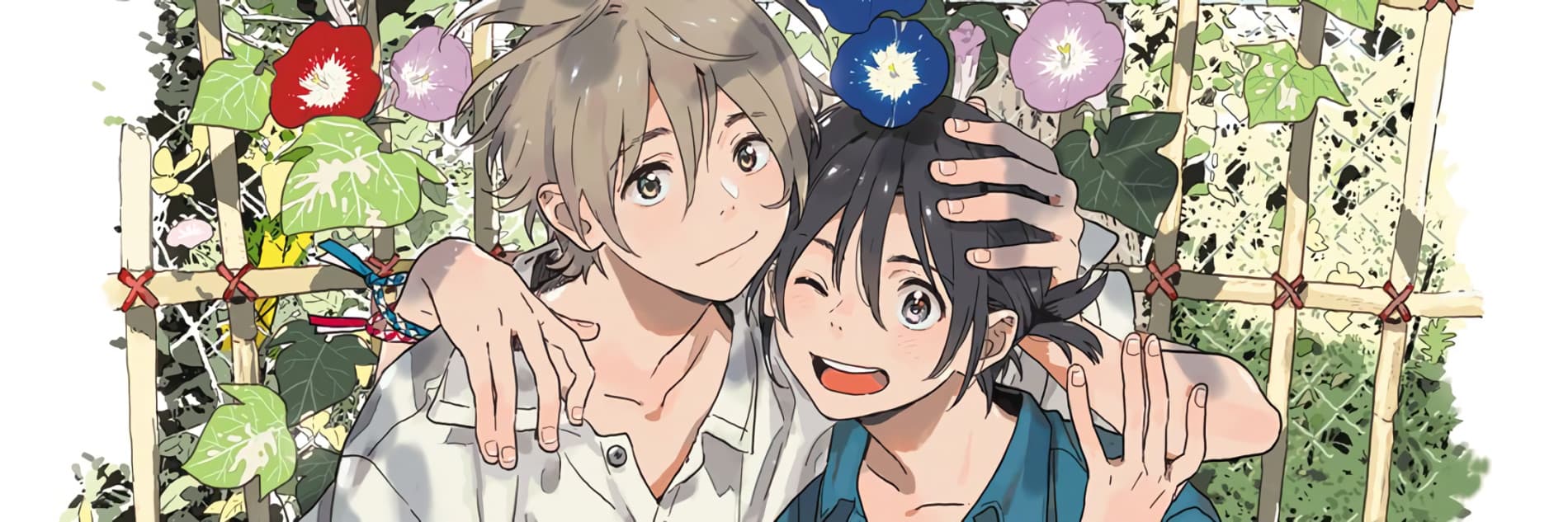
This frame in particular immediately caught my eye, and I thought it was a brilliant and beautifully artistic way to represent the characters. I would include more screenshots but I don't really have the time to go through the movie again, and there aren't many pictures available online.
mlm representation

Good representation for the LGBTQ+ community is hard to find across the board, but it isn't a stretch to say that BL suffers the most from over-sexualization. I was glad to see a movie like Umibe no Étranger, and throughout the film, I thought to myself "this actually feels like a queer person wrote it." Too many films today, anime or otherwise, feel like a straight or cis person looking in and trying to describe what a queer relationship would be like. A film doesn't have to have the absence of homophobia (internalized or otherwise) to portray a queer character, because those are very real things that queer people experience. However, too often it feels like a film comes from a straight perspective, trying to fit queerness into the heteronormative world. Again, there doesn't have to be an absence of those very real problems like questioning one's sexuality or internalized homophobia, but if a story that's meant to be a romance focuses more on those feelings rather than how they affect that character's relationship, or the relationship itself, my bet is a straight person wrote it.
Umibe no Étranger doesn't do that. [very minor spoiler next sentence] We see Shun struggle with his sexuality, but it feels accurate and real. His struggle to accept his sexuality isn't the focal point of the movie, but it has real effects on his relationship with Mio. An LGBTQ+ romance that isn't just a coming-out story? Wow, what a breath of fresh air.
See next section for my small inclusion of the wlw characters, Eri and Suzu.
story & characters

I honestly couldn't tell you whether I was just in an emotional mood today or Umibe no Étranger was just that good, but I was already crying a bit after the first 5-10 minutes. There was just something about the way the director(s) portrayed Mio's childhood that really got to me. The contrast between his extremely happy self and the grieving, lonely 17-year-old Mio got me worked up. This movie does an amazing job at storytelling. There is a three-year time skip, but Umibe no Étranger doesn't waste your time with typical queer romance tropes. Even as Shun is struggling with his sexuality, this is simply a barrier in their relationship but is never meant to serve as the sole focal point of the movie. You can feel his frustration and Mio's as they try to piece together what they're feeling and how to go about their relationship. Their fears and concerns are relatable and believable. They are complex, mlm characters that are written brilliantly. This was what got to me the most; Mio and Shun feel like real people that you're watching struggle and fall in love.

I also appreciated the further inclusion of wlw characters. These kinds of minor details really add to the immersion and representation of Umibe no Étranger, and it just goes to show that by being mindful of details like these can really help to normalize LGBTQ+ relationships in media. The inclusion of Eri and Suzu isn't forceful or out of place, because neither are queer people and their relationships. We simply exist, just as Eri and Suzu do in this movie.
final thoughts
 I'm really a sucker for these types of movies, in the same way I love watching 12-episode, emotional anime. Movies like Umibe no Étranger tend to be my favorites. I really enjoyed the storytelling, plot, and characters, and just the overall experience of watching a genuinely good BL anime. I can only hope that we see such good anime adaptations, shows, and films like this for GL anime as well.