
You know how, after a while, it feels as if certain genres and subgenres of anime – or any medium for that matter – become parodies of themselves? Whether it’s the super-dramatic, super-scaled mecha adventure, the fan service-ripe, godforsaken high school harem rom-com or the tried and true, bombastic, never-ending battle shounen, it’s sad that with seeming inevitability, anime eventually become victim to their own tropes and clichés.
▶ Video ▶ Video
The fantasy genre, and more specifically the isekai/‘trapped in a fantasy world’ subgenre, is no exception. In recent years we’ve been treated to a plethora of shows where the dark, edgy protagonist has flexed his muscles and, with the aid of his unrivalled intellect and the immutable power of love, has overcome whatever obstacles, villains or beasties the world has thrown at them, virtual or otherwise. And as much as we enjoy watching teen nerdboy wish fulfilment, I think I speak for a lot of people when I say it’s gotten old, fast.
Enter Grimgar of Fantasy and Ash.
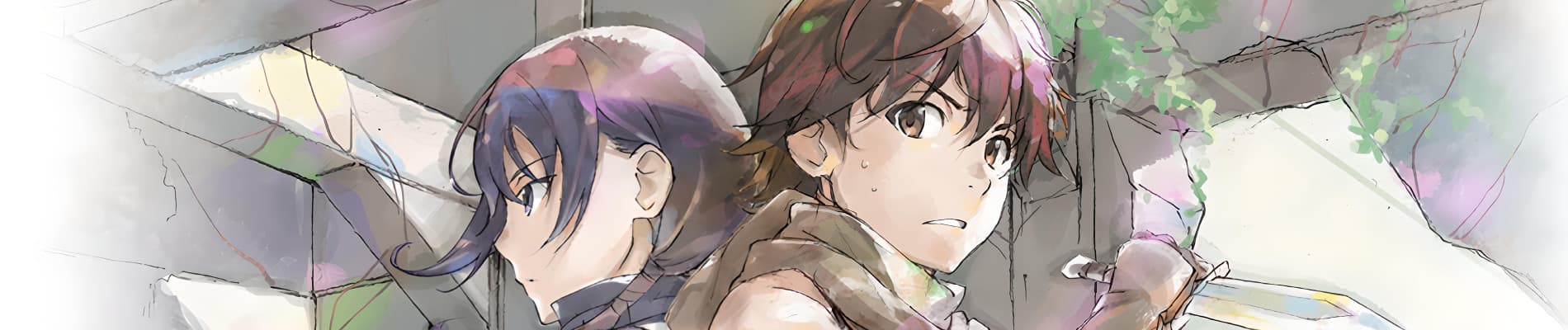
Adapted from a light novel series and coming out of A-1 Studios, it’s a familiar scenario. Our hero, Haruhiro, awakes in a fantasy world with no recollection of his past life, though it’s clear that he came from the modern world. In order to make a living, he is forced to band together with a group of other misfits and slay monsters for loot.
Been there done that, right?
Except, despite its similarities with other titles in the transported-to-another-world genre, Grimgar has one simple yet fundamental difference.
It asks the question: what if real people were placed in this scenario? How would actual people, totally unaccustomed to such an archaic, savage lifestyle, act and fare if they were thrust into a world where the rules are literally kill or be killed?
The result is perhaps one of the most refreshing takes on fantasy-action anime in recent years. Instead of the usual overpowered heroes we’ve become accustomed to, we’re treated to a range of unique individuals, scared, desperate and somewhat incompetent, but still willing to do whatever it takes to survive.
As such, the series isn’t so much a plot driven action-adventure series as it is a character drama. There is no apparent goal, no evil villain and no way to escape. Instead, our unlikely band of heroes can only learn how to survive and grow and adapt with only each other to rely on.
As its originality is undoubtedly Grimgar’s greatest strength, by natural extension you’d think that its unique focus on character growth and development is one as well. And it is, for the most part.
All the main cast grow. They’re forced to, given the gruelling situation they find themselves in. Most of this occurs through character interactions and how they differ over time. In other words, there’s a lot of dialogue. And yet, said dialogue rarely becomes burdensome or boring. In fact, it’s by far the most gripping aspect of the show. As the group are forced to endure mounting hardships, the individual members respond in a range of different manners. Tensions flare and tears are shed. And ultimately, it all feels so organic, so natural and so very real.
That’s because most of the cast are really quite authentic. Each has their own traits, their own strengths and their own flaws, with a particular emphasis on these flaws and how the cast climatically confronts and overcomes them.
However, majority of the screen time was on the two principal characters. And by majority, I’m talking the vast majority. Whilst the rest of the cast certainly have personality, they are nowhere as nearly developed as our primary two. In fact, it was almost disconcerting how, considering how nuanced and well-rounded Haruhiro is, a couple of the main crew are restricted to having only one or two defining character traits.
This is partially due to pacing. Grimgar is a slow burner. Like, slower than that old lady driving in the fast lane slow.
On one hand, this is undoubtedly a good thing. Not only does it set the series apart from the usual breakneck pacing of fantasy adventure titles, but it pays dividends in allowing the characters to interact and mature at an organic rate.
On the other hand, Grimgar can get distractingly slow. Initially, this wasn’t an issue for me. Sure, it takes a while before things start rolling, but I found the lackadaisical pacing to be endearing and refreshing as opposed to irritating. However as the series progresses it becomes painfully obvious how little is actually happening at times. It’s as if the show became so consumed by its own lethargy that it decided to hit the pause button on a few occasions. When it literally takes a character half an episode to get out of bed and walk to a café, any and all charm is spontaneously replaced with frustration-inducing nausea. It’s perfectly acceptable for a series to progress gradually, but when time that could have been spent further developing secondary cast members, world building or the likes is wasted on absolutely nothing, it becomes burdensome and obnoxious.
A large portion of the pacing issue can be attributed to the obscene number of self-contained tropes Grimgar creates for itself. The irony is almost painful in this respect, where a title that distinguishes itself by defying genre tropes is victim to its own quirky but tedious meta. A ridiculous amount of time is spent on montages, tonally conflicting fan service, insert songs, cooking segments, freeze frames, circular introspection - you get the idea. It’s perplexing how this actually happened, and again detracts way too much time that could have been spent more productively.
For a fantasy title, surprisingly little attention is given to world building. Now as a huge fantasy/sci-fi fanboy, I personally would’ve preferred some more exploration of what seems to be a rather typical medieval setting, though it wasn’t the be all and end all. What Grimgar does achieve, however, is a seamless integration of thematic weight into the world surrounding Haruhiro and co. Grimgar deals with some heavy subject matter, often verging on melodrama, and the emotional impact and weight of these themes is almost palpable in the various scenarios the cast encounter. As per its title, Grimgar encompasses both the wondrous implications of fantasy as well as the more sombre, morose ones of ash, with one element never quite overshadowing the other. Also, the action sequences are deliciously gritty.
Visually, the series is very hit or miss. The watercolour backgrounds, which are undeniably gorgeous and also help invoke the whimsical, fantasy feel of the series, eventually become somewhat stagnant and repetitive. It was clear there were budget difficulties, with frequent dips in art quality, extended freeze frames and some rather hilarious animation hiccups. Character designs were okay for the most part.
Music was pretty cool. Once again, I emphasise the prevalence of insert songs – apparently one of the major sponsors was a music label. The OST, if a bit generic, is dominated by rock tracks and is pretty much exclusively performed by the band (K)NoW_NAME, just like the OP << Knew Day >> which I personally enjoyed a lot. The ED << Harvest >> is comparatively tenderer.
Grimgar is a satisfying series. It handles itself with maturity and distinction, and is a welcome and refreshing addition to the fantasy genre. And yet, I can’t help but feel that it falls half way. So much is left unrealised, so much screen-time is wasted and so much of its maturity is needlessly subverted. And while Grimgar of Fantasy of Ash was a solid start to the 2016 anime calendar, it could and should have been so much more.