To this day, Kimi ni Todoke remains one of my favorite rom-coms of all time, close to my heart in a way that few other series manage to touch. If I were to designate one reason above all else why it was able to sweep me away so completely, it’s that it takes place in a world that is fundamentally good. Everyone in Kimi ni Todoke is the best person they can possibly be, always ready to reach out a helping hand to guide each other through their troubles. The show’s world feels like a world that actively wants its characters to succeed, and the result is probably the single most comforting atmosphere in all of anime, a universe that I love diving into and snuggling under like a warm fluffy blanket on a winter’s day. It would be so easy for a show with this much heart on its sleeve to come off as overly saccharine, but thanks to the strength of its stellar cast, its production values, and Sawako herself being one of the smartest written anime protagonists of all time, it never tips into treacle. It’s a beautiful balancing act of warmth and compassion that I’ve never seen pulled off quite as well as it is there.
I bring all this up to say that Iroduku: The World in Colors captures that same essence better than any show since Kimi ni Todoke itself, and the result is one of the best shows of 2018.
What makes Iroduku such a fantastic successor to Kimi ni Todoke’s throne of nice people doing nice things is just how well its premise and execution embrace the easy, un-posturing warmth that human interaction can be at its best. The story follows Hitomi, a girl from the future born to a family of witches with an obvious depression metaphor that keeps her from seeing colors. You might think that this concept would be enough to fill an entire world of storytelling possibilities all on its own, but nope; that’s just the set-up for the real story. The actual plot kicks in when Hitomi’s grandmother uses time magic to send her into her own childhood for reasons that aren’t immediately explained in-universe, but on a meta sense are very clearly an attempt to help her granddaughter work through her emotional issues. Thus, Hitomi finds herself transported sixty years into the past- a.k.a. our present- and doing her best to fit into normal life there, going to school, joining a club, connecting with her grandmother’s now-teenage self, and meeting a similarly disaffected boy whose drawings are the one thing she’s able to see in color, all while trying to figure out why her grandmother sent her back in the first place and what she’s supposed to do.
So yes, the fertile set-up of magic and time travel ends up being the skeleton for a very loose slice-of-life/romance tale, less interested in the mechanics of this unique take on the world and more in the emotional journeys of everyone in the photography and artistry club Hitomi ends up joining. But therein lies the subtle genius at the core of Iroduku’s story; while the mystical and magical elements aren’t the focus, they are still woven into the fabric of the narrative. In this world, magic is commonplace and common knowledge, but not in the sense like Harry Potter where it’s wizards and broomsticks around every corner; here, magic is integrated into life as we know it, not so much altering how the world operates as providing spice and flavor to a very familiar setting. This is a story about a normal group of teenagers living normal teenage lives that just happens to have magic dancing around the edges. It’s a story of a group of photography students who care for each other and want to see each other succeed, of the bonds they share and the bonds they form, of the passion they have for their art and how they use it to prop each other up, and all the while Hitomi and her grandmother are able to provide visual splendor to the emotions everyone’s feeling with a single wave of they improvised Pocky wands.
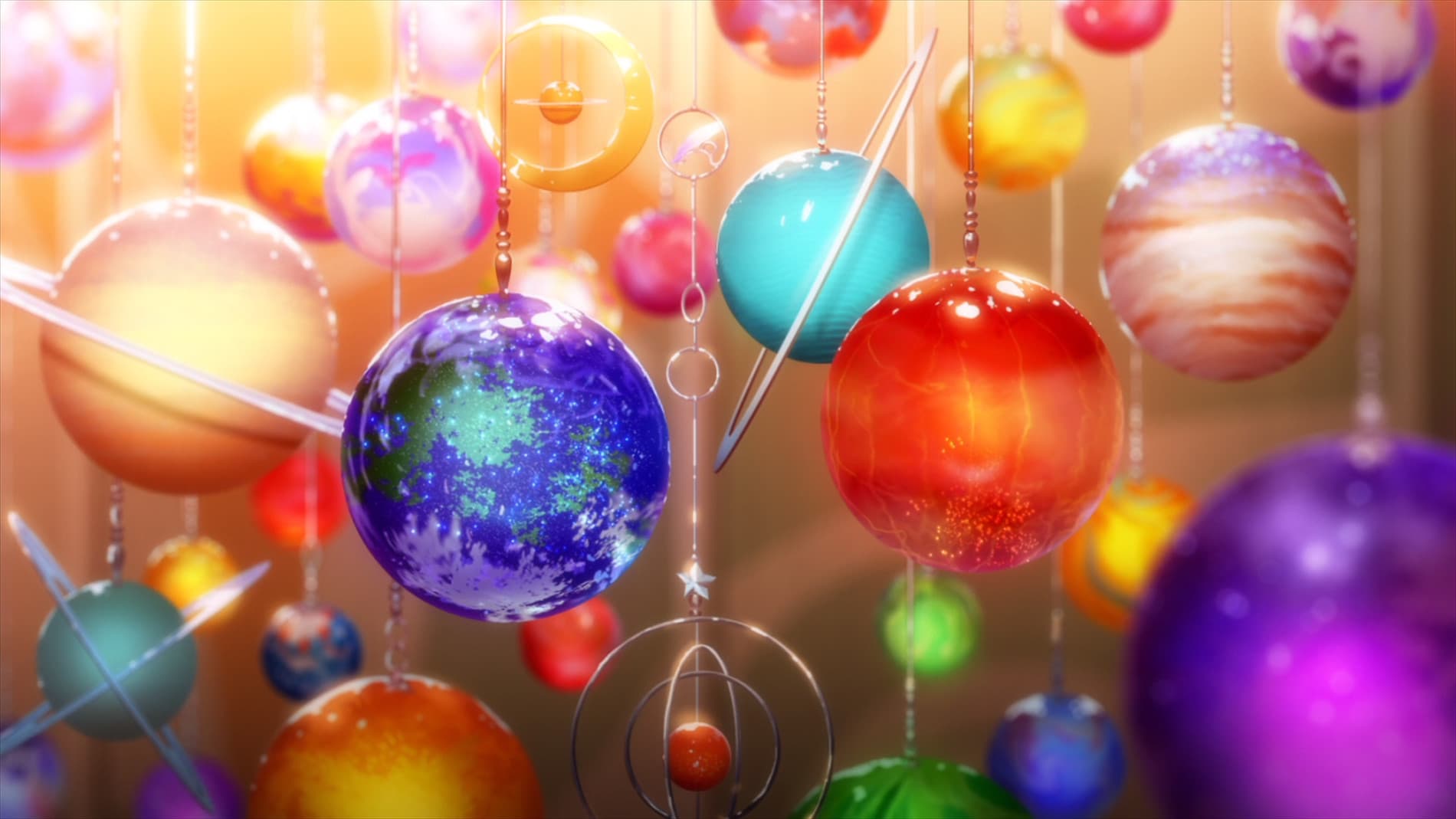
And that’s what I love about this show; it’s magical realism where the magic truly feels real, and reality truly feels magical. If magic actually existed in an otherwise normal interpretation of our universe, this is exactly how I imagine it would be implemented; as something familiar yet exciting, in powders and potions that everyone can use but not everyone can make, creating splashy effects to enhance school projects and demonstrations, a collector’s item for adventurous souls who love to experiment, a recipe one can brew up with patience and time, baked into every subtle facet of these ordinary, extraordinary lives its characters lead. I love watching them use water magic to walk on water for a club presentation like one might use a fog machine. I love watching Hitomi learn to cook up enchanted sand as if it were a real recipe with components that can run dry and a clear process to its creation. I love how alive this world feels, how utterly gorgeous its reflection of reality is. Admittedly, I am the biggest slut in existence for exactly this kind of heartfelt confectionary, ESPECIALLY the pastel rainbow color palette that makes every ray of light feel like it’s been reflected through a million stained glass windows before reaching the earth. But thanks to just how goddamn staggering the production values are (seriously, even in a year with Violet Evergarden this show is remarkable in its beauty) and how warm the character interactions are, it manages to feel truly whimsical, capturing a flee-flying spirit of imagination and wonder that makes the world feel as alive to us as it does to Hitomi as she gradually opens her shell up.
While I compare this show heavily to Kimi ni Todoke, it isn’t following that show’s exact framework. Kimi ni Todoke was very focused on character writing, on making each individual player in its world feel as alive and vibrant as humanly possible. It was a show where I could look at each character and recognize them as a fully fleshed-out creation with their own thoughts, feelings, and desires. That’s not the case with Iroduku; no one in this show, except perhaps Hitomi’s wonderfully rambunctious teenage grandmother, is complex or memorable enough to carry the story on their own. The strength of this cast comes from their interactions and how their warmth all feeds into each other, which explains why the first and last episodes, in which Hitomi has alternatively not yet formed those connections and is leaving them behind, are easily and unfortunately the weakest episodes of the show. The character writing just isn’t strong enough to support them on their own. Thankfully, it makes up the slack with its situation writing: when Iroduku’s characters talk, they feel like real people having real conversations about real issues, like I could step through the screen and join right in with them. What helps capture this feeling of naturalism is that the dialogue writing is very good at saying just as much as it needs to and nothing more. The characters will occasionally speak in emotional exposition, laying out the groundwork of their emotional states, but it never goes so far as to spell out the conclusions you’re supposed to reach. It just lets these characters reveal as much as they need to, and leaves the unspoken end result of those conversations to hover in the air, providing texture to every single time these character interact from then on.
And nowhere is this clearer than in a handful of utterly breathtaking scenes that are too spoilery to properly explore in full. To speak without giving away the game, there are moments where Hitomi’s magic takes her into the color-filled drawings of the aforementioned artist boy, and if you know anything about art in fiction, it shouldn’t be a surprise that these moments end up delving deep into these characters’ psyches with metaphor and symbolism bubbling from the depths of this crayola-sketched world. But what truly makes them such a experience is that these metaphors are allowed to play themselves out in silence. The precise details of what’s going on in these surreal sequences don’t matter; what matters is the feeling they evoke. Which means you’re allowed to watch these abstract, almost avant-garde expressions of feeling just wash over you, getting you into the characters’ emotional headspaces better than any expositional dialogue would do. And it’s really goddamn powerful. I had to remind myself to breathe at several points, I was so entranced by the unspoken story playing out in front of me. It’s only once the magic is over and the characters have returned to their world that we get some context into what emotions and experiences formed the basis of all those metaphors, and once again, we’re only given just enough to “get it” without spoiling the mystique of the event itself. If for nothing else, you should watch Iroduku just for those few sequences; they’re really a sight to behold.
But in reality, you should watch Iroduku for so much more. You should watch it for its utterly gorgeous depiction of a world just a colorful hop removed from our own. You should watch it for the warmth of its cast and their immensely fun interactions. You should watch it for the timelessness of its reality, and the engrossing whimsy of it magic. And you should watch it for its poignant, affecting story of depression, hope, and learning to see color in a world of black and while. Iroduku: The World in Colors is a gorgeous feast for all senses, including the most important one: the heart.
21.5 out of 25 users liked this review