
Before their reclaim to fame with Haikyuu and PSYCHO-PASS, Production I.G. was well-known for their callous militaristic works, such as Ghost in the Shell, Jin-Roh: The Wolf Brigade, Patlabor, among others. Of course, it's in bad taste to mention the aforementioned titles without their director; Mamoru Oshii. Extremely partial to dystopian and political themes, Oshii's acquaintance with the studio birthed many classics still ripe and praised to this day.
Then there's Blood: The Last Vampire. The 48-minute film isn't as held in as illustrious of a light as its brethren, but proved to be somewhat of an anomaly production-wise and an overlooked entrant in Oshii's track record. While Ghost in the Shell and Jin-Roh primarily relied on hand-drawn animation cels, Blood was one of the anime medium's first test tube babies with overwhelming digital animation. Blood stirred up some attention for other reasons, as well.

Less than an hour of sailor-fuku and vampires
Blood's runtime of a mere 48 minutes is its most glaring weakness. Even with films twice its runtime, proper character development and a structured story is often impeded. And with Blood, their presence is made even less scarce. Character development need not be mentioned, since characterization in Blood is shrouded and gaping with a lack of background context. Most notably, is Saya's character. Her interaction in the film was befuddling, to say the least. Violent and snarling at a man's exasperated sigh of "Oh, Jesus...", I had to rewind the scene a few times to ensure character context hadn't escaped my view. This sentiment carries over several times over the course of the film. As such, Blood feels much more like a fragile exo-skeleton of a concept, rather than a solid film. However, the concept it's built on is solid and so is many other parts of Blood that overwhelmingly compromised for my enjoyment.
A bit too grand for its allocated runtime, the premise follows Saya, a sailor-fuku clad girl of obscure origin, hunting down vampire-esque creatures called Teropterids. Note the "obscure origin" and "Teropterids". Had Saya been given quick and simple characterization denoting her origins and the Teropterids simply being labeled vampires, it would've inflicted suitable modesty for the film's short runtime. Nonetheless, the shrouded mystery behind the premise is one to keep your eyes peeled for from the get-go, though you may be left with insatiate hunger.
Though character context is left untouched, Saya's narrow character is filled with her drive to eliminate the Teropterids. Blood: The Last Vampire is just one of Saya's many violent ventures, as she infiltrates an American military base school to out several of her prey. There's little deviation and filler in its story, Saya's sword cuts down a straightforward path of cruel gore and splattered blood. Saya wastes no time quite literally sniffing out her prey and slicing them down, albeit delayed due to a certain Japanese school nurse.
There's no room for substantial characterization, character development or story context in Blood's earnest drive for gore and action. However, labelling it as a one-stop goreshow or B-list horror flick is wrong. Blood is certainly not a politically-driven, dystopian setting film you'd expect from Production I.G., but it has its semantic merits in depicting the intense emotions and atmosphere encapsulated in a 48-minute concept film.

We're going digital
Though Hiroyuki Kitakubo directed the film, Blood starts off with a Oshii-flavored bang. That is, the high-sprung action sequence devoid of context. Despite the lack of dialogue, the silently macabre train sequence loudly speaks on the phenomenal, fluid digital animation and low-lighting. 3DCG and 3D imaging still has quite a stigma today, but Blood is one to dispel. Smoothly intermixing the characters with 3D-rendered background, the sequence lacks any awkward hints. The low-level lighting is just as amazing to bear witness to, with the train's fluorescent lighting buzzing to faint darkness, casting muted tones on Saya's face as she runs with shaky motion blurring.

Animation-aside, the music and sound production is also boasted in this first sequence. The lack of dialogue is compensated by the increasingly ominous orchestra, jagged clinking-and-clunking of the train and finally a very Hollywood-esque chase sequence sound track ended with a slicing impact. The superb sound production and finely selected music carries over for the rest of the film. Though I'm hard-pressed to label Blood as a horror film, the soundtrack is reminiscent of such, with occasional eeriness accompanying climaxing scenes. The majority of the film features action and gore, and as such, intense and upbeat tracks synchronize with them.
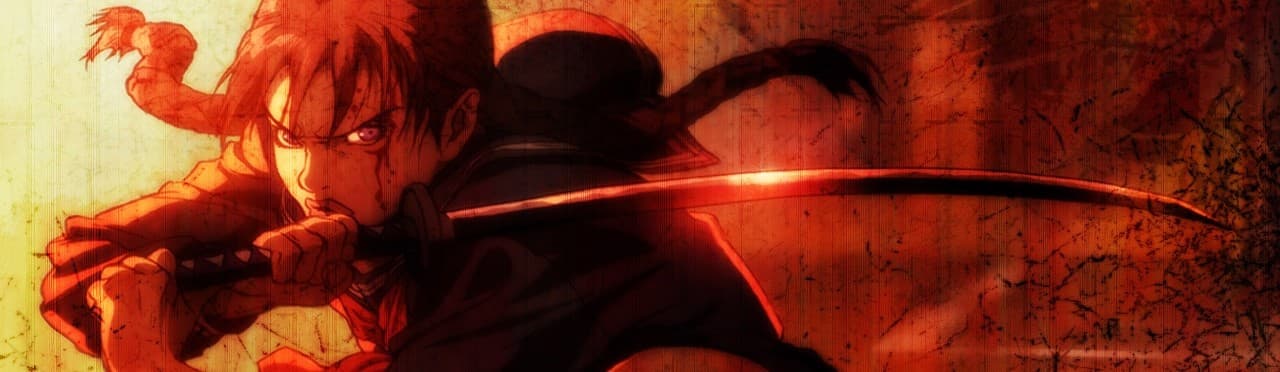
Going back to the visuals, the character design is nearly as favorable as the fluid animation. Katsuya Terada, a video game designer, was enlisted to draw the characters and proved to be a fine choice. There's a rough and rugged sense to the characters, primarily due to the the thick lines. Aside from being visually strong, it also works well to accentuate their animated facial expressions. Saya is the most outstanding example. Her stern scowl morphing into rage sees her flashing eyes, creasing lines pushing against her forehead and her mouth rampaging. The fantastic character animation plays a substantial role in conveying the detail in facial expressions, as well, but the designs in it of themselves are absolutely strong and detailed.


English, Motherfucker, do you speak it?
As I mentioned at the start, Blood had received attention for another reason. Which is, its English dub. Yes, Blood was intended and created to be dubbed in English with Japanese subtitles. Along with 3DCG, English dubs don't have the most cherished reputation. As for Blood, what can I say?
It initially felt uncanny, particularly with the first conversation. Robotic, is the best I could describe it. Though the voice actors actually did, the flow of the conversation felt as if the lines were read off a script without much fluidity. As the film progressed, however, the unnatural sense faded with occasional awkwardness that still didn't impede my enjoyment much.
Very little Japanese is spoken, limited to just Saya and the nurse's conversations. Thanks to this, you'll be able to enjoy the cum-inducing visuals to their full extent.

Conclusion
Blood: The Last Vampire is much more than a concept film than what its incomplete story and characters may lead you to believe. The use of 3DCG and imaging is far removed from its nefarious reputation, offering a fluid feast of action and movement, both intense and subtle. The low-level lighting and tones boost the quaint, yet macabre atmosphere of this film. High quality on the technical side, enjoyment is left satiated by the end of this 48-minute course of gore and blood.
Still, the incomplete nature of Blood may require light stomach medicine after this stunning feast. Trailing off at the end with a mere, final hint at Saya's character, there's an obvious compromise of visual and atmosphere over vivid story. Blood is very much a story drugged up on its superb atmosphere and production, rather than impactful characters.
Blood: The Last Vampire left me burping and rubbing my stomach. I relished this appetizer of a film for being one of the first to usher in the age of digital animation. However, beyond just that value, Blood is a fantastic supernatural and action film that I could repeatedly watch purely for its production value. Among with its more famous brethren in Production I.G.'s catalog of films, Blood: The Last Vampire is one just as valuable.
